Trump’s Roman Empire-Like Fall in Mideast Brings Opportunity
The Iran catastrophe could revitalize America First.
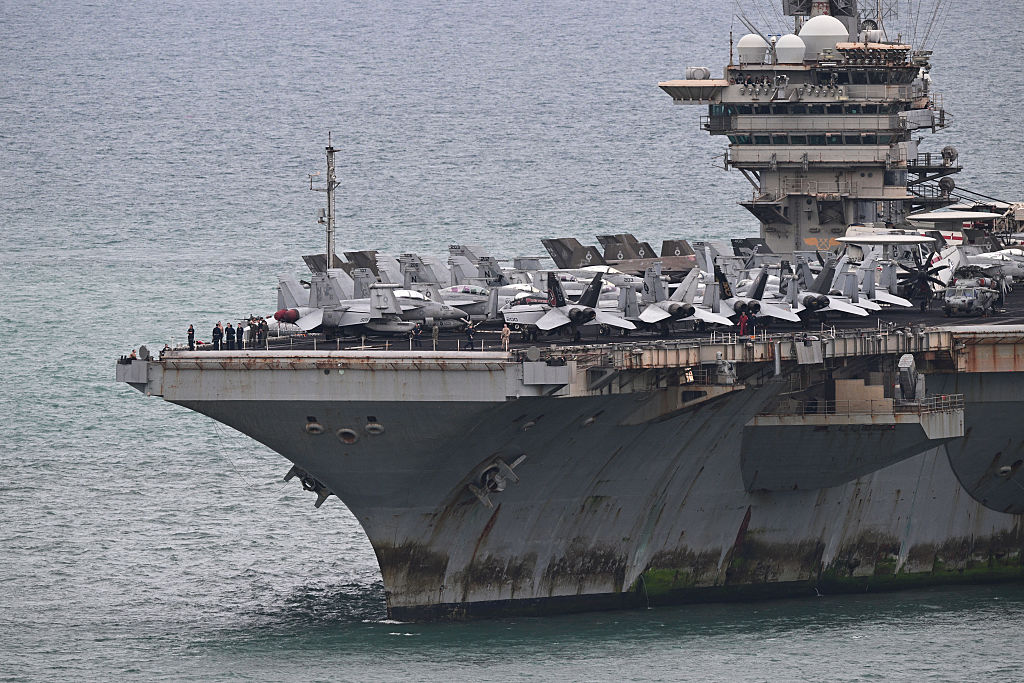
The resumption of tit-for-tat strikes between American forces and an emboldened Iran in early September shattered any illusion of a lasting lull as the conflict entered its seventh month. Meanwhile, the escalating situation in Yemen—where the Houthis have tightened their control over strategic regions surrounding the Bab al-Mandab Strait and struck key Saudi oil infrastructure—has not only sent oil prices soaring, but also fully exposed the Iran War’s regional scale and global implications. And now, Tehran has stepped up attacks on vessels in the Strait of Hormuz as the U.S. tries to reopen the waterway.
But beyond the immediate news cycle, the tendency to fixate on shipping traffic in the Strait of Hormuz and similarly tactical developments leaves Washington blind to the true historical significance of the current moment. The Iran War is a structural watershed as seismic as the fall of the Berlin Wall in 1989. We are witnessing the logical end of U.S. overextension in the Middle East and the birth of a post-American West Asia defined by a new regional equilibrium.
The combined effects of the Trump administration's incoherent military objectives, optics-driven approach, and chaotic prosecution of the war find close parallels in the overextension of the Roman Empire. In 260 AD, Emperor Valerian marched toward the rugged terrain of western Persia anticipating a swift, decisive victory over the Sassanid Empire. Instead, plague struck and his supply lines collapsed, leaving Valerian’s legions trapped. He was taken captive by his enemy, the Shahanshah Shapur I, and forced to live out his life as a prisoner of war in Persia. This development represented far more than a simple tactical defeat. Valerian’s downfall sent shock waves across the civilized world, exposing the hard limits of imperial power projection in a faraway land. It signaled that Rome was overextended, strategically exhausted, and no longer capable of maintaining an offensive posture along its distant frontiers.
President Donald Trump’s promises to end foreign conflicts, prevent World War III, and recalibrate America’s bloated Cold War alliances played a major role in his 2024 campaign. But instead of making good on these pledges, he launched a new forever war in Iran (despite multiple warnings from officials in his own administration), undermined U.S. military credibility, and proved even more bellicose than the liberal internationalists in DC he claimed to have vanquished. MAGA foreign policy has devolved into a form of “red-pilled globalism,” driven by arbitrary executive impulse, economic coercion, and unilateral military interventions. Predictably, it has run into a brick wall: The structural limits of American power in the 21st century are now fully visible to adversaries and friends alike.
Yet, the Iran War could ultimately prove a “Pyrrhic defeat,” a strategic chastening that also serves as a necessary catalyst for long-overdue structural adjustment and a grand strategic reset. By laying bare the futility of Washington’s ideological hyper-interventionism and permanent military presence overseas, Trump’s Valerian-style fall could be a blessing in disguise, forcing Washington to finally withdraw from the Middle East and adopt a realist, clear-eyed “America First” foreign policy.
For nearly five decades, American strategy in the region has been shackled to the Carter Doctrine. Promulgated in 1980, it declared that the United States would use any means necessary to prevent outside domination of the Persian Gulf and guarantee the free flow of Middle Eastern oil. Today, the underlying rationale for that commitment has vanished. The Cold War has long ended. The United States is the world’s leading producer of crude oil and natural gas, and it now has access to Venezuela’s vast oil reserves.
Ironically, the ongoing war in Iran and the resulting closure of the Strait of Hormuz have crippled global oil supplies and sent energy prices soaring, worsening inflation and raising the risks of a global economic recession. Operation Epic Fury failed to topple the Islamic Republic. Iran’s asymmetric strategy—leveraging the country’s highland geography, its web of underground “missile cities,” and mass-produced drones—has shown U.S. military bases in the region to be vulnerable targets rather than valuable platforms for power projection. MAGA militarism has proven that the continued pursuit of global primacy in a post-unipolar era destabilizes the world order and harms U.S. interests.
The shift in the distribution of power is probably irreversible. American bases and clandestine sites have suffered repeated and debilitating attacks from Iranian forces. Given the exorbitant costs and scale of the damage, the Pentagon is considering reducing the U.S. military footprint in the Persian Gulf after the war. The conflict has also consumed massive quantities of sophisticated U.S. munitions, leading to critical shortages in both stand-off offensive weapons (e.g., PrSMs, ATACMS, Tomahawk cruise missiles) and defensive interceptors for air defense systems like THAAD and Patriot. America remains an extraordinarily powerful country, but its failures against Iran demonstrate the essence of strategic overreach: not weakness in absolute terms, but a mismatch, worsened by the emerging multi-nodal world, between expansive commitments and finite resources.
The end of the Carter Doctrine in West Asia should not be mourned. Rather, it should be seen as a vital strategic correction that could yield immediate dividends, provided the transition is handled with prudence. Extricating the U.S. military from the Middle East would save tens of billions of dollars annually while halting the diversion of critical defense hardware from the Western Hemisphere and the Pacific.
Furthermore, removing the American security umbrella would force regional powers to confront their own security environment and negotiate a pragmatic balance of power. Indeed, the Iran War’s far-reaching repercussions are already driving a new security architecture through the Mecca Joint Defense Agreement among Turkey, Pakistan, and Saudi Arabia. The framework could yet extend to Egypt and, perhaps, eventually Iran—creating a Nixonian concert of powers centered on these five dominant states of the Middle East plus Israel (ME5+1). A retrenched Washington could also transform itself into a neutral arbiter and reengage with the region as an economic partner, advancing its commercial ties and business interests across the greater West Asia without being dragged into local conflicts. The new equilibrium could thus serve both American interests and regional stability.
Subscribe Today
Get daily emails in your inbox
Most importantly, any path toward exiting the Iran quagmire also clears the way for an authentic, durable, and disciplined “America First” foreign policy—one properly understood not as a disguised ideology or an ephemeral political movement tied to a single personality like Trump, but as a tradition of sovereign realism rooted in the American founding and concrete national interests.
Like every great power in history, the United States faces geographical, material, and institutional constraints that cannot be wished away. America’s resources and hard-earned capital are too valuable to squander indiscriminately, myopically, or on a whim. A post-Iran War U.S. grand strategy must reorder America’s hierarchy of interests accordingly: defending the homeland and Western Hemisphere, rebuilding the domestic industrial base to ensure U.S. economic and technological competitiveness, maintaining a decisive balance of power in Asia and the Pacific by helping allies build up their capabilities to counterbalance China, and encouraging capable middle-tier and regional powers to assume primary responsibility for the peace and stability of their own neighborhoods.
The revealed hollowness of MAGA’s exceptionalist rhetoric and unilateral militarism may feel today like the reckoning undergone by Valerian, but ultimately it could unleash a sober America First realism that would remedy and revitalize American power. Still, ensuring that the Iran predicament is remembered as a “Pyrrhic defeat”—not a total loss for America’s global power and prestige—involves making a pivotal choice: Washington must forgo its hubris, resist institutionalized complacency, and adapt to the new systemic realities worldwide.