Does Rand Paul Want to Merge the American and Israeli Defense Establishments?
Explaining the Kentucky senator’s NDAA vote.

The former Republican Rep. Marjorie Taylor Greene posted on X on July 15, “Every Republican Senator voted to merge our military with Israel’s military. The most America LAST thing they could possibly do, selling our military out to a foreign country.”
“It’s absolute treason and betrayal,” she added.
Greene was referring to a vote the previous day, in which 50 Republican Senators had supported a failed attempt to advance the annual defense policy bill known as the National Defense Authorization Act (NDAA). This bill, which authorizes defense spending and sets policy for the military, has attracted considerable controversy for a provision—Section 219 in the House version, and Section 1217 in the Senate version—that would significantly expand cooperation between the U.S. and Israeli defense establishments.
In the House, Rep. Thomas Massie (R-KY) had been working assiduously to have that provision removed. Yet House leadership did not permit a vote on Massie’s amendment to strip Section 219, and this past Wednesday the bill passed with the provision in question largely intact (an amendment by Rep. Anna Paulina Luna (R-FL) did remove the word “integration,” but kept essentially everything else the same).
Now the action is in the Senate, which will again attempt to pass its own NDAA bill. Here the sticking point is not so much the Israel-related stuff as the ongoing Iran War, which is the reason every Democrat except Fetterman voted “nay.” And because 60 votes are required for most legislation in the Senate, this has kept the NDAA blocked so far.
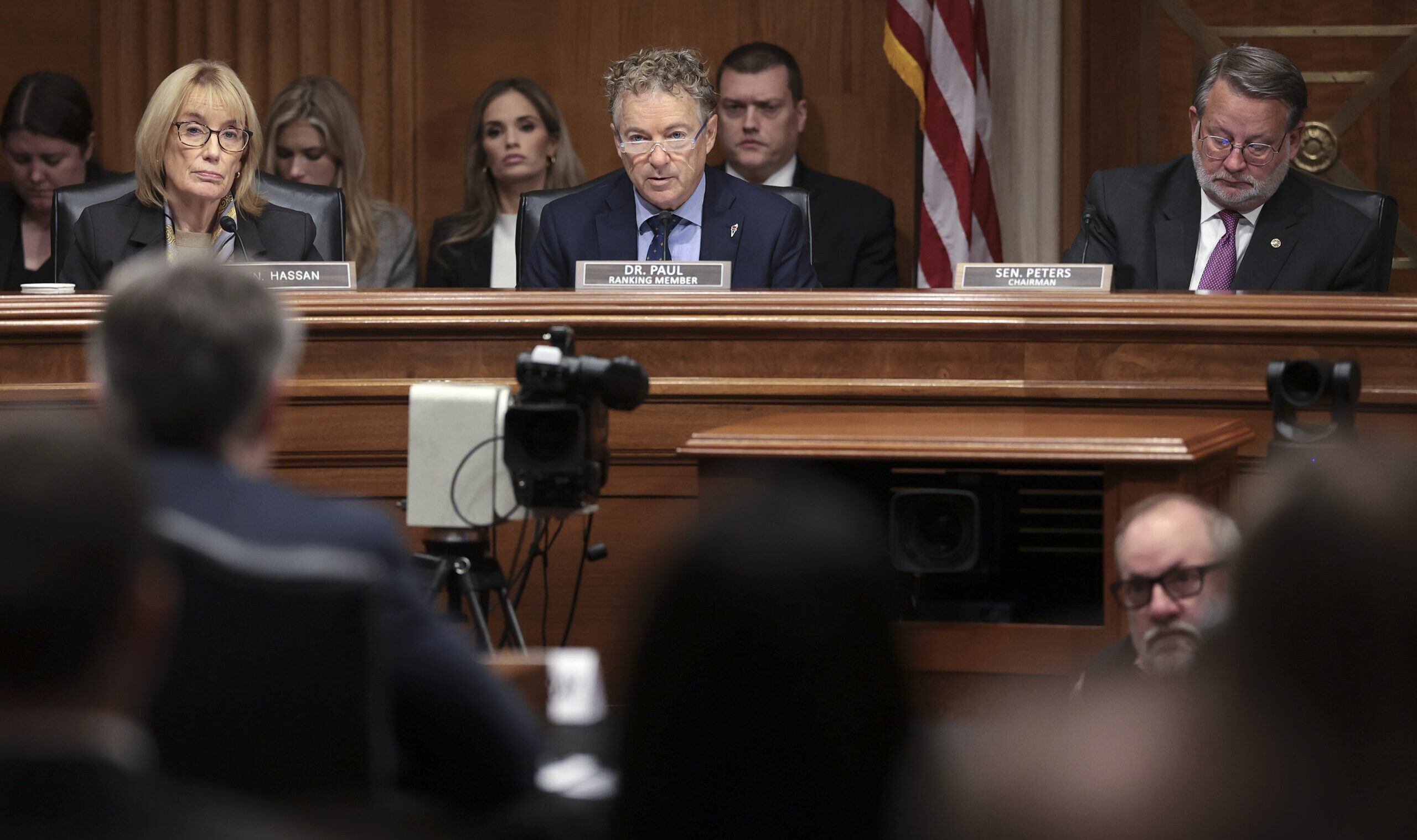
Of the 50 Senate Republicans who voted to move the bill, though, Sen. Rand Paul (R-KY) stands out. His support was, on its face, a strange move, given the Kentucky senator’s usually reliable record of opposing big government spending (the Senate NDAA would authorize $1.15 trillion in new defense spending) and entanglement with foreign countries and foreign wars. (Full disclosure: I used to work for Paul.)
Indeed, Paul’s vote in favor provoked anger from some who felt betrayed.
The X user Kacee Allen provided a roll call list and, highlighting only Paul’s name, writing “Here’s the list of all 50 TREASONOUS Republicans Senators, including Rand Paul, who voted Yes on merging the Israeli and U.S. militaries. Anyone who voted for this should be immediately removed from office.”
The popular account “The Patriotic Blonde,” run by Breck Worsham, wrote in the wake of Paul’s vote, “Rand Paul you have COMPLETELY lost the plot. Lose my number.”
There were a decent number of similar negative reactions to the senator’s vote, understandably, because the vote did give the appearance of an about-face.
But Paul’s critics were also overlooking something crucial: the vote at issue was a procedural one.
The complex rules governing procedure in the Senate often require multiple votes on a bill prior to final passage. The one two weeks ago was such a vote; it was, in Senate’s classically byzantine parlance, a vote on cloture on the motion to proceed. In other words, a preliminary vote to tee up a substantive vote.
My suspicion, then, was that Paul had voted “yea” purely to move the ball forward, without endorsing either the bill in its totality or any individual provision within. And, as it turns out, this was exactly what had happened.
As Paul’s senior advisor Doug Stafford told The American Conservative in an email, “Sen. Paul has opposed the war Israel started with Iran from day one, and of course, does not support integrating Israel’s military with the U.S.’s."
Stafford continued, “[Paul] is opposed to the underlying bill, but this vote was a ‘motion to proceed’procedural vote that would allow senators to debate and to amend.”
“You can’t amend it unless you get on it,” he added.
Having worked for both Paul and his father, the former Rep. Ron Paul (R-TX), I thought I recalled that this was something the elder Paul would also do as a matter of course.
So I reached out to Ron Paul’s longtime legislative director, Norm Singleton, who had the following to say:
When he served in Congress, Dr. Ron Paul usually voted with Republicans on rule votes even when he was a definite 'no' vote on the underlying legislation. Voting for the rules helped convince House leadership to allow Dr. Paul to have his pro-liberty amendments debated and voted on.
Senator Paul’s vote for the motion to proceed enables him to offer amendments and get senators on the record on important issues of U.S. foreign and military policy that would otherwise remain buried in the fine print of the NDAA.
Makes sense. If one believes the purpose of the Senate is to consider, debate, and ultimately vote on legislation, it doesn’t really make sense to obstruct the procedural measures that allow these things to occur. Especially if one hopes to introduce fixes of one’s own.
Interestingly, only one GOP Senator was a “nay” on that NDAA vote earlier this month. This was Sen. John Thune (R-SD), who as majority leader is the chief of the Senate’s Republican members. And not only does Thune, in a sense, “own” everything his party does in the Senate as a body, he is also consistently hawkish on national security matters and extremely pro-Israel. In fact, he is so supportive that he once cosponsored legislation to make it a federal crime for Americans to participate in boycotts of Israel.
Subscribe Today
Get daily emails in your inbox
So why would Thune vote against moving this bill? Again, the answer is procedural: Only Senators who vote on the winning side of a question may introduce a motion to reconsider it. So by voting against advancing the NDAA, Thune makes it possible to put forward another vote to move the bill at some point in the future.
Thune, in other words, knows procedure.
And Paul does too.