Year One of Trump II
The administration, like all administrations, has been a mixed bag. The question is whether the good or the bad will dominate in the second year.
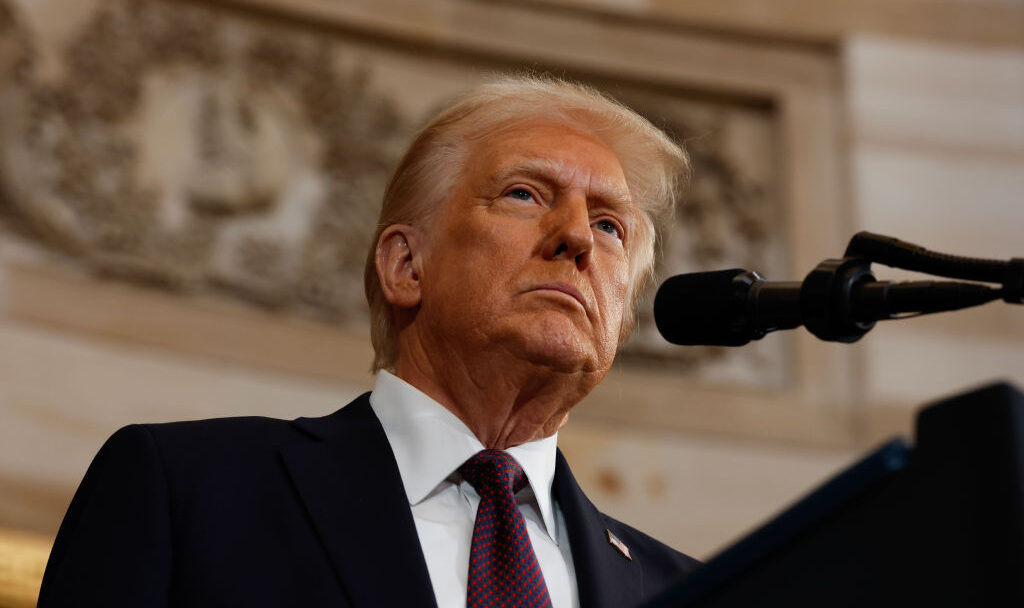

It has been almost a full year of Trump II—full in more ways than one. There has been good and bad, and it’s worth surveying both sine ira et studio. But (and in one way this is the highest endorsement a journalist can make) it has undoubtedly been interesting.
Foremost in the “good” column: The economy is ripping along. The Atlanta Fed expects the economy to have grown more than 5 percent in the fourth quarter of 2025, building on robust growth earlier in the year. The tariff schedule does not seem to have put a significant dent in growth, let alone brought about the economic cataclysm predicted by its most strident critics. This is a bit of a surprise; even those who supported it in some form expected real disruptions, particularly because of the administration’s peremptory implementation. At the same time, the trade deficit has in fact come down precipitously. Inflation remains lower than it was during the Biden administration, although still above the Federal Reserve’s 2 percent target. On the other hand, the jobs market is weak, unusually weak given the growth numbers; some analysts still fear that the AI boom, which has been the major driver for markets, is a bubble.
On immigration, the administration has delivered concrete success: Border crossings have fallen to almost nil, and deportations have proceeded at a steady clip. (Critics from the right who are unhappy with the pace of deportations should engage in some self-reflection about what they actually expected from the 2024 campaign’s visibly hyperbolic promises.) The victories haven’t been uniform; H-1B reform has been a bit of a mess, and the optics of enforcement have threatened the overall popularity of the administration’s immigration policy. (The ICE shooting in Minneapolis, while not the clear-cut martyrdom the activist left would claim, was messy and probably avoidable, and raises justifiable questions about the Department of Homeland Security’s flamboyant methods.)
The biggest questions assailing the administration come from foreign policy, where improvisation is not so clearly the best approach and the Trump coalition’s internal divisions are clearest. The early pressure on Israel to end the war in Gaza has given way to an uneasy “ceasefire” that still involves an awful lot of military activity and a peace settlement that seems to be eternally pending. The flurry of diplomatic activity to end the Russia–Ukraine War has produced nothing concrete, although American financial exposure has been drastically reduced. The U.S. went 15 rounds with Iranian nuclear negotiators, a process that produced several promising deal outlines, only to finish the effort off by bombing the Iranian nuclear sites to unclear effect.
Nor are the prospects going forward much clearer: The administration kicked off implementing the National Security Strategy’s laudable pivot to the Western Hemisphere with the spectacular military extraction of Venezuela’s Nicolas Maduro, leaving questions about how deep American involvement in the Bolivarian Republic’s management will go. Trump is making threatening noises at Iran again over its suppression of antigovernment protests. Something inscrutable is happening about Greenland.
An optimist would note two positive strains in this: First, the administration tends to frame justifications of foreign policy, even aggressive foreign policy, in terms of the national interest. (This is not to endorse the substance of the administration’s arguments, which is at times pretty dubious.) Second, the administration seems to have a persistent allergy to boots-on-the-ground operations. These are real improvements on the Clinton-Bush-Obama foreign policy consensus. On the other hand, it is not clear that using sudden overwhelming force and walking away is the sort of move you can pull indefinitely. And this is not to mention the perhaps quaint concerns about militarism and republican government.
Subscribe Today
Get daily emails in your inbox
It is worth striking a final, gloomy note on social policy: Social conservatism is over. From Trump twisting legislators’ arms to be “flexible” on the Hyde Amendment, already a pretty meager sop to the pro-life crowd, to cannabis rescheduling, it’s hard not to see the Christian right in bad decline on the issues that matter most to it. Rolling back DEI programs doesn’t count for much in the balance against over a million fetal murders a year.
The persistent criticism of the first Trump term was that the administration appeared incapable of executing on its policy ideas. This no longer seems to be the case; the dysfunctions appear to be the result of actual flaws or incoherencies in policy. I was perhaps over-optimistic about the administration’s ability or will to synthesize an agreeable program out of its governing coalition, particularly on foreign policy. (My sanguinity about Marco Rubio in particular seems to have been misplaced.) And, since midterms are unlikely to strengthen Republicans’ hand in the legislature, the agenda will be pursued in the spheres where the executive has the freest hand—foreign policy and law enforcement—which will tend to keep the contradictions and bad policies at the fore. The thematic questions are whether Rubio and Stephen Miller will continue to be the apparent drivers of policy, and whether the Democrats will be able to strengthen their legislative power such that they can frustrate the administration’s agenda.
It has certainly been a mixed bag—all administrations are—but it is tendentious to argue that a Harris presidency would have been better. Onward.