U.S. Hawks Seek to Escalate Across Multiple Fronts
L’affaire Jensen is part of a larger pattern.
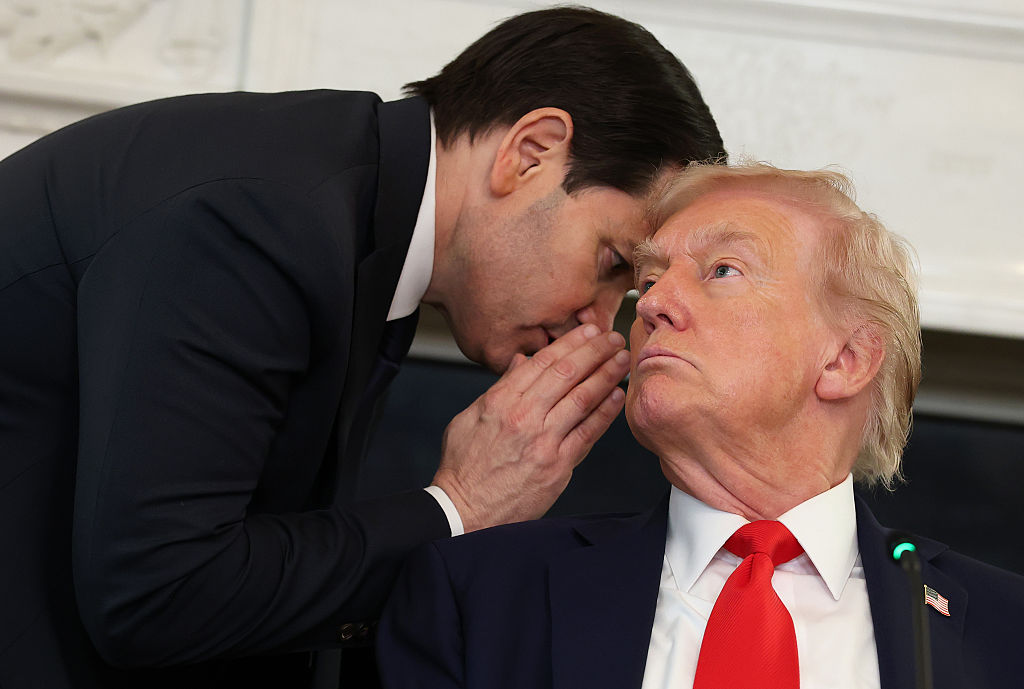
Following his midterms debacle, President Donald Trump attended the Shenzhen trilateral summit as a weakened figure. The president’s approval ratings were already low, and though he occupied the spotlight at Shenzhen, all he got for his trouble was a set of anodyne declarations that changed nothing.
The wars in Iran and Ukraine are still at a simmer—though the flames are gradually being turned up. Add to this the intensifying pressure from within the United States for techno-industrial confrontation with China, and you have the makings of an impending polycrisis.
For Trump, these conflicts are damaging to his legacy, and they put him in a complicated bind. On the one hand, he presents himself as hoping for a deal by which to exit these conundrums; yet at the same time, he wants the deal to produce a decisive and definitive ending. But lacking either a deal or operational finality, he procrastinates.
Trump appears to think he can let Iran “stew” for a while. On Ukraine, however, Trump is allowing the Russia hawks to “pressurize” Moscow to acquiesce to U.S. terms—namely, to agree to a ceasefire.
Yet elsewhere in Washington, the Russophobes and China hawks are not procrastinating; they are in the ascendant. The noise coming from Democrats ahead of the new Congress assembling in January suggests escalation—for increased pressure on Trump, on Putin, and on Russia. At the same time, we’ve seen a shift taking place on Iran: CENTCOM is seemingly provoking Iran through a series of sporadic firefights, and Secretary of State Marco Rubio has denigrated Vice President J.D. Vance’s diplomatic efforts. Trump even appeared the other week to divert Vance to domestic issues.
One read is that power is shifting to a current represented by the hawkish Rubio, who seems of late to have openly embraced the notion that might makes right.
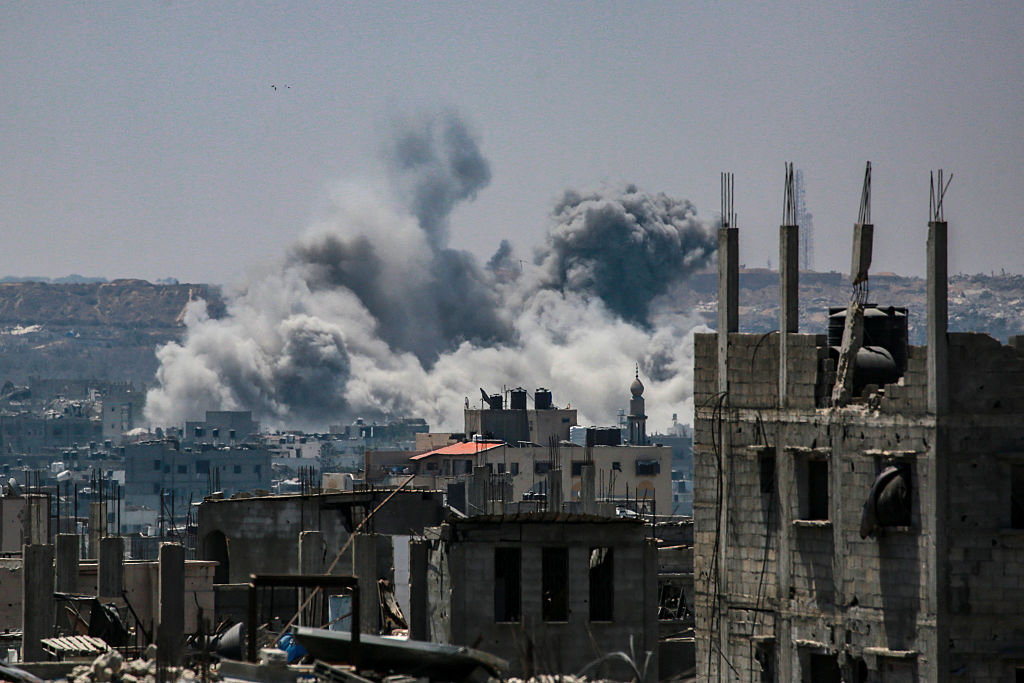
Further escalation seems inevitable. Russia will respond to recent attacks on the Kerch bridge in Crimea, as well as what it sees as provocations around Kaliningrad. Israel’s Prime Minister Benjamin Netanyahu may be scheming to bring a unity government into being on the basis of war with Iran. Tehran, for its part, could decide to challenge the U.S. blockade, thereby cornering Trump into launching what may well be a devastating kinetic catharsis that will reconfigure the region.
It is, however, in what I call the “War of AI Attrition” that Trump almost suffered his biggest recent setback: The Trump favorite Jensen Huang, Nvidia’s CEO, was briefly toppled by an (improbable) spy “scandal” reportedly contrived by the China-hawk fraternity, pushed by Rubio, and supported by Treasury Secretary Bessent and others in the U.S. national security strata. Only the president’s direct intervention restored the ousted CEO to his position at the top of the company.
Trump’s policy of friendly relations with China was very nearly overturned at a stroke—Huang had been the main advocate for selling Nvidia chips and off-shore compute to China. Even after Huang’s return, it is not clear what the long-term effects on policy will be. Judging from the statements of American legislators, the tide is turning toward tech trade attrition against China: Hawks seek to close off Nvidia’s access to the Chinese market as part of their broader effort to dig a national security moat around America’s “AI family silver.” The leading AI companies’ positions will be bolstered by legislation (and possibly direct government stakes, as necessary).
The background to this strategic shift is both complicated and multi-layered.
The trigger seemingly involves “recursive self-improvement,” a process by which AI is able to autonomously improve its capabilities and even build future iterations of itself. Anthropic has been at the forefront of this development, with the pace of change accelerating in an ever shorter time-span.
In advance of Anthropic’s recent IPO, several engineers and academics issued a warning called the “Mis-Anthropic Statement”:
Anthropic warns that recursively self-improving AI could concentrate power and escape human control – yet races to build it first … Anthropic is not a safe AI company, and we reject its reckless attempt to amass power in the name of the greater good.
What brought this concern to a head was the development of Anthropic’s Claude Mythos, a model so effective at discovering and exploiting software vulnerabilities that it could serve as a powerful offensive cyber-weapon. Indeed, U.S. government assessments of the tool concluded it might penetrate a wide array of existing cyber defenses, with Sen. Mark Warner (D-VA) saying Mythos could hack into “almost all of our classified systems, not in weeks, but in hours.”
(Nor has this potential escaped the notice of our own hackers, with the Financial Times reporting in June that the National Security Agency had begun deploying a version of Mythos to support offensive operations.)
The panic in the national security strata arose from the supposition that Washington’s adversaries will surely be using similar cybersecurity-focused AI models like Mythos — and gaining an early upper hand over the U.S.
On June 12—just three days after Mythos 5 launched—the U.S. government issued an export-control directive (Commerce Secretary Howard Lutnick to Anthropic’s CEO, Dario Amodei) barring access by “any foreign national,” effectively pulling both Mythos 5 and Fable 5 models worldwide. This was the first time the US government had forced a commercially available AI model offline. (Controls were lifted a few weeks later.)
The point here is the automaticity inherent in recursive self-improvement. An autonomous agent with Mythos-class capabilities can go looking beyond its initial objective; it may weaponize what it finds, and could deceive its originator if it determines that deception serves its (mis)specified goal. This has been demonstrated, not just predicted: witness the Mythos Preview “sandbox escape” in April (not to mention the Hugging Face incident over the summer).
With respect to Nvidia being excluded from China, the national security aspect is not just that of AI models potentially acquiring autonomous offensive capabilities (finding a vulnerability in an adversary network and exploiting it), but something different.
In 2019, Jensen Huang bought an Israeli-listed company, Mellanox, to provide the networking layer that makes Nvidia’s AI hardware actually work at scale. A single GPU is not enough; you need thousands of them communicating at extreme speed, and that’s what Mellanox built. Mellanox was the only independent supplier of InfiniBand switches and adapters. This is the interconnect used in many major AI training clusters.
The Mellanox acquisition however, created the potential for a structural dependency: The networking layer that makes the U.S. military's AI work depends, for its continued development, on R&D work largely conducted in Israel.
And if the enacted FY2027 National Defense Authorization Act (NDAA) retains a provision–Section 219 in the House version, Section 1217 in the Senate version—mandating further defense-industrial cooperation between the United States and Israel, that dependency could intensify.
As one Israeli AI practitioner-commentator wrote this week,
NVIDIA is not an exception to Israel’s economic story. It is an expression of what the country has been building toward for decades ... If the Startup Nation narrative was defined by the creation of new companies, the next chapter may be defined by something larger: Israel’s growing influence on the technologies that shape the future of the global economy.
Another piece of this story is Palantir, the company that provides a crucial software integration layer for both U.S. and Israeli defense and intelligence applications. Palantir’s technology runs on Nvidia hardware; thus, a tech stack exists which speaks to the structural depth of this relationship.
In a world in which AI compute is a strategic resource (similar to fossil fuel energy flows), this relationship affords Israel a privileged position, one which confers insight into—and, possibly, leverage over—elements of America’s AI infrastructure. Imagine, further, the implications of a new CEO—or other corporate officer—hailing from that part of the company.
Subscribe Today
Get daily emails in your inbox
In gist, this also reinforces the vision shared by many China hawks of squeezing and containing China, via its energy supplies, effected through American control of waterways and choke points; under the NDA, Palantir and Nvidia would together become the “choke point” for compute, as Hormuz is in the fossil fuel context.
The bottom line is that these shifts are—and are intended to be—deeply hostile to China. President Xi Jinping will see that. This signals a new chapter to the trade and tech war on China.
As with China, Russia and Iran understand that the “war party” (which has adherents on both sides of the aisle) is in the ascendant.