The Midterms Were About American Decline—Not Corruption
Democrats who seek to make the results all about Trump’s shady dealings are missing the point.
On April 23, 1985, at the Plenum of the Soviet Communist Party’s Central Committee, the newly elected General Secretary Mikhail Gorbachev laid out his ideas for reform in a landmark speech. A major focus was to be stamping out corruption. “The task now,” Gorbachev said, “is to work out concrete, effective measures to rid the distributive mechanism of wage-levelling, unearned income and everything that runs counter to the economic norms and moral ideals of our society.”
Soviet citizens reacted to this positively at first. There was great hope that these reforms would be achieved, particularly after flashy television performances where the authorities showed the public seized gold, cash, and other valuables. But as time went on, the show got tiresome. Three years later, at another Communist confab in 1988, the magazine editor Vitaly Korotich approached the podium and handed Gorbachev a “secret packet” that he claimed contained evidence that four high-ranking delegates present in the hall were taking bribes. The “Conference Bomb” was the beginning of the end of Gorbachev’s reform attempts and the beginning of the collapse of the Soviet Union.
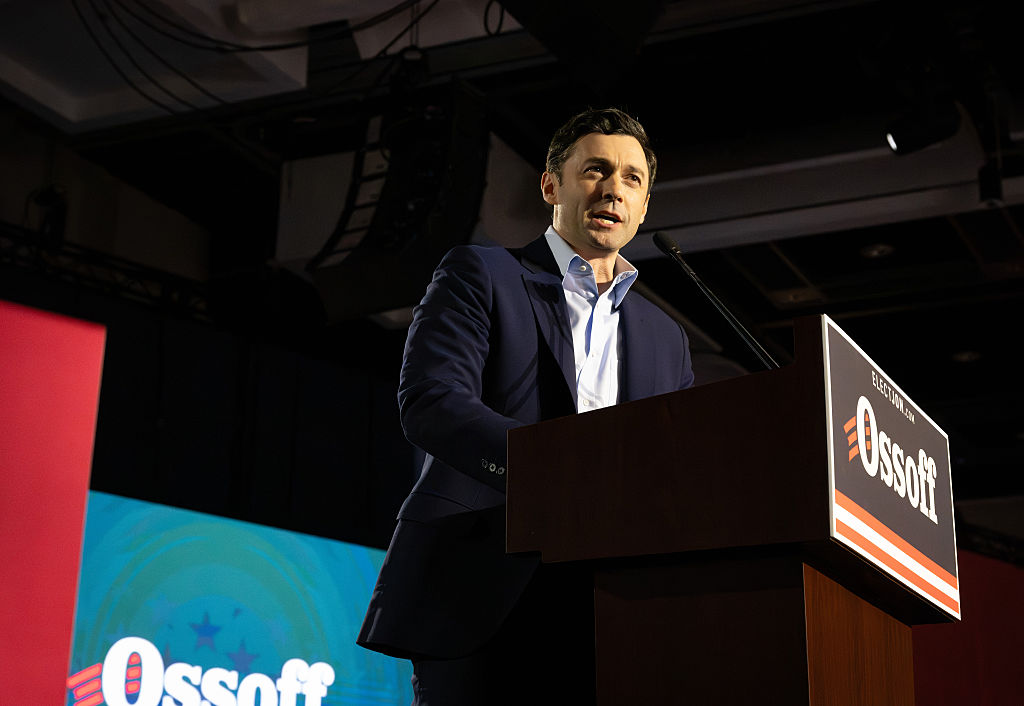
In the wake of the blue wave that swept the United States in the November 3 midterms, Senator Jon Ossoff gave a victory speech that went viral online. He linked two issues in the minds of Americans: economic decline and corruption. Ossoff was clearly channelling his inner Gorbachev, whether he knew it or not. But the corruption in question was not portrayed as systemic; rather it was all due to the Trump family. Where Gorbachev at least tried to grasp the nettle and highlight the pervasiveness of corruption across all of Soviet society, Ossoff’s version of a perestroika speech laid the blame squarely and more or less exclusively at the president’s feet. Nor did Ossoff’s speech address any other causes of economic decline, as Gorbachev’s did in his 1985. Rather, the Georgia senator gave the impression that all the country’s problems were due to the shady dealings of the Trump clan.
In 2026, we have seen this playbook deployed successfully twice already, once in Hungary and once in Serbia – both previous bastions of autocracy in the minds of American liberals. In Hungary, the country was experiencing the same economic problems as the rest of Europe, problems due in large part to sanctions on Russia and the related energy and affordability crises. But the new prime minister, Peter Magyar, won by telling the Hungarian public that the problems were due to the corruption of Viktor Orbán. Serbia is an even more unusual case. The country has not imposed sanctions on Russia and has posted record economic growth over the past few years. But a massive protest movement was mobilized to turn out people who usually do not vote. These people became convinced that whatever problems they had in their lives were due to the corruption of Vučić and his ilk.
Western liberals watched these elections closely. They know that their ideological project, which started in earnest in the 1990s, is doomed. Its globalism has little intellectual credibility left, and its standard bearers today are mediocrities—many of them deeply compromised by corruption of their own (not for nothing are they collectively referred to as the “Epstein class”). Watching events in Hungary and Serbia in 2026 were an enormous morale boost for this crowd; indeed, Sen. Elissa Slotkin reportedly traveled to Budapest to see what she could take from Magyar's playbook. And, as the recent attempt at a constitutional coup in Poland shows, these elites are increasingly willing to embrace openly authoritarian means. Listening to Ossoff’s speech with this context in mind, it looks like they are going to try to repeat the same trick with Trump.
No one would defend corruption. One group of people getting unfair advantages over everyone else is unpleasant and, well, unfair. But the idea that corruption is the major political problem in any given country is juvenile. It is not politics; it is a simulacrum of politics. It is the Weltanschauung of the college dorm room. “Man, it’ll never get better until we tear down the whole corrupt system, man,” says the 20-year-old as he reaches for another bong hit. And when this sort of nihilistic anti-politics is promoted in smaller countries, the external actors behind it know well its essential destructiveness. Indeed, the point is to destroy. These sorts of campaigns are usually targeted at countries where the incumbents will not bend the knee to the globalist liberals. If the strategy succeeds and plunges the country into chaos, those pulling the strings kick their feet back and laugh.
Subscribe Today
Get daily emails in your inbox
But now this strategy, heretofore mainly deployed in the global periphery, is being applied to the core. And if the experience of previous years is any guide, the United States is about to experience a seismic wave of blowback. Vulgar anti-corruption politics is inherently destructive. It is about burning down, not building up. Say what you will about Barack Obama, he promoted an uplifting vision of hope and change. Ossoff promotes a far darker vision. When politicians embrace these dark forces, they cannot help but give themselves over to them. It is almost as if they become possessed.
Consider the players named in Ossoff’s speech: Russia, the United Arab Emirates, Qatar, Albania, and Kazakhstan. Russia is grist for the mill. It is currently classified as an enemy of the United States and can be treated as a punching bag without many consequences. But what about the rest of these countries? The UAE, Qatar, and Albania are U.S. partners in geopolitically sensitive regions. Kazakhstan is an important transport hub in central Eurasia, where great powers are currently jockeying for influence. If these countries become the targets of Ossoff’s inchoate rage, what is to stop them flipping to the rivals of the United States? Not much, and Albania’s own prime minister—a progressive who is close to the Soros network—hinted at as much in a recent interview in Europe. “Burn it all down,” cries Ossoff, as the State Department bureaucrats look on in horror.
Perhaps the best way to think about these developments is that they are the natural outcomes of American decline. As this sets in, it becomes increasingly difficult to promise people a positive vision. And so, to get votes, the best strategy is to incite the mob. In a functioning body politic, the system would try to moderate excesses and ensure that they do not damage core strategic interests. But when the system itself is divided and weak, those defenses cannot work, and the demons summoned by the politicians-turned-carnival barkers go effectively unchecked. American politics may be about to pull itself apart in ways that no one could have possibly imagined a decade ago.