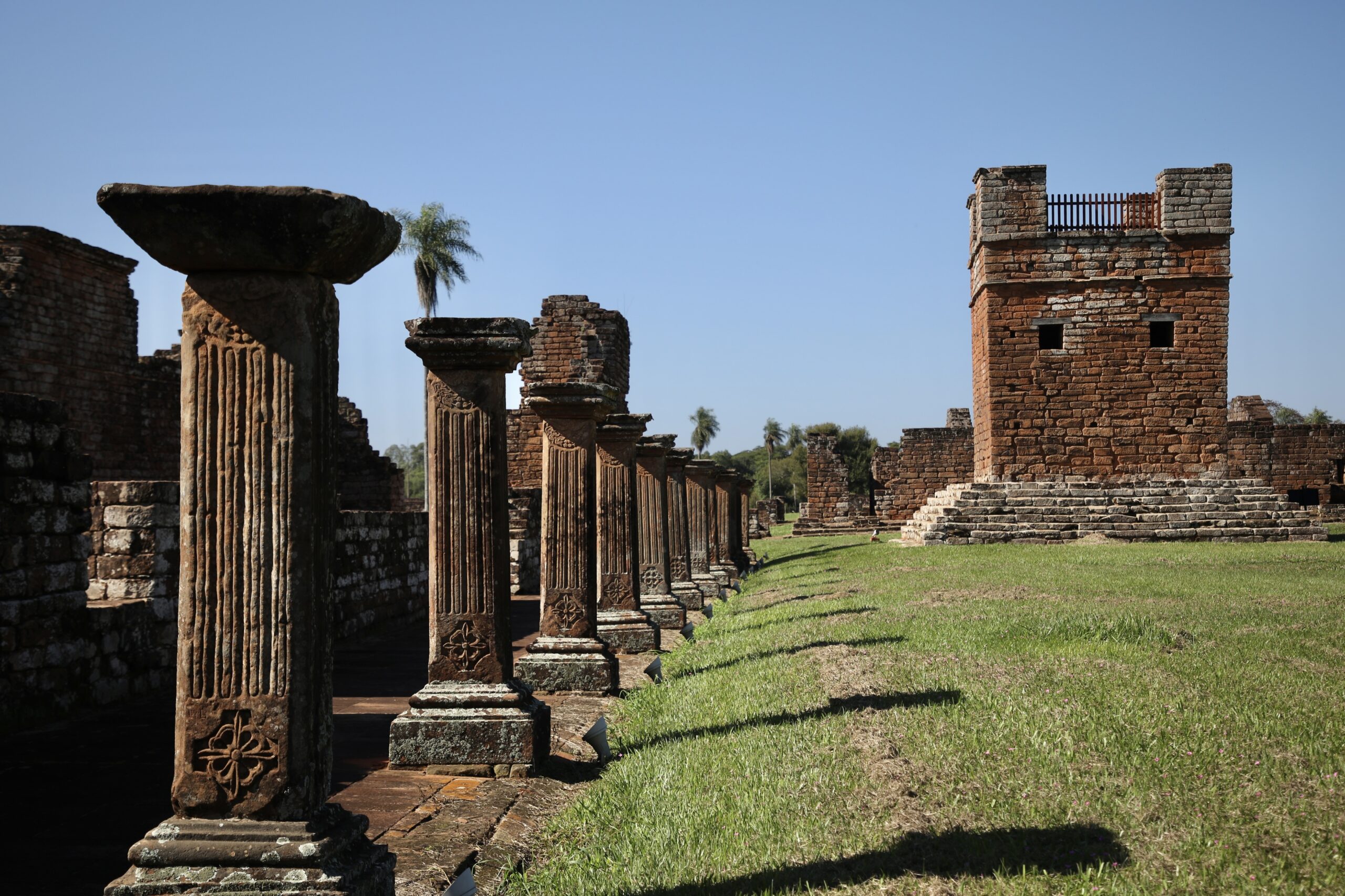
A sparsely populated place, rich in resources, and undefended by any nation-state, is not going to be left alone. It will soon enough be swallowed by a geopolitical power. Sounds like Greenland today, where 57,000 people live on a land mass significantly larger than Alaska, as nominal overseer Denmark provides no defense. And yet it also sounds like the Guarani people of Latin America, three centuries ago. They were left undefended by Spain, and so were conquered and enslaved by Portugal.
Some of us have seen this movie. It’s called The Mission, and it starred Jeremy Irons and Robert De Niro. Four decades after its premiere at the Cannes Film Festival, on May 16, 1986, The Mission is worth seeking out on streaming. It’s not only a cinematic gem—winning the Palme d'Or at Cannes, an Academy Award in Los Angeles, and many other honors around the world—but it’s also topical to today’s headlines.
Back in the 18th century, the mailed fist of raison d’etat pulped traditional and moral rights. So The Mission’s historical tale of undeveloped land, indigenous people, and the shock of the new provides a grim case study for those thinking about Greenland.
Yes, history is always rhyme-y. Yet if we learn lessons from the muse Clio (including her Hollywood manifestation), perhaps we can steer current events toward happier outcomes.
The Mission tells the tale of the 30 settlements established for the benefit of the Guarani by the Society of Jesus, the Jesuits, in the 17th and 18th centuries, in territory that’s now staked out by the nations of Paraguay, Argentina, and Brazil. (There were, of course, many Catholic missions all over the Americas; for instance, the U.S. cities of Los Angeles, San Diego, and San Francisco have their origins in the settlements built by another order, the Franciscans.)
The missions served two purposes: first, of course, to bring the heathen to Christ; and second, to protect new Christians from slave traders and other marauders. According to the Jesuit historian C.J. McNaspy in his 1982 book, The Lost Cities of Paraguay,
The Jesuits realized that the only way for the Indians to enjoy freedom and dignity in a world of colonialism would be to have their own separate communities. Here they could live and work for themselves, semi-autonomously, while owing fealty and paying taxes to the Crown.
The Jesuit missions operated as communes, engaged in agriculture as well as crafts learned from the European-born priests and brothers, including carpentry, sculpture, and metalworking. (McNaspy, who advised on the making of The Mission, showcases many New World artworks that beg comparison, in their quality, to masterworks of the Old World.)
At their peak, the missions were populated by some 140,000 souls. The modus vivendi shared by the Jesuits and the Guarani gained admiration across the world, even from such anticlerical contemporaries as Voltaire, Montesquieu, and Rousseau.
Now some among the modern will say that the Jesuit system sounds communist. In The Mission, the fictional character of Father Gabriel, S.J., answers smartly, “It was the doctrine of the early Christians.” The Jesuits (and other missioners) also drew upon the precedent of the monasteries. They, too, were communal, and yet historian Lewis Mumford credits them as engines of proto-industrialism, even capitalism.
Others among the modern will make a different critique: The Jesuit-Guarani relationship seems, well, colonialist, even white supremacist. There was, for sure, an ordained hierarchy: As the same Gabriel says, “We are not the members of a democracy . . . We are the members of an order.” An order ultimately answerable, of course, to the Vicar of Christ in Rome.
Yet in South America, the order, for as long as it lasted, protected the Guarani and improved their standard of living, bringing them in from primeval hunting and gathering. McNaspy relates the uplifting work of many Jesuits, including Antonio Ruiz de Montoya:
He wrote five books, some two thousand pages, which were published in the Guarani language. His grammar, dictionary, and spiritual books contributed notably to the stability of the Guarani language and are still in use today. These books helped to make the Indians literate. They were, indeed, probably the first indigenous literate society of our hemisphere.
And most importantly, the faithful would say, the priests brought the Guarani to God.
Still, violence sometimes erupted. McNaspy records visiting a church in Paraguay honoring a Jesuit martyred in 1628, beatified in 1931: “On a nearby wall, a marble plaque lists the names of twenty-three other Jesuit missioners who were martyred in the area.”
So why did the Jesuits go forth? Leave home for a life of arduous service at best, torturous sacrifice at worst? Not just to South America, but to the whole world? No observant Christian, mindful of the Great Commission, needs help answering such questions.
Still, The Mission is valuable because it illustrates one epic saga. The film begins with the martyrdom of a priest at the hands of the Guarani, providing a memorably Christ-like image. Knowing that his colleague had been killed, and by whom, Father Gabriel resolves to carry on. He, too, will go “above the falls”—those being the spectacular Igauzú waterfalls—and into the jungle, taking the gospel to the killers. Gabriel’s only weapon is an oboe, with which he plays a sweet tune. The Guarani are charmed, and let him live.
(The film’s score, by Ennio Morricone, is its own sweet symphony—it was so hummable that it was repurposed into TV commercials. Nominated for an Academy Award, it unaccountably failed to win, and yet fan history remembers it as legend.)
Once he is accepted by the tribe, Gabriel, joined by colleagues, makes converts. Together, they build the mission of San Carlos where the adults work and where the children excel at singing, also learning to make violins and other musical instruments. As one character in the film quips, “With an orchestra, the Jesuits could have subdued the entire continent.”
In 2019, the Jesuit magazine America recalled the film and the events that inspired it:
Among the many works of the Society of Jesus in its nearly 500-year history, its missions among the Guarani people of present-day Paraguay and Bolivia remain perhaps its most fabled. Known collectively as the Jesuit Republic or Lost Paradise, the Jesuit missions . . . combined 17th- and 18th-century visions of the kingdom of God with a respect for indigenous culture that infuriated the secular powers that had allowed the Jesuits access to the region in the first place.
So these religious refuges were not to last. Regional and international macht-politik intruded. As one character explains, “a paradise of the poor is seldom pleasing to those who rule.” Local grandees didn’t want competition from the Jesuits, and back in European capitals, dirty deals were done. The film cites the prime minister of Portugal, the Marquis of Pombal (1699–1782), as the impetus for asserting imperial dominion over the Jesuit outposts.
Portugal and Spain renegotiated their South American borders in 1750, ceding the territory to Pombal’s forces, dooming the missions. Indeed, for its own reasons of state, the Catholic Church went along; in the film, church hierarchs worry that resistance to the deal in Paraguay would redound against not only the Jesuits as an order but the Church as a whole.
A kindly but world-weary cardinal visits San Carlos. Duly impressed by the good works he sees, he nevertheless delivers an ultimatum: The priests and their charges must submit. Some of the priests, thinking first of their flock, wish to fight, but not Gabriel. “If might is right, then love has no place in the world. It may be so,” he sighs. “But I don't have the strength to live in a world like that.” And so, surrounded by his congregants, he accepts his martyrdom.
In the film, as in the actual history, state power overcomes lex naturalis, the God-ordained natural law that had guided the Catholic Church and its venturesome—sometimes too venturesome for its own good—offspring, the Society of Jesus. Their America magazine concludes on a plangent note: The settlements are remembered as a “shining, tragic moment in Catholic history.”
Indeed, the history of what the Jesuits accomplished still abides. As the Cardinal says, “The spirit of the dead will survive in the memory of the living.” And for some, of course, there’s eternal treasure in heaven.
Okay, so now let’s connect the Guarani to the Greenlanders. Greenland is officially autonomous from Denmark, although the Danes never fail to speak for Greenlanders in international arenas.
But Denmark is too small, and too pacifistic, actually to defend Greenland. Instead Copenhagen invokes international law, expecting great powers to obey.
Yet history offers a harsh verdict: It tells those paying attention that legal intangibles mean little in comparison to national covetousness.
After all, the Guarani had natural law on their side, and it did them no good when the shooting started. Moreover, it takes nothing away from the diligence and fidelity of the Jesuits to say that here on earth, the favor of political princes is a factor. Indeed, the Catholic Church would not have survived these 2,000 years if it were unaware of rendering unto Caesar.
So while it’s easy to admire the noble savage in his state of nature—this author wrote admiringly of the first North Americans last year here at TAC—it’s harder to figure out how to keep them viable in the face of modernity’s onslaught. If pre-modern natives are to keep their way of life, they need to be in some sort of preserve, akin to a national park.
Yet President Donald Trump has no intention of playing park ranger. For better or worse, he is with the developers.
Earlier, we took note of the Marquis of Pombal, the powerful prime minister of Portugal from 1750 to 1777. He was a relentless modernizer at home, while at the same time an ardent proponent of slavery abroad (including for the Guarani).
Stipulating that the differences, across the centuries, are far greater, some will see similarities between Trump and Pombal. Neither man ever had patience for pieties and protocols that got in the way of getting things done. Both were consequential in their time—and destined to be controversial ever after. “I don’t need international law,” Trump said recently, adding that he would be guided, instead, by “my own morality. My own mind.”
So like Pombal before him, Trump has no interest in leaving a rich territory to remain pastoral. Trump is long on record as wishing to develop Greenland’s resources, and he has added further arguments about needing Greenland for the sake of U.S. national security. As he said on January 11, “you have Russian destroyers and submarines, and China destroyers and submarines all over the place.” In response, he jibed, the Danes have nothing: “Basically, their defense is two dog sleds.” Trump added, “If we don’t take Greenland, Russia or China will take Greenland.” He concluded, “I’m not going to let that happen.”
That’s Trump, the macher. Yet in sharp contrast to Pombal, Trump has no desire to subjugate the indigenous. Instead, all along, he has wanted to seduce Greenlanders by making them rich. That is, gaining wealth by selling the resources under their own feet—resources that the greener-than-thou Danes have not deigned to dig. And in his deal-making urgency, Trump keeps upping the ante.
Trump’s offers have been rejected by officials of both Denmark and Greenland, and yet interestingly enough, at least on an anecdotal level, when the offer is put to ordinary Greenlanders, they are intrigued. Needless to say, this wouldn’t be the first time that the elites think one thing, while the masses think another—exploiting that populist arbitrage has been Trump’s trick all along.
Yet even European elites are coming around to Trump’s bottom-line realism. Justina Budginaite-Froehly, a former official in the Lithuanian defense ministry now at the Atlantic Council, writes, “Europe’s problem is not that Washington sees Greenland as a strategic asset. It is that Europe has largely failed to do so itself.” The Danes and the rest of the European Union must think harder, lest some foreign power simply walk into Greenland—and never leave.
So here’s a prediction: Trump’s plan for Greenlandic aggrandizement will be at least partially successful. As German foreign minister Johann Wadephul put it on January 12, a “compromise" is coming. That is, Greenland will be opened up to economic development, even as it is made secure against military depredation.
If so, then Greenlanders can look forward to both peace and prosperity, enjoying the benefit of, say, a resource-based sovereign wealth fund. Let’s pray that the plan is well-grounded, including a healthy social system, providing the locals with not just cash, but the moralizing structure of good jobs at good wages.
One last question: Will we ever see the exemplary—some might say miraculous—leadership of the Jesuits again? The conventional wisdom says “no.”
In general, today’s transnational elites see miracles as artifacts of an earlier age—subject, of course, to critical scrutiny. As far back as 1867, Matthew Arnold, the Victorian man of letters, set the skeptical tone of modern times:
The Sea of Faith
Was once, too, at the full, and round earth’s shore
Lay like the folds of a bright girdle furled.
But now I only hear
Its melancholy, long, withdrawing roar.
And yet for all the soigné disenchantment of the elites, every day we see evidence that seas of faith are advancing, loudly. We can all name -isms, across the spectrum, that motivate marchers, warriors, and martyrs. If we were to somehow measure zeal, we’d see that the names have changed, but not the energy level. Across the globe, the actions of billions, whether we approve of them or not, prove that the wellsprings of faith and belief run deep. Perhaps they are, in fact, infinite. So how does that happen?
Of course, discernment is always needed. One is reminded that another Matthew, living long before Mr. Arnold, recorded in the New Testament: “False messiahs and false prophets will appear and perform great signs and wonders to deceive, if possible, even the elect.” Perhaps that Matthew was really on to something.
Of course, if there’s the false, there’s also the true. Can’t have one without the other. And there will always be believers in the true. That’s not just faith: that’s observation. We see it all the time: some believer giving everything for the sake of saving another.
Subscribe Today
Get daily emails in your inbox
And so we come back to the Jesuits. In The Mission, we see a man being invested in the Society, as God is implored: “Teach him to be generous, to labor and not to count the cost . . . to serve with no reward, save the doing of your will.”
Jesuits are still being formed today, and not everyone loves or even likes them—controversy has been a steady companion of their existence for half a millennium.
In the end, Providence will judge whether zeal has been expended for good or for ill. In the meantime, humans are advised to gather up clues, hoping to gain insight into the good: from Scripture, from history books—and maybe even a 40-year-old movie.