Maria Wittner’s Warning


Busy day today doing publicity for the book, but a gratifying day. The message is getting out there. People know that there is something very wrong in our society, and that a shadow has fallen across our civilization. A reader of Live Not By Lies writes that he is loving it. He adds:
We went to Budapest a couple of years ago for my wife’s 40th birthday. I’ll never forget one of our food tour guides, a younger woman who would claim herself to be a progressive liberal, look at us in all seriousness & say to never give up your guns because if you do, you’ll have nothing to fight back with once they come after you. Her demeanor immediately changed as if she was recalling all the horrible stories from direct witnesses of Hungary’s German & then Soviet occupation.Her words have haunted me, even more so as we march closer to this ontological possibility. It grieves me that so many of us may have to experience decades of this type of rule & then proclaim in the future the same sentiment that she did to me, only not from a place of fear that it’ll happen but from direct experience. Lord, have mercy.
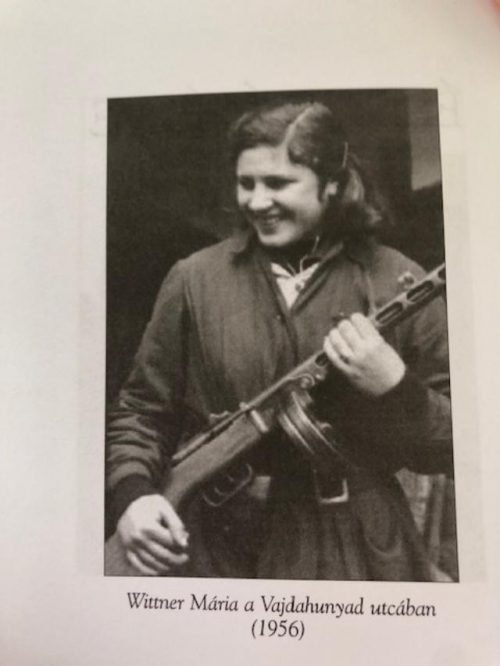
Defending the right to speak and write freely, even when it costs you something, is the duty of every free person. So says Mária Wittner, a hero of the 1956 Hungarian uprising against Soviet occupation. A communist court sentenced Wittner, then only twenty, to death, though this was later commuted to life imprisonment.
“Once I said to one of the guards in prison, ‘You are lying.’ For that alone, I was taken to trial again,” remembers the feisty Wittner. “The state prosecutor said to me, ‘Wittner, why did you accuse the guard of being a liar? Why didn’t you just say, ‘You’re not telling the truth’? I said, ‘It matters that we speak plainly.’”
For her insolence, Wittner was sent back to prison with extra punishments. She had to sleep on a wooden bed with no mattress and was given reduced rations. By the time her sentence was commuted and she was released, Wittner weighed scarcely one hundred pounds. Nevertheless, she insists that a broken body is a price worth paying for a strong and undefiled spirit.
“We live in a world of lies, whether we want it or not. That’s just the case. But you shouldn’t accommodate to it,” she tells me as I sit at her table in suburban Budapest. “You will be surrounded by lies—you don’t have a choice. Don’t assimilate to it. It’s an individual decision for each person. If you want to live in fear, or if you want to live in the freedom of the soul. If your soul is free, then your thoughts are free, and then your words are going to be free.”
Under hard totalitarianism, dissenters like Wittner paid a hard price for their freedom, but the terms of the bargain were clear. Under soft totalitarianism, it is more difficult to see the costs of compromising your conscience, but as Mária Wittner insists, you can’t escape the decisions. You have to live in a world of lies, but it’s your choice as to whether that world lives in you.
These are real people, not characters in a novel.
A reader sent me this from his Facebook feed:

How about that. What is that person talking about? This:
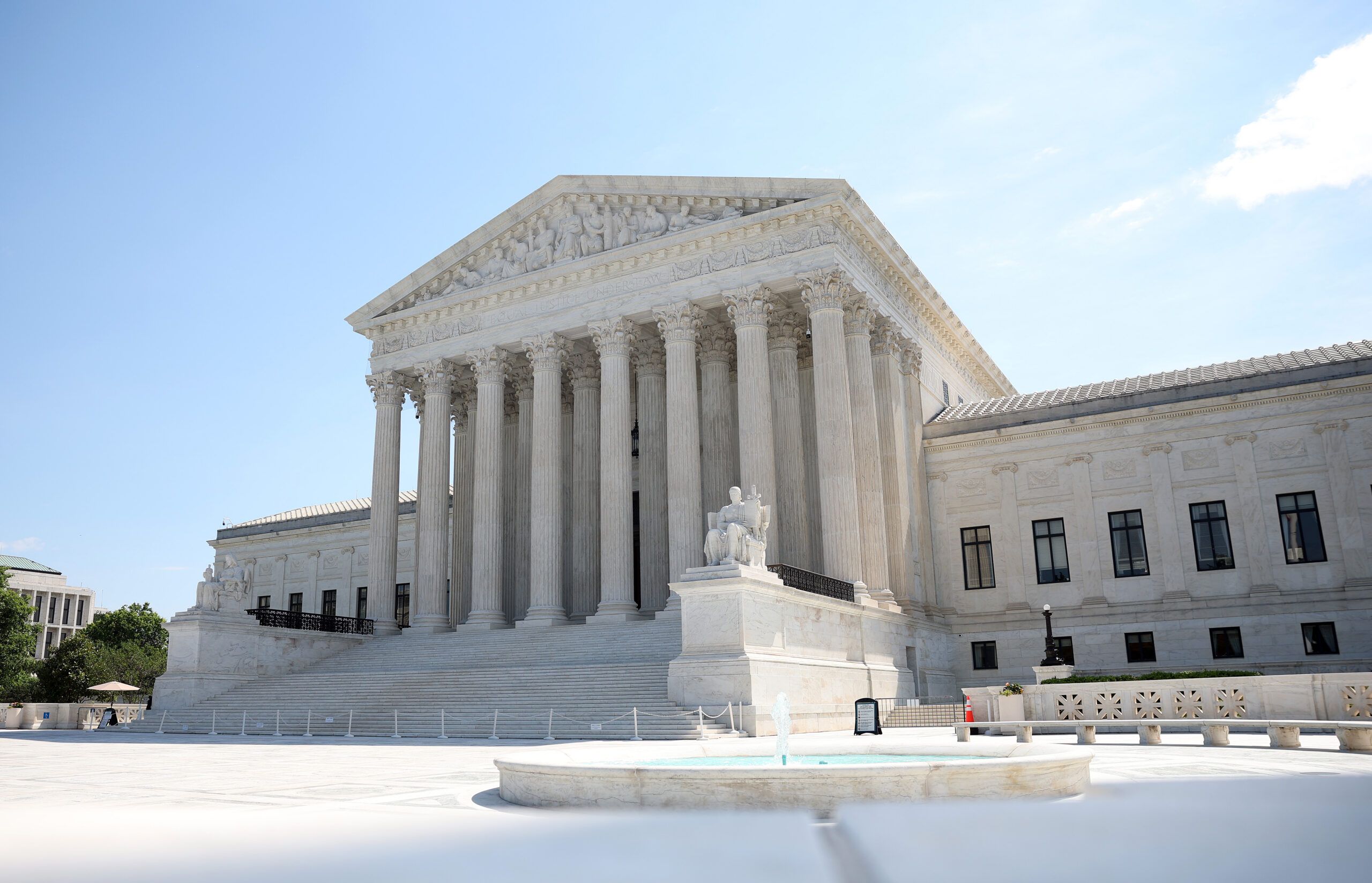
Supreme Court Justices Clarence Thomas and Samuel Alito issued a broadside against the high court’s 2015 same-sex marriage decision on Monday when the court declined to hear a case brought by a former Kentucky county clerk who refused to issue a marriage license for such couples.
The two justices agreed with the decision not to hear the case but used the occasion to take a legal baseball bat to the court’s 2015 decision Obergefell v. Hodges, which declared that same-sex couples have a constitutional right to marry under the 14th Amendment guarantee to equal protection of the law.
Writing for himself and Alito, Thomas said that the court’s decision “enables courts and governments to brand religious adherents who believe that marriage is between one man and one woman as bigots, making their religious liberty concerns that much easier to dismiss.”
His words came in a case brought by Kim Davis, a former county clerk in Kentucky, who in the aftermath of the same-sex marriage decision refused to issue marriage licenses to same-sex couples and was sued.
“Davis may have been one of the first victims of this court’s cavalier treatment of religion in its Obergefell decision,” Thomas and Alito wrote. But they agreed that the court properly decided not to take up Davis’ case because, they said, it does not “cleanly” present the issues in the court’s 5-4 decision five years ago.
Nevertheless, they said, the case “provides a stark reminder” of the consequences of the same-sex marriage decision. By choosing to endorse “a novel constitutional right over the religious liberty interests explicitly protected in the First Amendment, and by doing so undemocratically, the court has created a problem that only it can fix,” they said. “Until then, Obergefell will continue to have ruinous consequences for religious liberty.”
Thomas and Alito point out that Obergefell is not in the Constitution, but religious liberty is. As the reader pointed out in his note to me, “Nowhere in the opinion do they call for overturning Obergefell. They simply point out the unresolved issues when you create a right from whole cloth and label anyone who doesn’t agree with it a bigot.”
Holding this opinion, though, makes you unfit for public life, according to some leftists. “People like [this] must never be allowed in places of power again.” In his Obergefell dissent, Justice Scalia said he does not believe that the Constitution either mandates same-sex marriage or forbids it. It is a matter for legislatures to decide. This opinion is intolerable. I would never say that the justices who voted for Obergefell must never be allowed in places of power again. But then, I am not an intolerant maniac.
Do you want to know why there are lots of people who have no faith in Donald Trump, but who are going to vote for him anyway because of the judges he will appoint? This. This is the reason. They believe — accurately, I think — that the federal judiciary is going to be the last line of defense for the old First Amendment liberties against what the “impolite progressivism” of the social justice zealots. I said that on my interview this morning on the Hugh Hewitt Show, and I believe it.
A reader writes to quote this passage from Live Not By Lies, about the Bolsheviks in exile:
The comfortable Philistines were not the kind of people prepared to suffer and die for their beliefs. The Bolsheviks were. The tsarist government sent many of their leaders into Siberian exile, which did not break them but made them stronger.
“Exile stood for suffering, intimacy, and the sublime immensity of the heavenly depths. It offered a perfect metaphor for both what was wrong with the ‘world of lies’ and what was central to the promise of socialism,” writes historian Yuri Slezkine. To be a revolutionary in those days was to share a sense of purpose, of community, of hope—and an electrifying bond of contempt, a contempt we see in the social justice movement today toward anyone who differs from its religious claims.
The reader said that in a recent showdown in his workplace with a SJW mob, he felt the power of the “electrifying bond of contempt” that united them in their opposition to him — a man they saw not as a colleague, but as nothing but a bigot who had to be suppressed. The “electrifying bond of contempt” is what holds together and propels people like the unnamed (I took his name out) Facebook zealot forward in their campaign to cleanse society of evil people like us conservatives, Christians, and all who won’t live by their lies.
I received a good review of Live Not By Lies from Barton Swaim in the Wall Street Journal, who cites the book’s claim that these latter-day revolutionaries mean business:
In the bleak future envisioned by Mr. Dreher, infantilized Americans happily repeat dicta they know to be lies—whatever ludicrous “isms” about race and gender the academic and
media elite care about at the moment—and eagerly submit to constant surveillance by
hyper-progressive Big Data companies. I have no idea where an ascendant left will take
America, and, as he freely admits, neither does Mr. Dreher, but he is right to dismiss the
commonplace notion that young progressives are “snowflakes” and “SJWs” (social justice
warriors). They are, many of them, savvy and ambitious political operators. “Unlike their
Bolshevik predecessors,” he writes, social-justice cultists, as he calls them, “don’t want to
seize the means of economic production but rather the means of cultural production.
A student reader of Live Not By Lies e-mails:
My family is strongly conservative and understands that the Leftist ideologies are dangerous, but they don’t understand just how near and powerful the danger actually is.
Many people I respect don’t conceptually link the Russian student radicals who murdered millions with the American student radicals of today. For them, the Bolsheviks were murderers and the students today are misguided. Eventually, “The pendulum will swing back.”
I don’t blame them for this misunderstanding. After all, it’s only in Russia that it seems believable for an ex-seminary student [Stalin] who “evangelized” his classmates into atheism to become the supreme dictator of an ideology that slaughtered millions. But unbelievable things happen every day on campus.
You have to experience the current university climate while you read accounts of the Russian intelligentsia to know what “student radical” means. My school presented me a dress rehearsal for the revolution.
At my school, students fear to tell jokes because anything that doesn’t sound politically correct won’t won’t be forgiven. Classes that were supposed to teach became exercises in ideological conformity, where the purpose of literature was to find the “racism” in every book. Our student newspaper made publishing conservative opinions a Sisyphean struggle and published articles condemning charity events as oppressive without a glance.
Older people in my life say these signs aren’t truly terrifying because the revolutionaries aren’t killers. But they don’t understand the full cultural impact of abortion. My generation is very used to the concept of solving problems by murder.
He goes on, but I’ll stop there. Here’s a related passage from Live Not By Lies:
Few in Russian society, outside of the imperial court’s bubble, believed that the system could carry on. But Tsar Nicholas II and his closest advisers insisted that sticking to the proven ways of traditional autocracy would get them through the crisis. The leadership of the church also ignored internal calls for reform from priests who could see the church’s influence wasting away. Russia’s intellectual and creative classes fell under the sway of Prometheanism, the belief that man has unlimited godlike powers to make the world to suit his desires.
In retrospect, this seems almost unbelievable. How could the Russians have been so blind? It was, in a sense, a problem of the imagination. Reflecting on the speed with which utopian dreams turned into a grisly nightmare, Solzhenitsyn observed:
If the intellectuals in the plays of Chekhov who spent all their time guessing what would happen in twenty, thirty, or forty years had been told that in forty years interrogation by torture would be practiced in Russia; that prisoners would have their skulls squeezed within iron rings, that a human being would be lowered into an acid bath; that they would be trussed up naked to be bitten by ants and bedbugs; that a ramrod heated over a primus stove would be thrust up their anal canal (the “secret brand”); that a man’s genitals would be slowly crushed beneath the toe of a jackboot; and that, in the luckiest possible circumstances, prisoners would be tortured by being kept from sleeping for a week, by thirst, and by being beaten to a bloody pulp, not one of Chekhov’s plays would have gotten to its end because all the heroes would have gone off to insane asylums.
It wasn’t just the tsarists who didn’t see it coming but also the country’s leading liberal minds. It was simply beyond their ability to conceive.
I don’t believe that we are moving to a torture society in the US — though I should tell you that one of the American immigrants from a communist country that I’ve kept up with since researching the book believes that I am very naive on this point — but I absolutely believe that we are quickly moving into a situation in this country that most of us simply cannot conceive. We think it can’t happen here. One last quote from Live Not By Lies:
It only takes a catalyst like war, economic depression, plague, or some other severe and prolonged crisis that brings the legitimacy of the liberal democratic system into question. As Arendt warned more than half a century ago:
There is a great temptation to explain away the intrinsically incredible by means of liberal rationalizations. In each one of us, there lurks such a liberal, wheedling us with the voice of common sense. The road to totalitarian domination leads through many intermediate stages for which we can find numerous analogues and precedents. . . . What common sense and “normal people” refuse to believe is that everything is possible.
In each one of us, she said. In you and me both. We are not on the precipice of having normalcy restored, if only we can get chaotic Trump out of office (as many people think). We are on the brink of something much more sinister. This does not make Trump a good man or a competent ruler. In fact, like Nicholas II, his mistakes, enabled in part by a misplaced confidence in the stability of the system, may be accelerating the catastrophe. But it should give pause to anyone who thinks that these radicals who stand to be empowered in the wake of Trump’s ouster will be pleasant people who want nothing more than to make America nice and boring again.
Anyway, as they say in Hungary, “Hála Istennek a második módosításért” (thank God for the Second Amendment).
UPDATE: I have to apologize to you all for the way Disqus is behaving today. I’ve never seen anything like it. I keep approving comments that the system takes to spam. One of you even was banned today, and wrote me about it — but I didn’t do it, and I don’t think anybody else at TAC did! This is the worst system, Disqus. The worst.