
It was never clearer that the world you and I grew up in no longer exists than on a hot, arid summer afternoon in Riyadh, Saudi Arabia in May of this year. The oil-rich Saudis, keen to jump into the AI arms race, had invited all the tech and business elites who will decide the future of mankind to an investment forum in the desert. Many arrived in their finest attire, eager to shake hands and lay the groundwork for what they promise will be an economic and cultural renaissance driven by artificial intelligence.
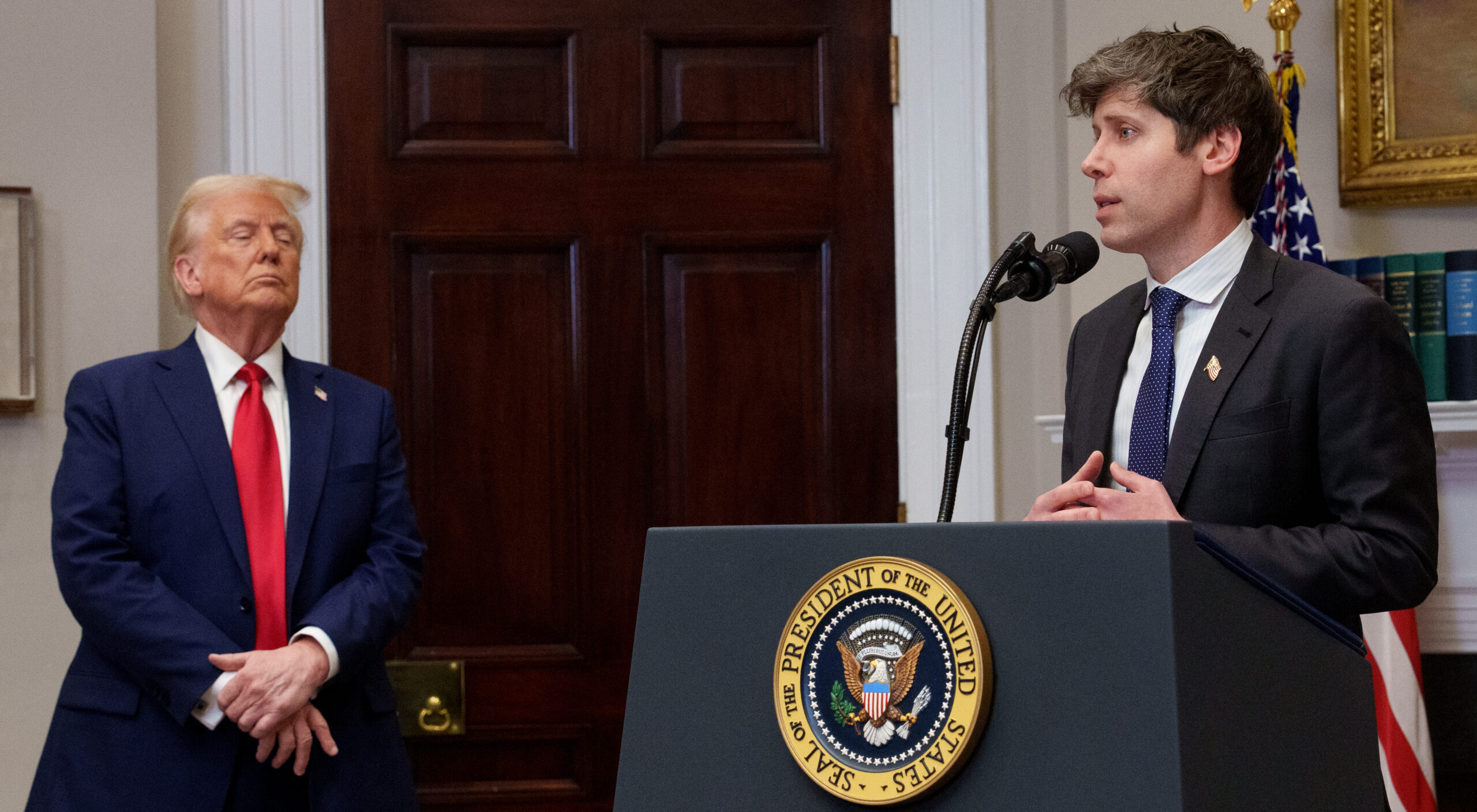
President Donald Trump was there too. It was Trump’s first big international jaunt since his reelection and the 78-year-old Republican, whose health has been repeatedly scrutinized throughout 2025, struck a rejuvenated figure standing beside Saudi Crown Prince Mohammed bin Salman as the pair greeted a who’s who of the global tech elite. The CEO of Tesla, Elon Musk, made the cross-Atlantic trip, along with Alex Karp from Palantir, Jensen Huang of Nvidia, Amazon’s Andy Jassy, Google’s Ruth Porat, OpenAI’s Sam Altman, AMD’s Lisa Su, and Uber’s Dara Khosrowshahi.
The meet-and-greet was just the latest in a years-long campaign by the Gulf States, and specifically the Saudis, to position the region as an indispensable hub for AI research, investment, and infrastructure. For the Saudis, the forum not only represented an opportunity to establish new data centers in its burgeoning kingdom but also to hash out trade deals for Humain, an AI startup launched by Saudi Arabia’s sovereign wealth fund that aims to become “a global leader in AI innovation and infrastructure.”
The Saudis, anxious to diversify from their reliance on the oil industry, have found willing partners with Western tech companies who not only view China as a looming threat in the AI space but prize the Gulf States, especially Saudi Arabia, for its lax regulatory environment, which allows for experimentation and pace in AI development. The investment forum in May, coupled with bin Salman’s state visit to Washington DC in November, sets the stage for a transactional relationship between the U.S. and Saudi Arabia that its proponents hope will accelerate AI innovation and adoption in ways unimaginable for both nations and their people.
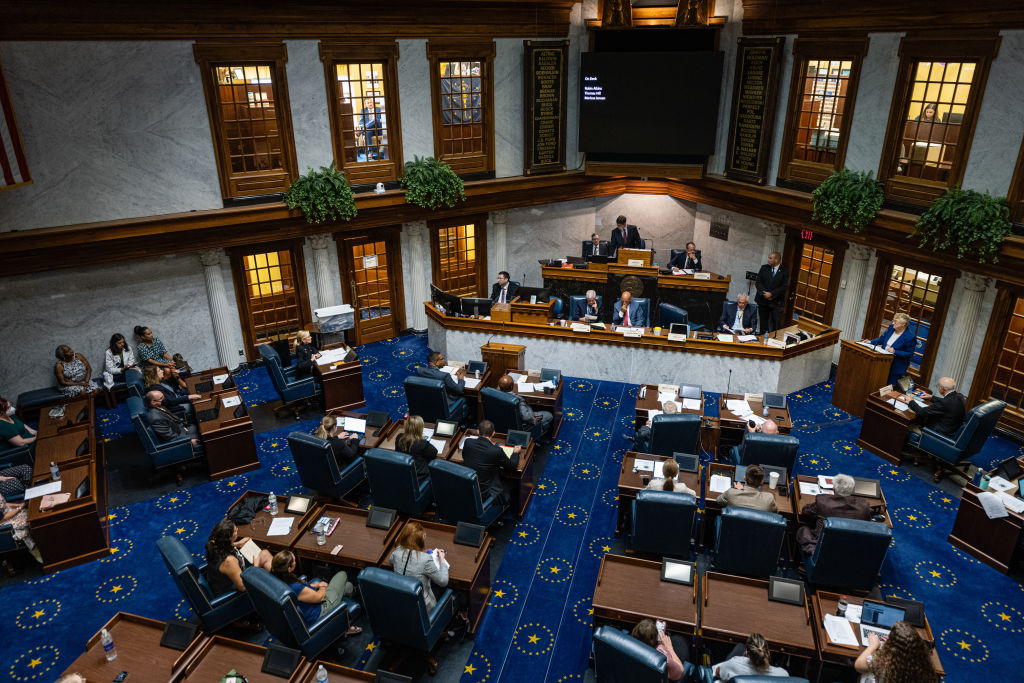
But back home in America, where democracy and the Constitution still notionally reign supreme, Trump’s open embrace of the private tech companies most interested in shaping the future of our society has been met with skepticism and outright mutiny from a bipartisan coalition of senators and representatives in Congress and beyond. Sen. Marsha Blackburn (R-TN), Rep. Marjorie Taylor Greene (R-GA), Sen. Josh Hawley (R-MO) and Sen. Ron Johnson (R-MN) have been among the loudest conservative critics, pushing back on attempts by the Trump administration to ban state governments from creating their own rules for algorithmic auditing, data privacy, AI transparency, child protection, and scamming restrictions.
The Trump administration and its acolytes argue that permitting 50 different state governments to create wildly differing rules for AI will slow the development of research and allow liberal states to create “woke” onramps for the nascent technology. “There must be only One Rulebook if we are going to continue to lead in AI,” wrote Trump in a post shared to his Truth Social on Monday. “I will be doing a ONE RULE Executive Order this week. You can’t expect a company to get 50 Approvals every time they want to do something.”
One of the most vocal supporters of a “one rule” federal standard that would supersede the sovereignty of state governments is Sen. Ted Cruz (R-TX), chair of the Senate Commerce, Science and Transportation Committee, who has argued that the budding industry should be treated like aviation and railroads, which demand national uniformity.
Never mind the fact that in 2015, Cruz introduced legislation defending states’ rights, at that time on the issue of marriage. “We should reject attempts by the Obama administration to force same-sex marriage on all 50 states,” Cruz said of his legislation then. “The State Marriage Defense Act helps safeguard the ability of states to preserve traditional marriage for their citizens.” The same arguments about states rights that were put forward by Cruz in his 2015 attempts to defend traditional marriage are the very ones now being used by detractors of Trump’s “one rule” federal standard on AI: The Constitution and the 10th Amendment grant enormous powers for state governments to govern themselves as they see fit, and we should not throw out more than 200 years of precedent in a slapdash manner simply to behoove the business interests of the wealthiest people in the history of the world.
Congress has taken every opportunity to push back on Trump’s desire to roll out AI expansion rapidly and nationwide. When Republicans attempted to sneak an AI provision into the “big, beautiful bill” that would have stripped states of the right to make laws about or regulate AI for 10 years, it was met with derision by Republicans and Democrats alike. Greene, who recently announced her retirement from Congress after receiving hundreds of death threats for countering Trump, has been among the most prominent detractors of attempts to weaken the powers of states to regulate AI.
“We should be reducing federal power and preserving state power,” Greene said of the provision in September. “Especially with rapidly developing AI that even the experts warn they have no idea what it may be capable of.”
Among the chief concerns for states’ rights advocates is a loss of flexibility when it comes to innovation and policy-making. Local variation allows states the ability to test different regulatory approaches before others follow, permitting state governments the opportunity to tailor AI systems to differing demographics, economies, and values. Opponents suggest that a cumbersome federal system will slow the reaction speeds to a number of concerns ranging from privacy violations and deepfakes to biases in automated decisions.
But for Trump, who in his second term has worked to merge Silicon Valley with the federal government, concerns about democratic accountability and potential overreach by tech companies are essentially nonstarters. Take for example Trump’s decision in May, only weeks after the Riyadh investment forum, to select the data analysis and technology firm Palantir for work linking disparate data sets between government databases.
In practical terms, the Trump administration is attempting to glean intimate details about the personal lives of people across the United States. From their student debt levels to bank account numbers, the Trump administration is actively attempting to consolidate a variety of separate records that will make it easier for the U.S. government to identify and track individuals regardless of their preference for privacy. Companies such as Palantir, which now hold contracts with the Department of Homeland Security and the Pentagon, are the tip of the spear.
Google is also getting in on the action. In a video shared to X on Tuesday morning, Secretary of Defense Pete Hegseth proudly announced the Pentagon will launch a military AI platform powered by Google Gemini for defense operations. “The future of American warfare is here, and it’s spelled AI,” promised the embattled Hegseth. "The possibilities with AI are endless.” Those possibilities, many of which we can barely envision or comprehend at the moment, are what is concerning privacy and democracy advocates who worry that expanding AI via a federal “one rule” executive order could spell trouble for everyday Americans if the proper guardrails are not implemented.
For those paying attention, it’s nearly impossible to go a day in our America without hearing about some new incursion AI has made into our human spaces. In San Francisco, three driverless Waymo vehicles got themselves into a high-tech traffic jam, stopping real, living human drivers from passing by on the street. Only two days later, OpenAI’s head honcho, Sam Altman, admitted during an appearance on Jimmy Fallon’s Tonight Show that he wouldn’t know how to raise his infant child without the guidance of an AI chatbot. Last Tuesday, McDonald’s released, with comments turned off, its first-ever all-AI holiday commercial to YouTube.
On Instagram, the home of human faces, one of the most popular new influencers on the platform is a completely fabricated woman whose completely fabricated pictures with digitally rendered celebrities have earned “her” over 700,000 followers. Just like that, the ground beneath our feet is dissolving at a pace that would have been unthinkable only a few short years ago, when we all laughed at the comically poor early AI videos of a notably fake Will Smith eating a bowl of pasta.
Not all who witness the shift are pleased. Take the actor Ethan Hawke, for example. Speaking with CBS Sunday Morning, the aging Hawke called AI a “plagiarizing mechanism” and touted his love for the theater “because AI can’t do it.” And the filmmaker Guillermo Del Toro, creator of Pan’s Labyrinth and most recently Frankenstein, said “I am not interested, nor will I ever be interested” in what AI platforms have to offer creatively.
Subscribe Today
Get daily emails in your inbox
More worrisome yet are the very real threats AI poses to the economic fabric of America. Speaking on 60 Minutes in late November, Anthropic CEO Dario Amodei warned that AI technology could “wipe out half of all entry-level white collar jobs and spike unemployment to 10–20 percent in the next one to five years” if governments fail to intervene on behalf of workers and create the sort of guardrails necessary to protect the American workforce.
With so many unknowns posed by the sudden adoption of AI, it makes logical sense why many state and local governments are wary of ceding hard power to a federal government run by an administration that has voiced few concerns about the sort of negative realities that could be conjured by computers. Anxieties about job security and human autonomy appear firmly in the back seat for Trump’s team; their only real concern about the technology appears to be whether or not the latest AI models are “woke.” Pushing forward with the project of accelerating the AI space, the Trump administration announced on Monday that the U.S. will begin selling the Nvidia H200 AI chip to China if America receives a 25 percent cut in return. As with nearly every decision made by Trump, cash is king.
Where AI goes from here is anyone’s best guess. Without the support of Congress, Trump’s EO will be as weak as the paper it is written on and in the future likely to be overturned, or worse, used by Democrats to enact draconian measures on the ethic of freedom that this country was founded on and which has protected its people for hundreds of years. This has always been the great concern of patriots, who recognized early in our nation’s history that granting unlimited powers to the federal government inevitably cuts away at the liberty of the individual downstream. For now, Americans appear to have simply no other option than to strap in and prepare for an era of unfettered technological creep wherein the desires of a few unelected tech oligarchs trump the long-earned independence of the American people.