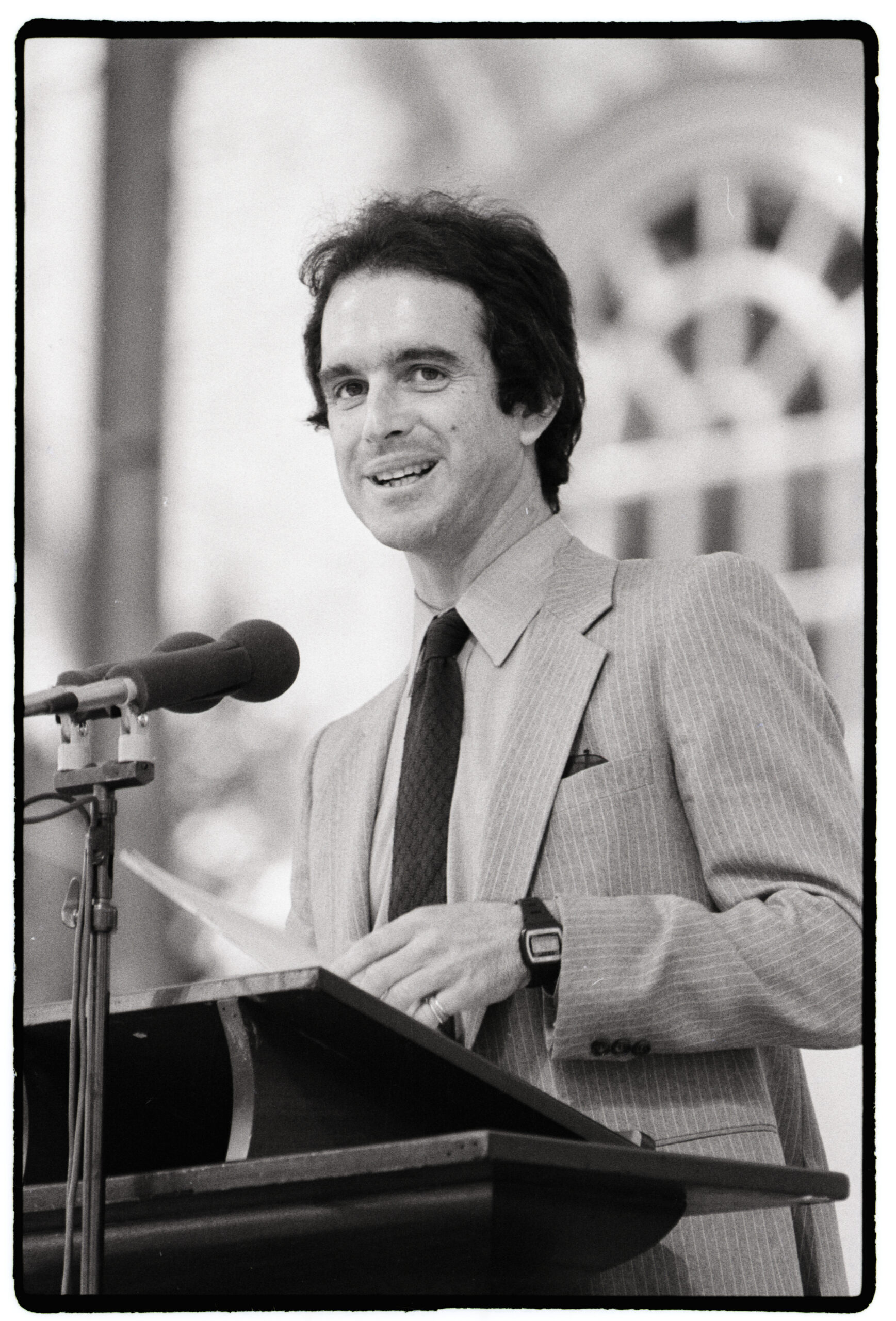
The Professional
A new biography makes an admirable but imperfect effort at capturing the life of the film director Richard Fleischer.

Richard Fleischer: Journeyman by Jason A. Ney. University Press of Kentucky, 410 pages.
If I were to tell you that my favorite film noir was The Narrow Margin (1952), my favorite crime thriller, 10 Rillington Place (1971), my favorite biblical epic, Barabbas (1961), my favorite modern horror movie, Amityville 3-D (1983), and my favorite sword-and-sandals extravaganza from any era, Conan the Destroyer (1984), you would probably think I was kidding or crazy. You might question my taste as a critic. If you were feeling the least bit charitable, you might accept the validity, or at least the plausibility, of some of these selections—The Narrow Margin, starring The Killing’s Marie Windsor as an imperiled dame aboard a fast-moving train, has acquired a reputation and was even fodder for a 1990 remake—but you would nevertheless find the combination of them to simply be too eccentric, too willful, to be taken seriously.
But it is precisely the combination of these films that gives them their meaning. This is not a random catalog of eccentric favorites but a survey of the career highlights of the director they have in common, the inimitable Richard Fleischer (1916–2006). To the doubters, of course, this is just one more reason to scoff at my judgment: To group these movies by their director would strike many as a fool’s errand, as pointless as trying to discern an authorial presence behind the latest helping of AI slop.
Yet few directors strove more gallantly to personalize their films than Fleischer, who lacked the advantages of writing his own scripts (e.g., Joseph L. Mankiewicz or Woody Allen), having access to good scripts from others, or being presented as a brand name to the public (e.g., Hitchcock, Otto Preminger, or even David Lynch). In other words, though Fleischer was no more distinctive than his betters, he was often no less, and what distinctiveness he managed was achieved against great odds.
What makes Fleischer’s work cohere is his career-long delight in taking any scene, in any movie, and ascertaining the best order in which to position the performers, the ideal spot to situate the camera, and the most striking time to move the camera. Hence the shot that observes and then follows Joan Collins and Ray Milland as they stride into a restaurant in the crime film The Girl in the Red Velvet Swing (1955) finds its echo in the shot of Arnold Schwarzenegger on horseback, approaching and then riding past the camera before pausing at the edge of a cliff in that Conan-derived silliness known as Red Sonja (1985). What Andrew Sarris once wrote of Delmer Daves can be applied to Fleischer: His films are “the property of those who can enjoy stylistic conviction in an intellectual vacuum.”
In his heroic but imperfect new biography of the director, film scholar Jason A. Ney clearly demonstrates admiration and affection for Fleischer. He is alert to some of the key aspects of the Fleischer style, including, as he rattles them off at one point, “complex tracking shots, lush CinemaScope imagery, and careful attention to period detail.” This is accurate, and Ney has done his homework, too, in sketching the interesting life and topsy-turvy career of his subject. The son of animator Max Fleischer—a pioneer whose work (Betty Boop, KoKo the Clown) was so fantastically peculiar that he was sidelined from the business—Richard Fleischer announced his arrival among the ranks of live-action directors in 1946 with Child of Divorce. In the decades that followed, he was granted opportunities by Walt Disney (20,000 Leagues Under the Sea), persevered through encounters with Howard Hughes (at RKO, where he made The Narrow Margin) and Orson Welles (star of Compulsion), and somehow tolerated Dino De Laurentiis on six films. (“I think I’m the only director that ever survived more than one.”) His last movie, made in 1987 for De Laurentiis, was a slapstick comedy that had something to do with Glad trash bags, Million Dollar Mystery. Perhaps we can understand why Ney, for all his advocacy on behalf of his subject, seems reluctant to join those of us happily ensconced in our intellectual vacuum.
Despite his measured enthusiasm, Ney often concedes too much to Fleischer’s critics, who are, regrettably, quoted often and at length. The New Yorker’s Pauline Kael, blind to Fleischer’s eloquent application of sheen to trash, called him “a glorified mechanic [who] pleases movie executives because he has no particular interests and no discernible style.” Ney, of course, disagrees, but one wishes he would disagree more intensely. Instead, he strains to identify common threads in Fleischer’s films—an unnecessary exercise given their obvious surface style. Ney proposes at one point that “malleability, driven by a capacious storytelling interest”—in other words, Fleischer’s ease across multiple genres—might, in and of itself, constitute the director’s “personal style.” This is thin gruel unlikely to have convinced Kael and certain to dishearten the director’s actual fans. Many directors hopscotch among genres; some do so anonymously, others do so with their vision as a constant. Fleischer was in the second group. (That Fleischer is quoted as expressing his preference for making many kinds of films versus “the same kind of films over and over under different titles” should be dismissed in much the same manner that we dismiss John Ford’s ludicrous insistence he was a mere fashioner of Westerns.)
Ney is clearly impressed by Fleischer’s professionalism—especially in evidence on several occasions when he was tasked with taking over a film already in production—but he lacks a flair for describing the fruits of that professionalism. Take the case of one of the films that Fleischer salvaged from another director: Tough Enough, a 1983 “drama” starring Dennis Quaid as a would-be singer who finds a new lease on life as a participant in “toughman” contests. The movie is not much: a kind of proto-MAGA epic, all the sadder for missing its ideal audience by 30-some years. And Fleischer is rightly applauded for how he handled himself. “He was really from another era, you know?” Quaid tells Ney. “When I look back at what he did, there was a certain discipline to him and a certain way of working that was from another place.”
Yet Fleischer was more than just a relic from the Golden Age with a good attitude; he showed up and he directed this thing. Consider a shot in this otherwise hopeless movie that has stayed with me ever since I first saw it twenty years ago: The camera shows us Quaid’s wife at home lolling in bed as she thumbs through a magazine; she is positioned slightly on the right of the frame. Behind her, in the distance, we see Quaid arrive home from a performance before an unreceptive barroom audience, entering through their front door and ending up on the left side of the frame. The two are separated by a wall of open shelving. The symmetry of the staging—Quaid on the left, his wife, who props herself up to talk, on the right—is pure elegance; the strategic placement of the shelving is a subtle way to express a certain distance between them. When Quaid walks closer, past the shelving and towards the foot of the bed, the camera, still positioned behind his wife, repositions to keep him in the shot. She clambers across the bed to pick the condiments—ketchup, mustard, and pickles with which he had been pelted at the bar—from his shirt. Such craftsmanly care should be identified and celebrated.
But, to my disappointment, Ney does not seem to share my enthusiasm for the ineffable qualities of Tough Enough, the making of which is dispatched in just a few pages. That much can be forgiven: Even the book’s 400-pluss pages cannot encapsulate the maniacal productivity of Fleischer, who, in the random five-year period between 1969 and 1974, made 10 films, including a Godfather ripoff, 1973’s The Don Is Dead, about which its costar, Frederic Forrest, says, “It was like doing a remake of Gone with the Wind as a sharecropper story starring Alec Baldwin and Shirley Temple.” Beggars can’t be choosers, and it is a miracle that any biography exists of a figure as seemingly marginal as Fleischer, who struggled to place his own excellent memoir with major publishers. But do we really need to read such putdowns in this, the definitive work on Fleischer?
To be sure, Ney deserves credit for interviewing numerous actors who worked with the man, though they sometimes don’t have much substance to offer. “He was professional,” says Leigh Taylor-Young. “He was definitely not a warm fuzzy.” Good to know. Lee Purcell comes closer to having an actual insight when she says Fleischer was “always open to ideas that I brought him”—“Unless,” she adds, “it would ruin the blocking or pull focus in a bad way from somebody else.” There we have it: the key to Fleischer, buried on page 242 and enunciated by the female costar of 1974’s Mr. Majestyk: for Fleischer, it was indeed all about the “blocking,” the beauty and order of the shot.
Unfortunately, Ney—impressed though he is with how Fleischer navigated a career that was both inside and estranged from the studio system—writes as though he has blinders on when it comes to the beauty and order in his late films. About Amityville 3-D, we are told that Fleischer’s “use of long takes”—that film’s major redeeming quality, as it was on John Carpenter’s au courant Halloween (1978)—is said to be “decelerating into stasis.” Later, we are told, that “nothing about Red Sonja works”—not even the photography by Fellini’s cameraman, Giuseppe Rotunno? We do, however, learn all about a medical scare on the Hungarian set of The Prince and the Pauper (1977).
Subscribe Today
Get daily emails in your inbox
Like many film biographies, the book is overstuffed with anecdotes. It is a strange book in the sense that it means to make a case for Fleischer, and often does, but consistently understates that case. At one point, Fleischer is implicitly praised for not being an auteur in the manner of John Huston, whom he replaced on The Last Run (1971)—which would be an insult were it true, but it’s not even true: Fleischer had far better defined visual preferences than the often clunky, changeable Huston. Yet Fleischer is characterized here as “a great compromiser, the kind of director with just enough style to give the picture some artistic flair.” This is faint praise and cannot be reconciled with the forcefulness with which Fleischer applied his technique to such down-market projects as the Neil Diamond remake of The Jazz Singer (1980)—on which Fleischer replicated the shooting style of a scene he had loved from William Wyler’s 1946 masterpiece The Best Years of Our Lives. This is not the handiwork of a great compromiser, even if the man had a mild temperament; this is an artist putting across a style without any commercial or critical inducement to do so.
Sadly, the tone for the book is set in the foreword by Turner Classic Movies host Eddie Muller. (Full disclosure: In 2023, I wrote a piece for Muller’s excellent Noir City magazine, and some years earlier, interviewed the engaging, well-informed Muller about The Narrow Margin for a newspaper column.) Muller dismisses the auteur theory by stating that Andrew Sarris’s “commendable commitment to ‘artistry’ in American cinema is, frankly, touchingly naïve”—but on what theory, other than the auteur theory, can a figure like Fleischer possibly be resuscitated? In defending Fleischer, Muller falls back on the same “professionalism” argument favored by Ney: “He always figured out a way to tell the story in the most compelling fashion, striving for elegant and efficient solutions that would bring a production home on time and within budget.” But there is something depressing about being told, as Muller does twice in his foreword, that the subject under consideration never made a movie as good as Citizen Kane. (“He never even came close,” Muller says.) Why, then, should we read on? And what about those of us who think he did come close? Shouldn’t this be the book for us?
There are many ways to judge when a culture has lost its confidence, and writing a book about the man who made Red Sonja but then feeling sheepish about that same man’s work turns out to be one of them.