A Drama in a Grand Hotel
A Left Bank hotel’s front-row seat to the twentieth century
Hotel Exile: Paris in the Shadow of War
by Jane Rogoyska. W. W. Norton and Company, 2026
344 Pages. $31.99
The Hôtel Lutetia is the only “Grand Hotel” on the Left Bank of the Seine in Paris, the world's most celebrated artistic and bohemian district. From its opening in 1910, Hôtel Lutetia was the haunt of famed writers such as James Joyce and visited by endless people from throughout the city and the world for the luxury it provided at prices available to the bourgeoisie. After the Nazis took power and France began to fill with German refugees, many of them Jewish, the hotel hosted a committee for the exiled German opposition. Then it became the headquarters of German military intelligence during the occupation. Finally, it became a center for returning “deportees” after Germany's defeat. In Hotel Exile: Paris in the Shadow of War, author Jane Rogoyska treats the hotel as the stage of a grand human drama. Though the people featured do not always have more than a tangential connection to the hotel, the author does many things well, particularly in showing how the brutal course of the 20th century impacted individuals who had little power over human events. The text is interesting and entertaining throughout, and, in the end, heartbreaking.
From the start, Rogoyska emphasizes the discretion of a hotel staff and its status as neutral territory, despite the fact that it was invaded and occupied. The early part of the narrative has little to do with the Hôtel Lutetia itself, and is instead about a variety of Germans choosing to flee the country of their birth. Some of them were famous at the time, such as Heinrich Mann; others would become famous much later, such as Walter Benjamin; others still were significant in their lifetimes but have fallen into obscurity.
Much ink has been spilled about why resistance to Nazism by liberal Germans was so ineffective, and the author does not attempt to answer this question, though she notes that a “Popular Front” alliance between the socialists and communists such as was later formed in France would have at least stopped the Nazis from taking power when they did. This text has a great deal of subtlety, but these people’s universal obliviousness to the fact that the Weimar Republic wasn’t working for the general public of Germany stands out. While historical comparisons to 1930s Germany are tired, one can’t help but see a similarity between our own class of academics, artists, and liberal bureaucrats having a golden age for their own economic and cultural status while showing no concern whatsoever for the man whose factory job was sold to China (not even insofar as how his disaffection may ultimately impact themselves).
France was the most popular destination for early refugees from Germany. But France was deeply politically unstable at the time, and following an initially warm reception, French governments kept changing, and refugee policies with them. For those well-established or with international income, the early period of exile was sometimes little more than an uncharacteristically bleak vacation. Others who were unable to obtain work permits went from comfortable bourgeois lives in Berlin to plodding the streets of Paris looking for handouts while seeking a few more days of reprieve from deportation in an endless Kafkaesque cycle. Commonly, these individuals had their citizenship rescinded by the Nazis and became officially stateless. At the refugee committee which held meetings at the Hôtel Lutetia, the gap between the French well-wishers and the actual lives of the refugees was vast, most of them long since unable to afford to go to such a place. Once the “Phony War” started—the 9 months of a state of war before the Nazi invasion—many were classified as “enemy aliens” and sent to French concentration camps, which, though grim, were nothing compared to what they would go through when handed over to the Germans by the collaborationist Vichy regime.
Following the German invasion, the hotel staff were put in the awkward position of being consummate professionals at the high level of the mid-century French service industry with Germans occupying their hotel. In perhaps the book’s most profound line, Rogoyska notes, “There is no book of rules by which staff in requisitioned hotels in an occupied country, the government of which has just signed an armistice, might be guided in their behaviour towards their new ‘guests.’” While they maintained professionalism, the hotel’s chef caviste hid the most valuable wines behind a false wall he constructed in the vast cellars below the building, and took some pleasure in knowing the German occupiers were not cultured enough to tell the difference between a fine wine and an excellent wine. Unlike many humans featured in this story, the wine did survive the war unharmed.
The hotel’s occupiers were not, strictly speaking, Nazis. It was instead German military intelligence, the Abwehr, who requisitioned this particular hotel. The Abwehr was the last remaining independent power center within the German state, and presumably chose the Lutetia because it was away from all of the other “grand hotels” requisitioned by the Nazis, which were on the Right Bank. The Abwehr was composed of professional soldiers, who, while rarely Nazi Party members, still worked towards the goals of the German state over which Hitler otherwise had total power. They did great harm to the French Resistance with their counter-intelligence operations. Even if part of the war machine, it is interesting to compare the Abwehr’s overall impotency against Hitler to the German liberals who similarly had no idea how to resist the rise of National Socialism. In some ways, the Abwehr was both better and worse; it was from within that body which arose the nearly-successful plot to kill Hitler in 1944. Still, overall, they were quite respectful guests given the circumstances, and it seems serving them was more of a nagging sense of frustration for the employees than a traumatic experience, though in one instance a German soldier who didn't know how to eat an artichoke accused the kitchen of sabotaging his food.
By the time the Allied invasion chased the Germans out of France, 165,000 people had been deported to concentration camps, including 90,000 “political deportees” (commonly resistance members) and 75,000 Jews. There were an additional 1 million French prisoners of war from Pétain's capitulation, and 650,000 French being used as forced labor conscripts. After liberation, the Hôtel Lutetia was opened up as a reception center for the return of the deportees who had been sent to concentration camps, typically “disappeared” with no notice as to their status, known as les absents. The city planned a grand reception for their return, but were shocked to see the image of Holocaust survivors as we have come to recognize them—so malnourished their skin was nearly transparent, in threadbare striped pajamas, barely able to understand the world around them. For months, Frenchmen, and some others who had nowhere to go, continued to be found across the former Third Reich and transported to Paris.
Subscribe Today
Get daily emails in your inbox
It is at the Hôtel Lutetia where many were reacclimated to human society, carefully fed, and dressed in clothes gathered by volunteers. In theory, they were to be given a 48-hour stay as a sort of reward for surviving, but many had to stay much longer. Some needed extensive medical or psychological treatment. For many of France’s Jews, who only had a 3 percent survival rate after deportation, there was no one to reunite them with. The orphaned children were severely behind on development and many were ultimately sent to centers in Palestine. What’s more, the returned had to be treated with the chemical DDT, stripped and cleaned, and interrogated to make sure they were not war criminals trying to escape punishment—in short, mirroring their treatment by the Nazis from whom they had just been freed. This section of the book is particularly well done, though challenging to read, as one learns the fates of those the reader was introduced to years earlier in their lives. Throughout it all, the staff at the Lutetia, suddenly with a drastically different “clientele,” were consummate professionals, as the typically invisible servant class has been throughout most of history’s great events.
Hotel Exile is not perfect. It is overly diffuse and often broken up into small sections that give a halting aspect to the narrative, particularly given the broad array of people it covers. Still, it provides a unique look at a landmark world event and the lives of those forced to live through it while giving a clear picture of Paris before, during, and after the German occupation. While consistently interesting, in the end perhaps its greatest lesson is that in the most difficult circumstances it is rarely obvious what you should do. Sometimes it really is the best to just get up in the morning and go to work, even when the clients are foreign liberals, occupying enemy troops, or Holocaust victims.
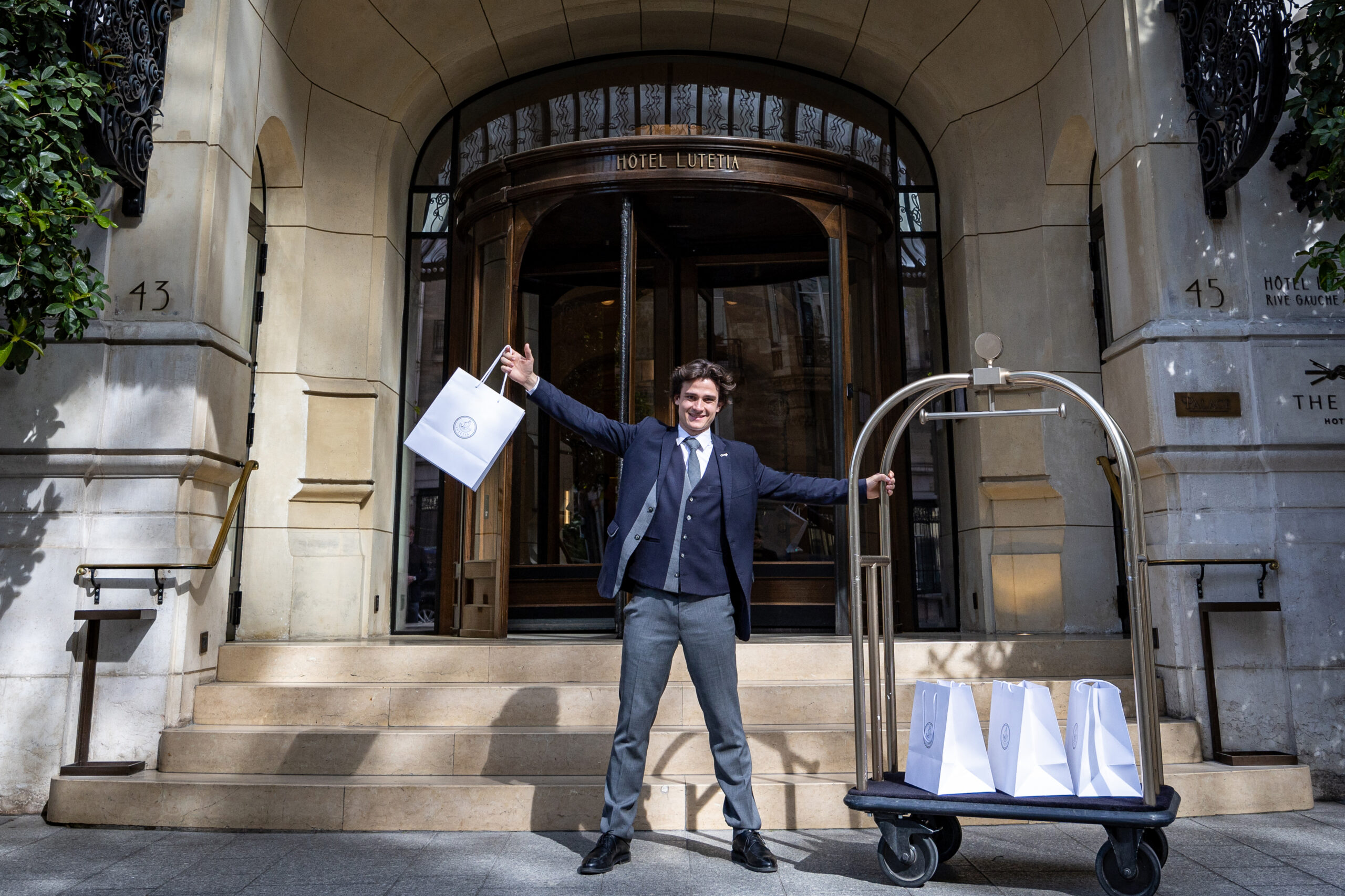
As to the Hôtel Lutetia itself, after more than 100 years of uninterrupted service it was purchased by a real estate consortium in 2014 and closed for renovation. The historic furniture was sold off, and it was reopened in 2018 as a luxury hotel for the global elite, costing over $1,500 a night if booked three months in advance. In a sort of grand irony, which Rogoyska for some reason chose not to mention, the new owners are Israeli. Human affairs are always in motion, and the Hôtel Lutetia remains a stage.