Spark of Divinity
A new biography of Muriel Spark sheds new light on the novelist’s troubled early life.
Electric Spark: The Enigma of Dame Muriel, by Frances Wilson, Farrar, Straus and Giroux, 408 pages.
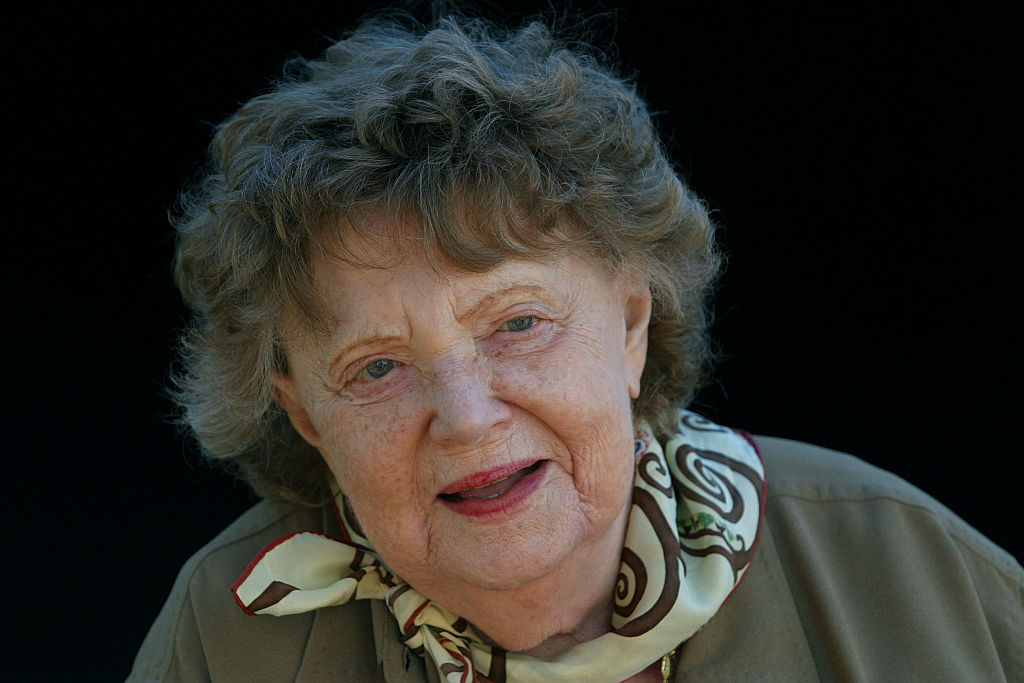
Twentieth-century letters are rife with examples of major writers who, upon making a later-in-life confession of faith, experienced a later-in-life artistic flowering. Undoubtedly, T. S. Eliot and C. S. Lewis had other matters on their minds when they converted to Christianity, but the inarguable enhancement of their work—the ability to produce Four Quartets and the Chronicles of Narnia corpus, respectively—was an undeniable, not-at-all-unhappy side effect. This pattern of improved literary output upon conversion can be especially discerned in the cohort of converts to Catholicism among leading writers and poets of the last century, including Graham Greene, Robert Lowell, Walker Percy, Evelyn Waugh, and Muriel Spark, the last of whom is the subject of a fine, piercingly perceptive new biography.
“Does the supernatural feel real to you?” an interviewer asked Spark in a 1996 BBC documentary about her life and work, The Elusive Spark. Here, she spoke plainly about the firmament against which her faith was set. “Yes,” she said. “I don’t believe in psychic experiences for myself. I’ve never had one. It doesn’t work like that. But the supernatural has to be real, because the natural world—life itself—is not explicable in terms that exclude the supernatural. To me.”
Later, she cheekily explained her decision to forego the Anglican Church, into which she was baptized as an adult, for Catholicism a short time later: “I found it hadn’t been going long enough, as far as I was concerned—300 years old,” she said of the Church of England. “I thought, ‘May as well have the real thing,’ which was . . . the Catholic religion.”
The temptation to associate a writer’s spiritual state with their artistic excellence is particularly potent in the case of Spark, who, prior to her conversion to Catholicism and her near-concurrent breakthrough as a writer of serious fiction, was something of a wreck. Happily, or not, it is Spark’s prehistory that occupies Frances Wilson’s Electric Spark: The Enigma of Dame Muriel: “The Muriel Spark who interests me is not the grande dame of her last forty years but the young divorcee whose arrival in post-war London sent feathers flying and started all the hares. I return to the years of turbulence when everything was piled on.”
Barney and Cissy Camberg welcomed their daughter Muriel into the world in 1918 in Edinburgh. Her father, an engineer, was Jewish, while her mother borrowed freely from various religious traditions. “She put seven candles in the window on the Sabbath, went to synagogue on Yom Kippur (in order, Muriel said, to show off her hat collection), celebrated Passover, kept an image of Christ in her locket, a Buddha on a lotus leaf in the living room, served hot cross buns at Easter, mince pies at Christmas and pork all year round,” Wilson writes. The extent of this eclectically ecumenical background on Spark’s spiritual formation remains unclear, but what is undeniable is the salutary influence of her early schooling on her later career.
Spark attended James Gillespie’s High School for Girls, where, from ages 11 and 13, orbited one particularly vivid teacher, Miss Christina Kay. “Miss Kay’s philosophy was beauty and truth, both of which she found everywhere, including in etymology, mathematics and grammar; reproductions of paintings by Leonardo, Botticelli and Giotto were taped to the walls,” Wilson writes. If some of this sounds familiar, perhaps it is because the school and the teacher provided the raw material for Spark’s best-known novel, 1961’s The Prime of Miss Jean Brodie. But Spark was not merely storing nuts for the winter; her talent, especially in poetry, was evident even as a youth. “There is as little self or sentiment in her juvenilia as in her adult writing,” Wilson writes, adding, “As a schoolgirl, Muriel was revered by staff and pupils alike.”
Like Ray Bradbury and John Cheever, Spark was a major 20th-century writer who found she could function in the absence of a college degree. “Edinburgh University was out of the question because Barney could not afford it, and Spark would always be conscious of not having a degree,” Wilson writes. All the same, between Miss Kay and her own efforts at self-education, Spark seems to have emerged the better for having bypassed college. “The female undergraduates in the city looked, she thought, as though they had never heard of Gary Cooper or Marlene Dietrich,” Wilson writes. “They could write a dissertation on John Donne, but ‘so could I.’”
Yet this book is a lesson in how often promising starts can, for a time, go unfulfilled. Equipped with smarts (and a knowledge of shorthand), Spark obtained her first paying employment as the assistant to a department-store proprietor in London. Then Muriel married a teacher called Sydney Oswald Spark, whose surname she retained for life but whose hand in marriage she did not. The union was embarked upon hopefully—“as the creature of Miss Kay, Muriel believed in grand romantic gestures”—but strains soon presented themselves. “She had no indication until she was married that Ossie had attacks of violent paranoia and had been seeing a psychiatrist, or that he was going to Southern Rhodesia (where his brother had recently settled) because his erratic behavior—such as firing starting pistols in the classroom—had made it impossible to hold down teaching jobs anywhere else,” Wilson writes in an incredible sentence.
From there, this book reads like a litany of miseries. After the union to Ossie unsurprisingly faltered, Spark, by then the mother to a little boy named Robin, conspired to pull up stakes from Southern Rhodesia. By 1944, she had wended her way to London, in time joined by Robin (with whom she would maintain a cool, sometimes adversarial relationship). In 1947, after managing to get a position as the general secretary of the Poetry Society, Spark was given a three-month trial stint as editor of its house organ, the Poetry Review. “Mrs. Spark, ‘diminutive, charming’ and ‘tarted up to the nines,’ had not been given ideas about her station by a university education,” Wilson writes. “This was all for the good; a no one from nowhere is what the Poetry Society was looking for, who would keep out the modernists and have few ideas of her own.”
Of course, Spark had an abundance of ideas, and when she began exercising her editorship, faced sharp resistance. “What the appointment committee failed to foresee,” Wilson writes, “is that she would bring to her role the full force of the self-worth which had not since her schooldays been allowed expression.” That Spark prevailed in elevating the standards of the Poetry Review before being given the heave-ho is indicative of the course of this chapter in her life.
One has the sense of Spark spinning her wheels. She attained some modest professional accomplishment by coauthoring a series of nonfiction works with Derek Stanford, a significantly less talented collaborator. Undoubtedly there is value to Emily Bronte: Her Life and Work (1953), co-written with Stanford, and The Bronte Letters (1954), co-edited with Stanford, but does anyone really believe these were worthy outlets for the future author of The Girls of Slender Means (1963)? Even Wilson acknowledges that “it seems baffling, given the severity of her editorial standards at the Poetry Review . . . that Muriel yoked herself as a writer to Derek Stanford.” It is not as though they were highly remunerative assignments, either. Her penurious condition during these years was not her only problem. Heavy usage of Dexedrine had left her persuaded that T. S. Eliot had embedded arcane messages, decipherable by her, in his play The Cocktail Party.
Subscribe Today
Get daily emails in your inbox
In 1949, as if willing herself to acquire the spiritual gravitas necessary to become a great writer rather than merely an effective poetry editor or functional biographer, Spark asked Stanford, “Have you ever wanted to become a Catholic? I would, if I could find faith. I shall set out on a pilgrimage, I think.” Initially associating herself with Anglicanism, she was baptized in 1952, embarked on a period of instruction in the Catholic Church in January 1954, received into the church that May, and received Holy Communion for the first time later that month.
Amid this flurry of ecclesiastical activity, Spark encountered the works of Cardinal John Henry Newman, whose letters she co-edited with Stanford. “It was I who introduced her to his writing in whose steps she had followed,” Stanford claimed. To the extent that she was aware that her new faith would enrich her work, Spark appears to have converted with a degree of calculation. “She liked the saints, angels, miracles and mysteries, and the fact that for Catholics ‘anything can happen to anyone,’” Wilson writes. “She also liked the paradox, metaphor, sixth dimension and rearrangement of time and space, which is also what she liked in a poem and so recreated in her fiction.” Her short story, “The Seraph and the Zambesi,” was a prize-winner in 1951, and her novel The Comforters, sufficiently laced with Catholic themes to elicit praise from Evelyn Waugh, emerged in 1957.
This book terminates before it can meaningfully attend to Spark’s years of fortune and glory, but Wilson has made her point by focusing on her lean and hungry years and the inflection point that her conversion represented. “Once she had the security of God,” Wilson writes, “Muriel stopped caring about style, and once she stopped caring about style, she found her style in a stylized carelessness.” That Spark wrested control of her life and career after so many reversals offers greater proof for the existence of a divine order than many other arguments. Spark died on Maundy Thursday 2006, Wilson notes: “Wrapped in a shroud, she was buried on Easter Saturday in the cemetery of the local church, Sant’Andrea Apostolo in Oliveto, beneath a stone slab bearing the legend ‘MURIEL SPARK / POETA.’” Waugh is said to have regarded her as a saint “because her prayers always worked.” Indeed.