Put Out More Flags
The American flag is as alive as the country it represents.
American Icon: The US Flag in Art
National Gallery of Art, June 6–December 6
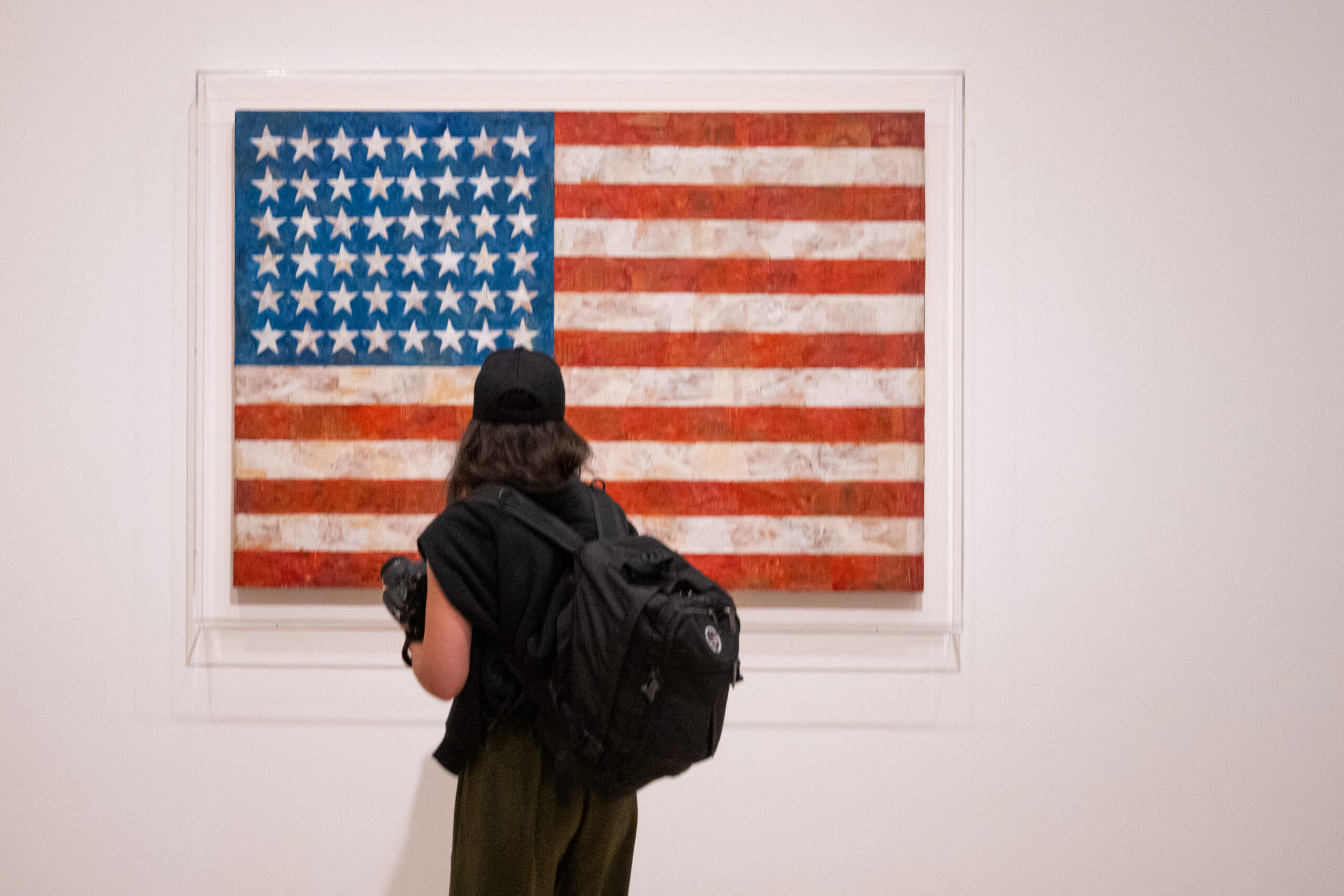
In 1954, Jasper Johns had a dream of himself painting an American flag. When he woke up, the artist executed his first work on the theme, in encaustic. More flags soon followed. Johns worked experimentally, often using outré materials and positioning the flag in strange configurations. But the basic form always remained the same: a rectangular field emblazoned with stars and stripes. It became an obsession. The flag’s design was so staid, reliable. He could really give himself over to it. And, in so doing, Johns felt that “it was something I could do that would be mine.”
Johns discovered something that many before him had realized: The American flag is a living symbol, and, like it or not, it lives inside every American. The artist took great comfort in that fact. “Using the design of the American flag took care of a great deal for me because I didn’t have to design it,” he said. After all, everyone already knows what it looks like, what to expect from it. When he painted a flag, Johns, like the French academic painters of the 19th century, worked within set conventions. But just as with the best of those painters, it was the conventions themselves which “gave me room to work on other levels.”
It is difficult to say exactly what those other levels are. In his authoritative study of Johns, the author Michael Crichton writes that the painter is intentionally opaque—and smart enough to realize that he ultimately has no control over how his work is interpreted. When Johns first started painting his flags, Pop Art did not yet exist (Johns never affiliated himself with the movement), and many people did not know what to think. Was his flag some kind of political statement? Was it kitsch, or commentary on kitsch? Was he in earnest? “Such a painting was surely art—or was it?” Crichton writes. The artist offered no answers; the work, he said, spoke for itself. “That became a problem for the viewer, alone,” Crichton writes. “Johns is gone; he has already made the painting, he has already presented the problem. The viewer is left to resolve it as best he can.”
The National Gallery of Art has two Johns flags on display in “American Icon,” its exhibition on the flag in art, which runs through the end of the year. Both are minor works, and rather dour, at least in comparison to Johns’s best-known flags. Flags II (1967–1970) is a lithograph in green, orange, and gray: strange colors for Old Glory. And Flag (1969) is a monochrome lead relief. Both present Johns’s problem of meaning. And both raise questions for their viewers about what the American flag stands for 250 years after the founding. The American flag, Johns said, is an object so familiar that it is “seen but not looked at.” When you examine it closely, what is it really?
The showrunners at the National Gallery have a pat answer to the question. The flag is a “living thing,” they concede, citing the U.S. Flag Code. But judging from the selections in “American Icon,” its life is narrowly directed toward highly didactic ends. “Over the centuries individuals and social groups have used the flag to reflect their own values and desires,” the exhibition notes say. “They have flown it to signify freedom, brandished it in battle, wielded it in protests, and paraded it to celebrate victories.” All true, but to limit one’s understanding of the flag to political action is to underrate its meaning. It is far more mysterious.
Part of the problem is that many of the artworks in the National Gallery are overtly patriotic, even jingoistic. The most famous of these is probably Allies Day, May 1917 (1917) by Childe Hassam. It is an impressionistic work, depicting the American, French, and British flags flying from the buildings on Fifth Avenue up by Central Park. It is a bright, joyful, and quietly bloodthirsty painting. When I was a child and visited the gallery with my parents, I misread “Allies Day” as “Armistice Day.” It was not until I was an adult that I realized Hassam was not celebrating the cessation of fighting, but rather delighting in American engagement in it.
Allies Day is part of a series of more than 30 flag paintings Hassam produced in conjunction with the First World War. The other famous one is The Avenue in the Rain (1917), which hangs in the White House. It is a shame that the National Gallery was not able to secure its loan for the exhibition. Unlike Allies Day, it is a sober painting. It also depicts flags hung from the buildings on Fifth Avenue, but unlike its sunny companion, the scene is rainy, and the buildings obscure, leaving the flags the only discernible object shimmering in the gloom. Although the painting was intended to spur Americans to join the European conflict, it is often interpreted as brooding and introspective, a commentary on American overreach. The Avenue in the Rain also happens to be a favorite of Democratic presidents: Bill Clinton, Barack Obama, and Joe Biden all hung it in the Oval Office during their tenures.
So much for the uncritically patriotic. Most of the wall space in “American Icons” is given up to the canonical critiques of the United States in the second half of the 20th century. The exhibition features a photo by Dorothea Lange, shot in 1942, of a crowd of school children pledging allegiance to the flag, among them Japanese-American school children just before they are carted off to internment camps. Elsewhere, we are presented with an undistinguished etching by Christopher Brown (Flag from the set Five Studies from an Endless Film, 1994). It is done after a still in the Zapruder film, just before John F. Kennedy’s assassination. Other flag-heavy protests make their appearance, too: the Poor People’s Campaign march on Washington, D.C. in 1968, the Hard Hat Riot in New York in 1970, the World Trade Center in the aftermath of September 11, 2001. Many of these photos appear to have been chosen not for their intrinsic interest but because they feature American flags at important political moments.
The finale of the exhibition is Mitch Epstein’s Flag 2000 (2000). This work is a large-scale photograph of a folded flag in a dry cleaner’s bag, set against a sickly Pepto-Bismol pink background. It is part of a series depicting the closure of Epstein’s family furniture store and real estate business in Holyoke, Massachusetts. From its beginning in 1911 to its closure in 2000, the store grew from a small business to the largest furniture store in Western New England, until it dwindled to nothing because of deindustrialization. The exhibition notes present the image, which calls to mind a flag draped over the casket of a fallen soldier, as a “remnant of the family’s American dream.” The sentiment is a fitting final word for an exhibition that seems to regard the country in the past tense and its flag as a melancholy symbol of doomed resistance.
Subscribe Today
Get daily emails in your inbox
As with many exhibitions tagged to the America 250 celebration, “American Icon” is a letdown. Simply put, the show lacks imagination. Since the United States adopted the flag in 1777, it has gone through 27 iterations. In some ways it is a curious relic of the country’s very brief neoclassical period, but in others, it is totally novel. It is not just the subject of paintings and photographs, but also features prominently in films, music, theater, performance art. Virtually every aspect of American life has been marked by the flag, and every generation refashions it in its own image. We wear it on our sweatshirts, swimwear, beach towels. We slap it on our beer labels, paint it on our cars, tattoo it on our skin. We salute it, sing songs about it, fly it in our churches. It is a remarkably flexible symbol; it can mean anything because it is everything.
For my part, I prefer the mystery of Johns to any other interpretation. When I look at his paintings, I see the accumulated weight of history. We like to say that America is young, but in Johns, you see a country coming of age. The artist sometimes works in encaustic, piling the wax high like rough mountain ridges. Other times he composes his flags with found materials: newsprint, stencils, and the like. On their own, these things are just junk. But when molded into the shape of the America flag, they form a sort of history without words. One of my favorite quotations about America comes from Sir Thomas Browne, who considered the New World a “great antiquity” that “lay buried for thousands of years.” The heavy, difficult flags of Jasper Johns remind us that, as Browne wrote, “Time hath endlesse rarities, and shows of all varieties; which reveals old things in heaven, makes new discoveries in earth, and even earth it self a discovery.”
The flag is one of these endless rarities. After the disappointment of the National Gallery, it is worth paying a visit to the Smithsonian’s National Museum of American History. There, under glass, is the Star-Spangled Banner, the original found piece of flag art. It is massive, torn, and impossible to turn away from. The whole of America is contained within its ragged edges. Who could have known that when the British gunboats bombarded Fort McHenry all night in 1814, they were creating a masterpiece that has outlasted every empire but its own?