The Noxious U.S.-Saudi Relationship Has to End
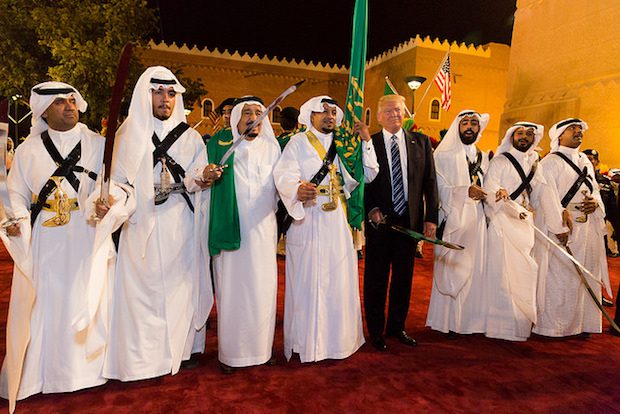
Bruce Riedel offers some ideas for how to change the U.S.-Saudi relationship in the next administration:
The place to start is optics. No more embarrassing and silly embraces. Treat him as he is: the murderer of thousands of innocents. The most despotic prince in the country’s modern history who imprisons everyone from his predecessor as crown prince to the women who demanded the right to drive. Don’t give the crown prince and his entourage visas to visit America.
Then change the arms relationship. No more weapons, munitions, spare parts, upgrades or technical assistance until the war in Yemen stops. The Saudis will have to abide; contrary to Trump you cannot run an American-supplied military with Russian or Chinese support [bold mine-DL]. If the British join in, the Saudi war machine, which is already not very impressive, will be in grave dysfunction. Congress has already taken some steps on arms and the impact in the kingdom is palpable. The royal family does not want to break with America however much they complain about us.
Riedel’s recommendations are very good ones, and it is unfortunate that they are going to have to wait almost two years before there could be anyone in the White House willing to follow them. The horrifying thing about Yemen’s humanitarian crisis is that the governments responsible for creating it, including ours, have it within our power to stop it at any time, but for more than four years all of these governments have chosen instead to destroy and starve an entire country for years on end. Congress already has majorities in both houses in favor of ending our government’s involvement in this atrocious war, but as long as Trump remains in office the Saudis and Emiratis know that they can get away with anything.
I would add a couple other suggestions for what the next administration should do when handling relations with the Saudis. The first one may seem superficial, but it is very important: stop referring to them as an ally. Call them a partner if you must, but stop pretending that the U.S. owes them any allegiance or support. The relationship is at most a purely transactional one that has been rapidly losing its value, and our political leaders shouldn’t talk about a despotic authoritarian client state as if it were a respected and trusted ally when it is nothing of the kind. Another suggestion would be that the U.S. should provide no cooperation to the kingdom’s nuclear program. If a government can’t be trusted to use advanced weapons responsibly, the U.S. shouldn’t be helping them to acquire nuclear technology. Finally, in light of the repeated violations of their end-use agreements with the U.S., the U.S. should sell no more weapons to the kingdom until our government can be certain that they won’t hand those weapons off to militias in Yemen or anywhere else.
The Saudi government bet heavily on Trump, and they should expect to pay an equally steep price for their many crimes when he is no longer in office to protect them. The war on Yemen needs to end, and for that to happen the U.S.-Saudi relationship as it currently exists has to end. The next president should commit to doing both of these. As Uri Friedman and Yara Bayoumy report, there is a good chance that could happen under a different administration:
“The Saudis used to have really strong bipartisan support in Washington,” Senator Chris Murphy of Connecticut, a Democrat and longtime critic of Riyadh, told us. Now “they are clinging to this alliance simply through the force of the regime’s relationship with one person: Donald Trump.”
“Maybe we have a hard time forcing a reset while Trump is in office,” added Murphy, who has sponsored numerous bills to rein in the security relationship with the Saudis. “But a reset’s coming.”
For the sake of the people of Yemen, it can’t come soon enough.