Could Lindsey Graham’s War Cost His Sister a Senate Seat?
The late senator’s legacy threatens Darline Graham’s political future.

“Lindsey liked war,” said President Donald Trump on the day of Sen. Lindsey Graham’s (R-SC) funeral in July. “He’s never seen a war he did not like.”
Now Graham’s sister might find out that voters even in ruby-red South Carolina like the Iran War a great deal less than her brother did.
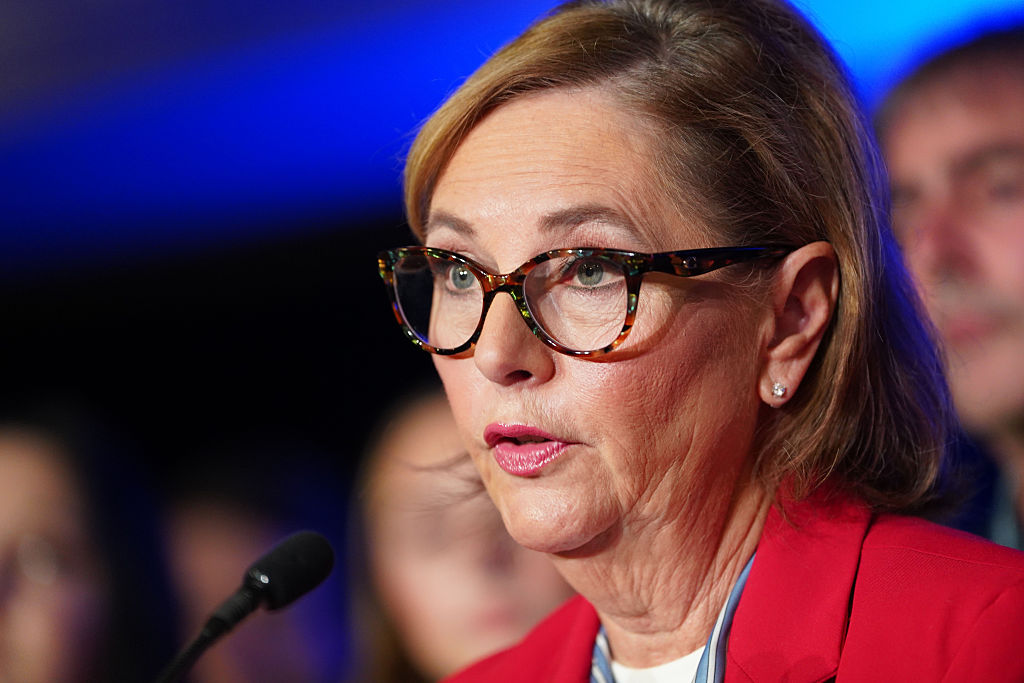
Appointed three days after her brother’s death to finish out his term, Sen. Darline Graham (R-SC) faces an actual election in South Carolina, where Republican senators have been safe for at least 20 years.
Not this year. A late September poll by the right-leaning Trafalgar group showed a neck-and-neck race between Graham and her Democratic challenger, the pediatrician Annie Andrews, with the Republican leading by only 1 point. Another survey from Insider Advantage, taken in the same period, also revealed a 1 percent difference favoring Graham. A Rasmussen poll released Friday showed Graham at 49 percent and Andrews at 45. Six percent of respondents were not sure.
By contrast, Lindsey Graham defeated his 2020 Democratic opponent by 10 points.
A number of red states this election year are seeing unusual surges by Democratic candidates due to voters’ concerns about rising gasoline prices and general inflation, and South Carolina is no exception. Andrews has not only centered her messaging around high costs but tied them to the Iran war. And the Democrat repeatedly emphasizes that Darline Graham voted three times for that war to continue.
In their only debate, televised on Sunday night, Andrews highlighted the war again while the Republican senator hewed to the standard neocon posturing worthy of a Graham.
“My opponent… had the opportunity to vote to end the war,” Andrews charged. “But three times in a row, she voted to continue it.”
“Why in the world would we stop now when they’re still dangerous?” Graham said. “And we are close to ending the war. Again, I think the president wants to end the war. I know he does. We all want the war to end.”
This is the closest Graham came to sympathizing with South Carolina voters who have tired of the war and the resulting price spikes. It felt like some recognition that the situation was dire on this front, for the state and for her campaign.
Still, the hawkish hits kept coming.
“But I support a strong military,” Graham added. “I believe in peace through strength.”
“I fully believe that we need to stand with Israel,” Graham added, predictably. “The same people that want to hurt and attack Israel want to come after us.”
“The terrorists that were close to getting a nuclear weapon will come here,” she said, repeating the common neocon refrain. “So, we need to stand with our strongest ally.”
She even tried to blame the war on Democrats.
“Let’s not forget again how the war started,” Graham continued. “The Democrats let Iran get a nuclear weapon almost.”
The 2003 Iraq War, including the fight-them-over-there-so-you-won’t-have-to-fight-them-here rhetoric, was popular at one time in “Bush Country,” as South Carolina has been called.
Today’s Iran War? Not so much. Andrews has capitalized on antiwar sentiments as she tries to yank a Senate seat from the Republicans.
“This reckless war in Iran has helped drive fuel prices to record highs,” Andrews said at a campaign stop. “Darline Graham has voted multiple times to continue this war that is directly responsible for the six-dollar diesel.”
“We need to lower the damn diesel,” she said.
When Lindsey Graham was still Andrews’s target—and when she had far less chance of becoming Senator than she does today—her rhetoric was even sharper on the war. “Lindsey Graham wants to send your sons and daughters to war,” Andrews said in March. “Your sons and daughters are the reason I am in this fight.”
Her focus now is on the impact of the war on voters’ pocketbooks. Judging by the polls, that new rhetorical strategy is working.
As a South Carolinian, I would still put my money on Graham winning. But the closeness of this race would have been unthinkable absent the political context created by Trump’s war. Moreover, many South Carolinians are uncomfortable with how the sister of the late Senator was awarded a high office by bloodright. Adding to the difficulty for Darline, a sizable number of South Carolina conservatives had supported Lindsey’s closest primary challenger, Rep. Ralph Norman (R-SC), who ran as an “America First” war skeptic. Many who had pinched their noses and voted for Lindsey may not do the same for Darline. Some Norman supporters have even pushed for a write-in campaign.
The Iran War itself probably won’t sway the election, but the higher prices very well could, and voters do know the former led to the latter. Voters watch the news. They budget. They pump gas.
They also see Republican leaders treating them as if they were stupid.
“Everybody’s frustrated about fuel prices, obviously, but that’s not related to policies, that’s not related to Republicans in office,” House Speaker Mike Johnson (R-LA) recently said in an interview, adding “this is related to the Strait of Hormuz.”
Well, what else could be related to the Strait of Hormuz? Perhaps the Iran War—a signature policy of “Republicans in office,” especially the one in the White House.
Antiwar Republican Rep. Thomas Massie (R-KY) recently shared that clip of Johnson and asked, “Who wants to tell him?”
Subscribe Today
Get daily emails in your inbox
Exactly. No one needs to tell South Carolina’s voters that the war is helping cause their financial pain.
Trump is right: Lindsey Graham loved war. His greatest legacy is arguably the U.S. war with Iran.
It meant a lot to him. It could also cost his sister his Senate seat.