Citizen Clinton
The former president’s new memoir is dripping in nostalgia—and melancholy.
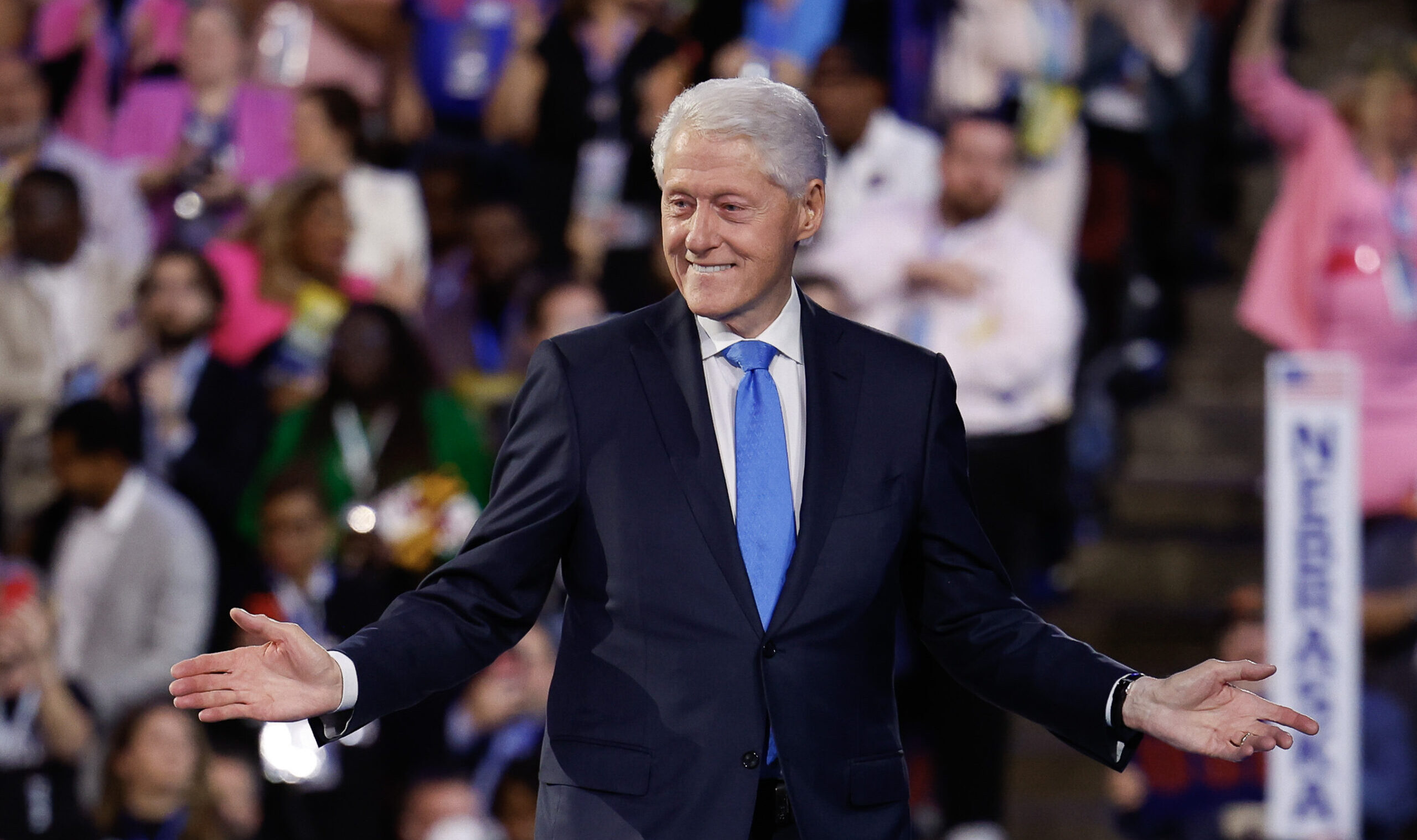
Citizen: My Life After the White House by Bill Clinton. Knopf, pp. 464.
When President Bill Clinton stepped off Air Force One into the steamy Manila air on the night of November 23, 1996, he was exhausted. Only three weeks before, he had prevailed in the general election over Senator Bob Dole, but since then he had enjoyed no rest. He had been hoping for some sleep on the plane, but it was not to be. Instead, his advisors drilled him the whole flight on questions of trade, human rights, copyright law, Taiwan, Hong Kong—all issues he was expected to address with the Chinese President Jiang Zemin the following day at an economic summit attended by the leaders of eighteen Asian nations.
China was a difficult subject for Clinton. He desperately wanted to admit the emerging power to the World Trade Organization before he left office—what a coup that would be!—but he was honest enough to recognize that it wasn’t possible, at least not until he convinced the regime to clean up its act. Meanwhile, the president had more pressing problems. Midway through the flight he had tried on his outfit for the summit, a formal barong tagalog, and discovered that traditional Filipino menswear was most unflattering to his Arkansan frame. The arms billowed about and the body stuck to his stomach. It made him look fat.
The president’s Secret Service detail at the airport was jittery. Police had discovered a bomb there several days before and another one at the conference center in Subic Bay. And the State Department had been tipped off to several credible threats against the president from Islamic insurgents in the country. An affiliate of the terrorist group Al Qaeda was rumored to be behind the bombs. Nothing was certain yet, not every loose end had been tied up. Clinton was aware of the situation, but he had faith in his team to sort it out. After all, this was the Philippines, practically American territory.
On the ride to the Manila Hotel, Clinton dozed. His wife Hillary, seated next to him, thought to herself that it would take an anesthesiologist to get her husband a good night’s sleep: He was always going, going. As the motorcade crossed a bridge outside the city, she looked out the window. It never failed to surprise her how much the Third World reminded her of Chicago. Maybe it was the train tracks which seemed to have been laid in a great hurry, or the industrial zones that directly abutted the highways, or those sudden spurts of electricity that sometimes lept from the overworked transformers atop the telephone poles, like an urban Saint Elmo’s Fire—in fact, like there—up there—A fireball! An explosion! Another bomb!
Hillary screamed. The car swerved and skidded and rolled. Her husband started awake, thrown from his seat. But it was too late. The bridge was burning, and through the smoke the Clintons could just nearly make out a red Mitsubishi SUV speeding toward the wreckage. Four men hopped out armed with AK-47 assault rifles. They were masked and chanting some phrase—was it Arabic?—and they sprayed bullets indiscriminately at the twisted motorcade. Bill was bleeding, badly. Hillary crawled over to him and, for the first time in many years, prayed.
Back in Washington, the news traveled quickly. In his home office at the Naval Observatory, the president-apparent, Albert A. Gore, received a sober briefing on the tragedy. When his staff finished, he noted that the last time this sort of thing occurred was thirty-three years prior, almost to the day. Then he was quickly sworn in over his wife’s family copy of the 1928 Book of Common Prayer. Later that night, he placed a call to his old professor, Martin Peretz, publisher of The New Republic, seeking advice about how to best guide the country into the new millennium.
The scene above may sound like a cut-rate pastiche of one of the thrillers Bill Clinton co-authored with James Patterson, but isn’t far off from what nearly happened on the road to Manila in November 1996. There was a bomb. It was placed by Al Qaeda. And the Secret Service only caught it once Clinton was already on the ground and loading into his motorcade. How different the world would be had they not—and how differently we would think of the 42nd president. Clinton won both his terms to office with less than 50 percent of the vote, and throughout his presidency he was a polarizing figure. But had he been gunned down at the end of his first term, he would have been considered an American hero. No Monica Lewinsky, no impeachment, no Camp David Summit—fortune would withhold all those future embarrassments from the president. Even the landmark legislation of his first term would fade into the background of personal myth. The public, with its hazy memory, would canonize Clinton as a late-century Kennedy, and, in time, he would come to personify the unrealized hopes of the unipolar moment.
But fortune is a tricky thing. These days Clinton is considered less unrealized hope and more wasted promise. He is painfully aware of his position and anxious to revise it. This he attempts to do in his second memoir, Citizen: My Life After the White House. The book, which was released in November, just after Donald Trump recaptured the White House, is filled with the usual Clintononia: pages of apologia for the 1994 Crime Bill, a defense of the North American Free Trade Agreement, and a celebration the military adventurism that marked so much of the United States’ foreign policy after the Cold War. But the whole affair is clouded with melancholy. Clinton knows that everything he stood for during his presidency is on the outs—even philandering is no longer en vogue—and not even he can will the ’90s and the New Democrats back into existence. The best he can do is cast himself in the role of unfairly neglected elder statesman.
The role is an awkward fit for the ex-president. Clinton recalls how his adjustment from political to private life was something of a comedown. His post-presidential role models are John Quincy Adams, Theodore Roosevelt, and William Howard Taft, but he admits that congressman, diplomat, and Supreme Court justice are not jobs suited to his skillset. Instead, he found that he was remarkably good at making speeches and rallying billionaires to sign checks for his foundations. He quickly lost himself in the role. One day in 2002, he was looking at himself in the mirror shortly after Hillary had won her first Senate election in New York. “My God,” he exclaimed. “I’ve become an NGO! Now what?”
The answer, which he has been working on for nearly 25 years now, is not a satisfying one. Clinton has a personal mission statement—“to maximize the benefits and minimize the burdens of our new century in the United States and across the world”—that seems straightforward. But, as Clinton once said of the word “is,” the definitions of many of these terms are “flexible” depending on context, and, frankly, the former president’s bottom line. This means often playing fast and loose with definitions of what’s really good for people.
In a minor example of this tendency, Clinton recalls how in 2010 he brokered a deal between Arkansas and Coca-Cola, Pepsi, and Cadbury Schweppes to get sugary drinks out of schools. The solution was simple. All the companies agreed to swap their sodas for diet drinks, flavored waters, and fruit juices. “The companies were still making a profit, and their younger customers were much better off,” writes Clinton in triumph. But anyone who thinks about it for more than a few seconds can see that, like many Clinton solutions, this one glides over the underlying issue: The soda companies are still selling addictive drinks to children, and, per the president’s odd euphemism, still thinking of children only in terms of consumption.
A more significant example of Clinton’s flexibility is his discussion of the tortuous relationship of wealth to philanthropy. There is a longstanding complaint, from both the left and the right, that rich people only “go in for philanthropy,” as Oscar Wilde had it, to shield their wealth from taxation and public scrutiny. And, besides, these detractors claim, no wealthy philanthropist would ever propose a solution that might actually improve the standing of the poor and needy because, in so doing, he would necessarily reduce that of the rich and powerful. Clinton admits that these theories are basically right, and while obviously he would like to see a more equitable world, he does not believe it is possible. For now, he writes, he would prefer a world run by the benevolent rich to any idealistic alternative.
“I’m convinced that in the messy real world,” he writes, “we’d be worse off without people like Bill Gates, Melinda French Gates, MacKenzie Scott, Susie Buffett, and Laurene Powell Jobs trying to save lives, empower poor people with better healthcare and education, strengthen global and national health systems, and incentivize governments in developing countries to build their capacity and eliminate corruption.”
Subscribe Today
Get daily emails in your inbox
This is of course exactly the attitude among Democratic leaders that got Trump elected in 2016 (though, it should be noted, not in 2024). And, even though Clinton has had eight years now to think over why his wife lost the White House, he still hasn’t figured it out. And not for lack of theories. Maybe it was people who don’t live in big cities: Throughout Citizen, he refers to those who live in “rural areas” with the same blanket contempt that turned many of those very people against Hillary Clinton in the first place. Or maybe it was the so-called Bernie Bros, whom he designates the “dark underbelly” of his party. Or Jill Stein, whom he implies is a Russian agent. On and on Clinton goes, with new hypotheses and grievances, before at last settling on the novel theory that the media, James Comey, and Vladimir Putin deserve most of the credit for Trump’s victory.
“This whole thing is hard for me to write.” Clinton admits. “I couldn’t sleep for two years after the election. I was so angry, I wasn’t fit to be around.”
Clinton concludes his memoir the way many old men do when their lives have become a litany of regret. He recalls how, as a young man studying at Georgetown, he was inspired by Tennyson’s “Ulysses.” At the time, the poem’s famous final line—“To strive, to seek, to find, and not to yield”—filled him with all the thrill and hope and promise of youth. It still sends a shiver down his spine, even to this day. And no wonder. Clinton is more like Ulysses than he knows—a wily and cunning leader, denied a glorious death on the fields of Ilium, only to grow old, longing, longing for a second a sailing, another shot at the impossible glories of youth.