America Eats the World (Cup)

It’s been more than 30 years since the United States hosted its first World Cup. The 1994 tournament, played in cities from New York City to Los Angeles, was seen as an opportunity to introduce the sport to audiences that, for more than a century, had prioritized baseball, football, and basketball ahead of the world’s game. It was an auspicious moment for a nation that has complicated relationships with outside influences and foreign cultures. For the Fédération Internationale de Football Association (FIFA), the decision to award the United States hosting rights was met with skepticism as some warned it could result in economic calamity. Others simply argued that Americans neither needed nor deserved the opportunity to stage a competition their country had never fully embraced.
When it was all said and done, America’s first World Cup proved a pivotal moment in soccer history, not only because of its economic success but also on- and off-field storylines that underscored both the beauty and volatility of the people’s game. Economically, USA ’94 still stands as the World Cup’s attendance benchmark. Nearly 3.6 million fans filled retrofitted American football stadiums across 52 matches, averaging just under 69,000 people per game. For FIFA, the World Cup was a boon, generating roughly $235 million in revenue. Those that doubted the U.S. could carry a soccer tournament of such economic scale had been sufficiently proven wrong. And as it turned out, America, and its people, were ready to embrace the world’s game.
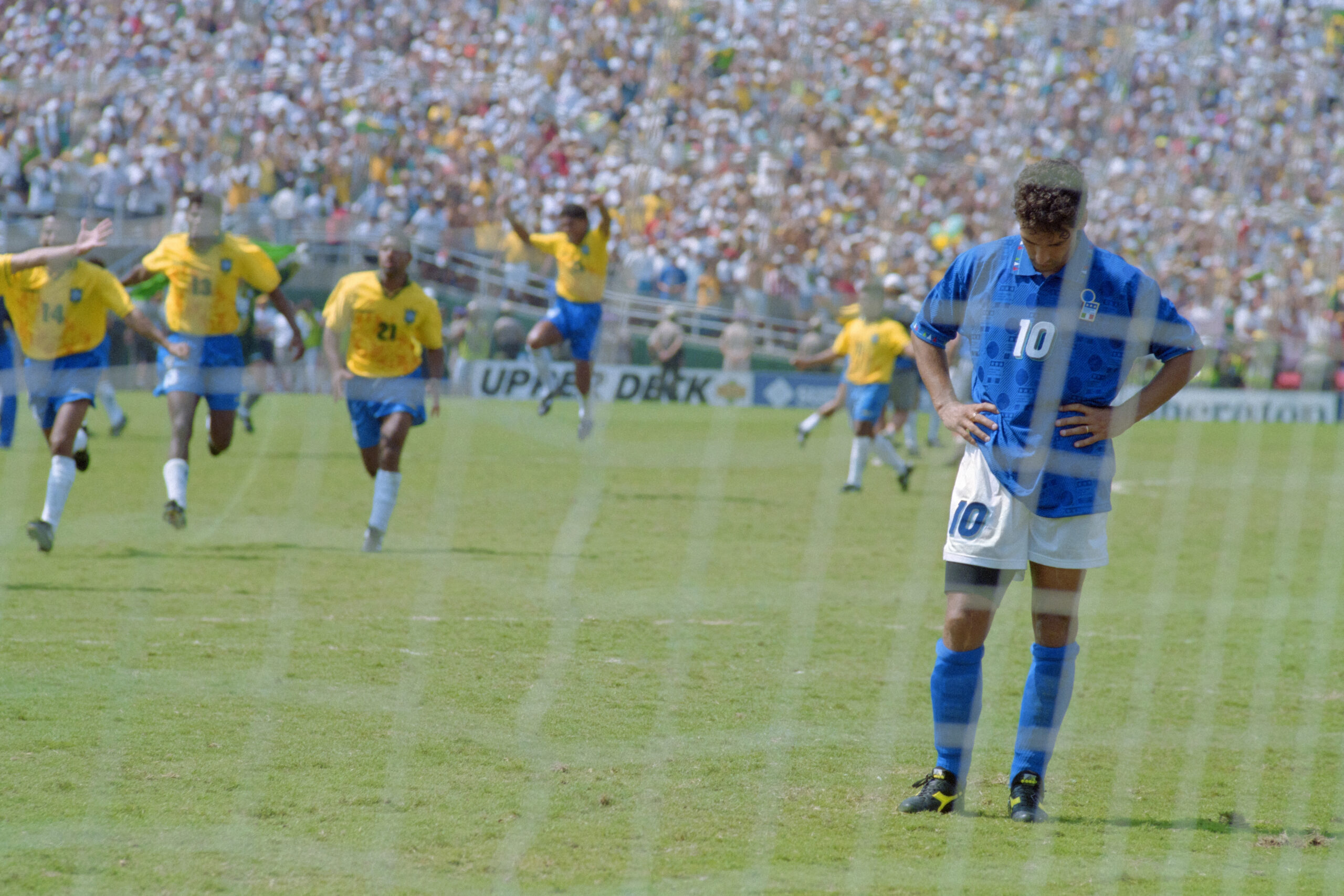
Numbers tell only part of the story. On the field, the tournament ended in one of soccer’s most iconic moments of individual heartbreak, as Italy’s Roberto Baggio skied his penalty over the crossbar in the final shootout, handing Brazil its fourth World Cup title. In the evening glow of the Rose Bowl, Baggio stood motionless. For all his brilliance across the month-long tournament, Baggio’s legacy was forever reduced to one frozen image, and he is still, to this day, referred to as “The Man Who Died Standing.” If Baggio’s miss captured the cruelty of the sport, the 1994 tournament also produced a moment off the field whose consequences reached far beyond the pitch, one that would leave a permanent mark on the history of soccer.
The Colombian defender Andrés Escobar had been home in Medellín for less than a week when he was gunned down in a parking lot outside a club during the middle of the night as the tournament was still being played. Heading into the 1994 World Cup, Escobar was seen as one of the premier players on a team that was widely regarded as among the most talented squads ever assembled in Colombian history. But as is often the story with Colombia’s national soccer team, reality rarely lives up to the dreams of its fans. Colombia crashed out in the group stages after losing against the U.S. and its roster of upstart players, many of whom were struggling to find work with European clubs who viewed their skills as inferior. Escobar played a major role in Colombia’s ouster after he inadvertently scored an own goal while lunging to defend a cross from American midfielder John Harkes. Escobar was shot six times and his attackers reportedly shouted "¡Gol!" ("Goal!") after every shot, a reference to the play-by-play call from the game.
And so it was that America’s first time hosting the World Cup was both an economic success and the occasion of two storylines forever ingrained in soccer fans’ memories. The games also acted as precursor to a boom in soccer appreciation and organization in the States. Major League Soccer was founded in the run-up to the World Cup and has proved a launching pad for young American talents ever since. Looking back, the 1994 World Cup acted as a springboard for a new generation of Americans who suddenly viewed the world’s game as very much their own.
The road that led back to America hosting the World Cup in 2026 was dark. In December 2010, FIFA's executive committee gathered in Zurich to vote on the hosting rights for the 2018 and 2022 World Cups. They awarded the tournaments to Russia and Qatar, two nations whose bids were later found to have been substantially aided by the sort of bribery, corruption, and backroom dealing that would make a Swiss banker blush. In the end, it was the United States Department of Justice, not FIFA's own governance structures, that cleaned up the mess. In 2015, American federal prosecutors indicted fourteen FIFA officials on charges of racketeering, fraud, and money-laundering in what became the most significant corruption prosecution in the history of global sports. America, a country that had been passed over for hosting rights in subsequent years, helped dismantle the system that had denied them. And so, when a cleaner FIFA eventually came looking for its next great host, America was the logical choice.
But things would change drastically. This time, FIFA decided not only to expand the size of its tournament but also the number of nations that would host its most important competition. Though the U.S. is the primary driver in 2026, both Canada and Mexico were also awarded hosting rights. As the World Cup grew from 32 teams to 48, so did the scope of its venues, which will stretch from Mexico City to Toronto. As host nations, Canada, Mexico, and the U.S. all automatically qualified. With the tournament’s expansion to 48 teams, nations such as Cape Verde, Uzbekistan, Jordan, Curaçao, and the Democratic Republic of Congo all earned bids that simply didn’t exist in previous competitions.
The inclusion of the DRC has come with concerns over the health of those traveling from the African nation. A recent outbreak of Ebola in the country is being monitored by both American officials and the World Health Organization, which has said a vaccine to treat the Bundibugyo species, a highly infectious and dangerous form of the virus, is still in development. Travel restrictions imposed by the U.S. Center for Disease Control have forced the nation’s soccer team, and its staff members, to enter the nation earlier than other teams. Though the entire playing squad is based outside the Congo, with many plying their trade at European clubs, the outbreak has cast its own shadow over the team, which will be making its first appearance at the World Cup since 1974.
But the health concerns attached to Congo’s inclusion pale in comparison to the travails of Iran’s national soccer team, which is set to compete in a World Cup hosted by the very nation that is currently waging war on its homeland. It was no surprise when Iran qualified for this year’s tournament. Led by the striker Mehdi Taremi, the Iranians are appearing in their seventh World Cup this summer, and their inclusion in the tournament marks the fourth straight qualification for the team. They are disciplined, they are strong, and Taremi’s skill on the ball will make them a dangerous matchup for New Zealand, Egypt, and Belgium, the three teams they are scheduled to face in group play.
“Scheduled to face” is the key phrase here as there are still concerns over whether the team will actually take part in this year’s competition. Each of Iran’s three matches are due to be played in the U.S. In March, only weeks after launching a joint attack with Israel against Iran, President Donald Trump suggested it would not be “appropriate” for Iran to participate in the event. He cited concerns for the “safety” of the players and team staff, but Trump was doing what he often does: manufacturing ambiguity and then leaving others to navigate it. Iranian officials responded defiantly, refusing to withdraw from the World Cup and arguing that only FIFA can make the final decision on whether Iran will participate or not. As of this writing, Iran's delegation is pursuing the diplomatic channels required to enter the country, having filed for Canadian visas in the Turkish capital of Ankara on May 21.
Iran's presence in the tournament has created an image problem with no clean solution for Trump or FIFA. The same president overseeing an active military campaign against Iran was, last December, awarded the inaugural FIFA Peace Prize by Gianni Infantino, the FIFA president. Infantino invented this award specifically for Trump, who has long coveted a Nobel Peace Prize that has eluded him. Infantino, who has cultivated a conspicuously close relationship with Trump since the latter’s 2024 reelection, has made little effort to disguise his admiration for the American president.
The Peace Prize is the most brazen expression of that affection: a trophy conjured from nothing that was awarded to a sitting president who has attacked or threatened one out of every 13 countries. FIFA's stated values and its actual behavior have never looked further apart. Whether Infantino was buying goodwill, securing favorable conditions for a tournament hosted on American soil, or simply feeding a powerful man’s ego, the effect is all the same.
And yet, none of these health or geopolitical concerns are as startling as the economic realities of a World Cup hosted by a nation that views the tournament as merely another economic opportunity instead of a celebration of the world’s game. Though soccer is mostly a suburban, upper-middle-class sport in America, across the globe it is a sport for and of the poor. Many of soccer’s greatest players grew up in genuine poverty, playing the game because it only required a single ball and a dream. From Diego Maradona and Lionel Messi to Cristiano Ronaldo and Zinedine Zidane, the list of players who came from nothing to dominate the game is long. These stories stand in stark contrast to this year’s astronomically high ticket prices, which have created a barrier that effectively prices out the very sort of fans and future players the sport was built on.
When the U.S. hosted its first World Cup in 1994, the average ticket price for group stage matches was between $50–80. To attend the final match at the Rose Bowl was roughly $1,300 in today’s dollars. But today, World Cup tickets for group stage matches average $558 a person, and that’s after accounting for a 25 percent decrease in average ticket prices in the weeks leading up to the tournament kickoff. And average tickets for this year’s final at MetLife Stadium in New Jersey are expected to range in price between $10,000 to $75,000, making it economically impossible for many of this country and the world’s biggest fans to watch the game in person. Nearby hotels tell a similar story, with rooms in host cities sitting unreserved at rates that have confounded organizers who projected a tourism bonanza.
“It is too expensive,” said Tim Weah, a starting winger for the U.S. Men’s National team, in an interview with a French newspaper. “Football should still be enjoyed by everyone. It is the most popular sport. This World Cup will be good, but it will be more of a show. I am just a bit disappointed by the ticket prices. Lots of real fans will miss matches.”
Clint Dempsey, a former U.S. Men’s National Team player who is considered one of the greatest to ever don the Red, White, and Blue, went further. "You can’t price out the working class from games,” noted Dempsey, who grew up in a trailer park in Nacogdoches, Texas before grinding his way to the top of the English Premier League.
Subscribe Today
Get daily emails in your inbox
Only weeks before the tournament kicked off, Weah and his fellow U.S. starter Weston McKennie joined New York City Mayor Zohran Mamdani on stage to announce that the mayor’s team had worked with the New York–New Jersey host committee to secure 1,000 affordable tickets for New Yorkers to attend the World Cup. The tickets, secured at no cost to city taxpayers, are non-transferable and awarded through a lottery system. Winners will pay $50 per ticket instead of the exorbitant prices that have locked many working-class New Yorkers out of the experience. “We fought hard to make the people’s game available to the people, and won,” announced Mamdani in a video clip shared to social media.
But 1,000 lottery tickets in a tournament of millions is a drop in the ocean. This year’s World Cup, more than any that has preceded it, will be one for the wealthy to enjoy. In a tournament played on the 250th anniversary of the United States, the country’s oldest tension, between its democratic ideals and its appetite for wealth, has never been more visible on a global stage. If you believe that’s an overstatement, just listen to what Trump said when informed that the average fan who wants to attend the U.S. group stage match against Paraguay will pay an average of $1,000 per ticket: “I wouldn’t pay it either, to be honest with you."
The game is as beautiful as ever. And the players are still extraordinary. But somewhere between Zurich’s backrooms and a $10,000 ticket to watch the final from the crow’s nest, the people’s game stopped belonging to the people.