Alice Carter, Leftism’s Poster Girl
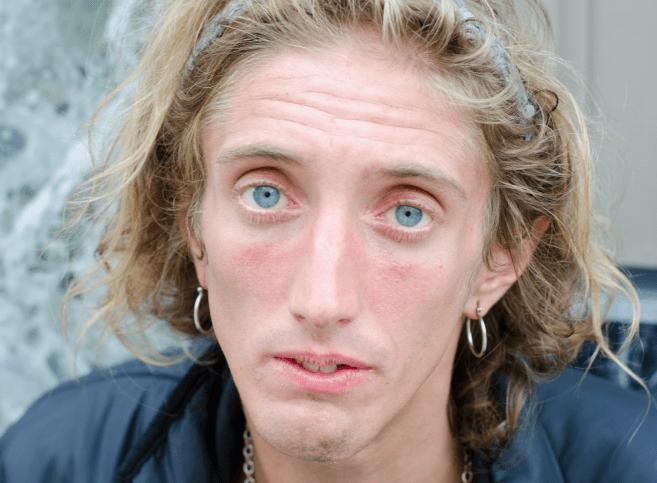

A reader writes:
I appreciated your post on moral order and civil conflict. I immediately thought of it when reading this story from the Washington Post, published the same day, which describes the life and death of a homeless addict who has long been a fixture of my own neighborhood here in Washington DC. What is fascinating is that the story describes in detail how literally hundreds of people tried in vain to help her sort out the mess her life had become before her death, and then immediately concludes that this is evidence that the system is at fault. Although the story recounts in detail how she pretty emphatically resisted all attempts to help her, this is discounted. At no point is the role of personal choice or responsibility ever mentioned, even in passing. Here is an excerpt:
“Alice Carter worked D.C.’s streets — and got worked over by them. She was a poet, addict, sex worker, parent, friend, assailant, schemer and source of inspiration to her faith community and those who loved her — when she wasn’t frustrating their exhaustive, exhausting efforts to make sure she was safe. Those efforts ultimately proved unsuccessful. On Dec. 17, Carter died of alcohol intoxication at Howard University Hospital after being found unresponsive at a Dupont Circle McDonald’s. Last month, the well-known fixture on D.C. streets became the face of a city auditor’s report that warned the District is doing too little to help those struggling with chronic addiction.”
While she definitely had mental health issues, these seem to have been exasperated first and foremost by the lack of any internal moral order. Yet her own agency in the tragic story of her life is discounted entirely, and, more worryingly, never seems to have been included as a part of attempts to help her restore order to her life. I think this is a great example of the disturbing societal shift that you describe in your post.
If you happen to write about this, please don’t use my name. This woman is now a neighborhood martyr, crushed by our oppressive system.
More from the Post story:
She was born in Maryland before her family moved to Ohio. Her parents divorced when her father was convicted of rape; they remarried after his release, then divorced again.
Carter, bullied because she was transgender, began using drugs as a teenager. She had a child with a girlfriend and survived a suicide attempt at 19 before joining a religious group that led her to Detroit and, eventually, to the D.C. area. She became a Whitman-Walker Clinic patient in 2006, when she tested positive for HIV.
Carter turned to sex work to survive, the report said, and the final decade of her life was a swirl of diagnoses, erratic behavior, hospitalizations, arrests for mostly minor crimes and failed interventions by an alphabet soup of District agencies. She was arrested in 2010, for example, after she jabbed a broken beer bottle at a man in Scott Circle, was sentenced to drug treatment, didn’t comply and ended up in jail.
On and on like that. Here is the city report about Carter’s terrible life. It’s written very sympathetically. It’s clear that this person was deeply troubled from childhood. It is an excruciating story. You really should read it, because the relatively short account in the Post doesn’t remotely do justice to the wreckage and violence of Carter’s life. Going through it, it was amazing to read about all the city services available to Carter. The system engaged Carter thoroughly. In the report, it is impossible (for me) to discern a line between “compassion” and “enabling.”
From the Post story, these grafs are so telling. First, this one:
Julie Turner, a social worker who tried to help Carter, said she met her in 2012 in Dupont Circle “passed out at a light post, half dressed with the remains of a needle in her arm.” Turner said Carter would periodically get sober, but the city’s outreach systems weren’t equipped to keep her alive.
“I want to believe that in a perfect world [with] long-term access to psychiatric treatment for psychiatric and substance abuse, Alice would have been able to transition in a healthy way,” she wrote in an email. “A week’s stay or a month in a hospital does not even put a dent in anti-social behaviors or the emotional turmoil and pain Alice felt.”
The social worker believes — or tellingly, wants to believe — that if only the system had been perfect, it could have saved Alice Carter.
But then look at this graf, about what people said at a liberal Methodist Church’s memorial service for Carter:
Deborah Smith, Carter’s mother, said her daughter struggled her entire life — with attention-deficit disorder, with substance abuse, with her gender identity. Ultimately, Smith said, “she did what she wanted to do, and you couldn’t do any different.”
She did what she wanted to do, and you couldn’t do any different. There it is. There is no system capable of saving an Alice Carter, who, in part for reasons beyond his control, was incapable of managing his freedom.
A sane society would have institutionalized Alice Carter ages ago, to protect Alice Carter from himself, and to protect the community from Alice Carter. Seriously, read the city’s report. You go from page to page, wondering how on earth someone like this, well known to authorities (both criminal justice and social work), could still be on the streets. And yet, there was Alice Carter, haunting downtown Washington DC, menacing himself and the public with violent outbursts (e.g., threatening people with a box cutter, throwing furniture in restaurants).
And yet, the reader who sent this story to me is afraid to let me identify him because “this woman is now a neighborhood martyr, crushed by our oppressive system.”
A society that will not defend itself from its Alice Carters, or defend its Alice Carters from themselves, is not a stable one. A society in which no one can speak the truth about this is doomed.
UPDATE: A sad, moving comment from reader RiverMerced:
Our third child, a son, now 38, is mentally ill. What exactly is the matter with him? Depends on who you ask. He’s had maybe six different diagnoses, and typically every professional who has examined him comes up with a new idea. (Bipolar? certainly he is on the autism spectrum.) He is living on the streets in Oakland. He has tried a lot of drugs (that I know of, doubtless there are more) but is down to marijuana, which is legal here. He doesn’t even drink any more. He’s been out on the streets since he was 18.
He’s a smart guy, was successful academically, but is not interested in further schooling. Too regimented. I got him into two different assisted-living situations, and he promptly behaved so outrageously that he got thrown out, which, I am convinced, was his intention. He cannot bear to be near other people in any living situation. For the most part he is not violent, and he stays away from homeless camps, where he would probably get into fights. He cannot live with us. We all acknowledge that after maybe three weeks he would make himself so obnoxious that we’d have to throw him out (yet again).
Psychiatrists and social workers have proved to be unsuccessful. At one time he was seeing a doctor who prescribed a variety of psychoactive drugs. Turns out there aren’t a lot of these – something on the order of ten – which are prescribed willy-nilly regardless of the diagnosis. None of them did any good, in his estimation (and mine).
Should he be locked up? It would have to be against his will. As it is, he can’t be locked up unless he breaks the law (he’s been briefly in jail several times and now knows how to avoid that), or is an immediate danger to himself or others, which he isn’t.
Should we blame “society” for all this? That would be pretty pointless. He could use more money (disability payments only go so far, and not far enough for rent in the SF Bay Area) but I’m not sure how he’d use it. In my dreams he’d find housing that didn’t drive him crazy, but I have seen zero evidence of that, nor can I imagine such a place. Should we blame him or me (Moms usually get blamed when something goes wrong) or both of us, his parents? Equally pointless. I’m convinced that everyone concerned, including my son, is doing the best they can with a difficult situation.
All societies struggle with this, so far as I can tell. Folks like my son fall victim to predators or other hazards in very primitive circumstances. (I don’t expect my son to live to old age.) Some societies make shamans out of them, which works – sometimes. Some societies lock them up in asylums, which certainly gets them off the streets but may do no more good, and probably do some harm. I’ve met some insane people in monasteries, which works for the well-behaved, though they do put the community under some stress. There’s only so much a religious community can take without compromising their primary mission. Anyway, not everyone is willing to join a monastery, and monasteries are not forced to take people they can’t handle. Victorian insane asylums (and some modern ones) turn into houses of horrors for the inmates, which works out to punishment for something that is not their fault.
Because there is a problem in life it does not follow automatically that there is a solution. At least not a solution available to human beings.
That my son and his very numerous cohort are making some cities (especially but not exclusively the ones with good weather) unlivable is a different but urgent problem. To which no one as yet has found a solution.