Kiev Shouldn’t Get U.S. Security Guarantees
Fighting Russia over Ukraine isn’t remotely in America’s interests.
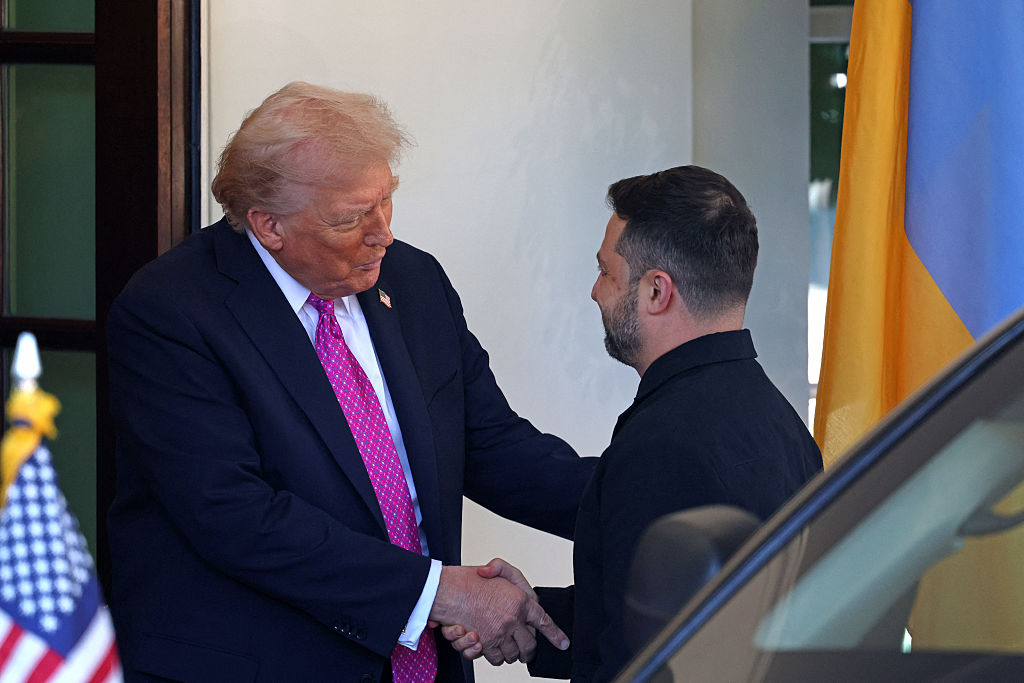

Despite the Trump administration’s claim to put the United States first, its Ukraine peace plans risk putting America last. For years, even before he became president, Donald Trump criticized the Europeans for free riding on the U.S. Today he has apparently proposed adding Ukraine as another defense dependent, with a possible trigger for war against nuclear-armed Russia.
The administration’s recent 28-point plan, criticized for leaning toward Russia, bars Kiev from joining NATO but offers “reliable security guarantees” instead. Although Trump officials did not detail the U.S. role, they promised “a decisive coordinated military response” in response to renewed Russian military action. The European response added a “U.S. guarantee that mirrors Article 5.”
French president Emmanuel Macron has been particularly insistent that Washington put American wealth and lives on the line, stating that “the absolute condition for good peace is a set of very robust security guarantees and not paper guarantees,” including from the U.S. The 19-point U.S.-Ukraine draft has not been published but likely moves toward the latter. Presumably these issues were discussed in Monday’s Moscow meeting between Russian president Vladimir Putin and U.S. emissaries Steve Witkoff and Jared Kushner, which revealed continuing disagreements on major issues.
For America, the details of a guarantee are the most important provision in any agreement. Not even Trump’s predecessors Barack Obama and Joe Biden, whom the president regularly accuses of weakness, were willing to make such a needless concession to the feckless Europeans.
That Kiev wants the American people to be ready to fight and die on its behalf is no surprise. Ukrainians have suffered greatly in a terrible war. Continuing combat is prodigiously consuming Ukrainian lives and wealth. However, alliances should be based on security, not charity. Although the conflict is a humanitarian tragedy, Ukraine’s future, and especially the details of any settlement, such as who controls the Donbas, are not vital U.S. concerns.
Of course, Kiev is not alone in its desire for support. Much of the known world—almost every European nation, most of the Middle Eastern royals, and the richest Asian states—remains on the U.S. defense dole. The wealthiest, most advanced foreign states continue to mimic suckling babies years, even decades, after the initial crises in which they first became reliant on Washington. America’s defense of Europe is at 80 years and counting.
Although the early U.S. republic aggressively overspread the North American continent, it was initially reluctant to risk its citizens’ lives and wealth in other nations’ wars. That barrier was breached by President Woodrow Wilson, more delusional megalomaniac than charismatic idealist, as he has been typically portrayed. World War I was an idiotic imperialist war in which the U.S. had no stake. However, Wilson was determined to remake the world. Which, unfortunately, he did, disastrously. His intervention wasted more than 117,000 American lives and resulted in another, even greater conflict. As Ferdinand Foch, the French general who served as supreme allied commander, described the botched Versailles Treaty ending the war: “This is not a peace. It is an armistice for twenty years.”
Successive U.S. administrations avoided the continent, soon wracked by communism, fascism, and Nazism. Even the Europeans were ultimately unwilling to defend Wilson’s and his allied compatriots’ handiwork, hence “appeasement.” World War II was the tragic but predictable outcome. The U.S. was dragged into the resulting imbroglio. After dispatching the horrific Third Reich, what remained of Europe faced the triumphant Soviet Union, headed by an even bloodier dictator.
So, Washington stayed that time. However, America’s continuing military presence, through the North Atlantic Treaty Organization—which would have been more accurately named the North American Treaty Organization—was intended to be only temporary, until Western Europe recovered economically. Dwight Eisenhower, no left-wing peacenik, said in 1951: “If, in ten years, all American troops stationed in Europe for national defense purposes have not been returned to the United States, then this whole project will have failed.” Seventy-four years later U.S. forces are still there and, if most Europeans have their way, will still be there in another 74 years, and probably beyond.
At least Washington then treated alliances as serious. They were extended to countries thought to be strategically important. There was Western Europe, which the U.S. had just fought to liberate, as well as South Korea and Japan, client states acquired in the aftermath of the same conflict. Security commitments also typically resulted from formal treaties, negotiated with other governments and ratified by the U.S. Senate. Multilateral agreements with less important participants, most notably the Baghdad Pact/CENTO, SEATO, and ANZUS, were looser and weaker.
In recent years, Washington has treated military commitments like hotel chocolates, to be placed on every guest’s pillow. In recent years NATO has inducted military midgets, such as Albania, Slovakia, Slovenia, Montenegro, and North Macedonia, with no strategic significance. Imagine trying to explain why an American soldier, airman, sailor, or Marine died for what amounts to little more than a celebrated movie set. Moreover, presidents have added informal guarantees without congressional approval—to the Mideast monarchies and even quasi-states, such as Rojava, the Kurdish region in Syria. Of late Trump has unilaterally declared America to be the guardian of absolute monarchy in the Middle East, turning the U.S. military into a modern Janissary Corps to serve thousands of dissolute kings, emirs, and princes in Qatar and Saudi Arabia. Can the rest of the Persian Gulf be far behind?
Yet one issue upon which presidents Barack Obama, Joe Biden, and, until now, Donald Trump agreed was not to make Ukraine a defense dependent. Although they proved unwilling to revoke President George W. Bush’s ill-considered promise to add Georgia and Ukraine to NATO, they also refused to induct either country. Successive administrations, warned by American intelligence officials and diplomats, recognized that would be a red line for Moscow. And neither the U.S. nor any other alliance members was willing to go to war for Ukraine.
However, over the last decade the allies effectively added NATO to Ukraine rather than Ukraine to NATO, which had a similarly negative impact on relations with Russia, encouraging Moscow’s invasion of Ukraine. Also important was the allied war on Serbia over Kosovo, which poisoned Russian public opinion toward the West. Although Putin’s wanton aggression was unjustified, allied officials bear significant blame for recklessly ignoring abundant warnings of what was to come.
Trump understands the problem of bringing Kiev into NATO. That would end any discussion of a peace settlement, given Moscow’s consistent refusal to accept such a result. In August the president insisted on Truth Social: “NO GOING INTO NATO BY UKRAINE.” Yet the administration appears to be pursuing the same course under another name. Presidential envoy Steve Witkoff argued “that the U.S. and other European nations could effectively offer Article 5-like language to cover a security guarantee.” He even believed, apparently incorrectly, that the Russians would find that acceptable.
Ukraine’s President Volodymyr Zelensky spoke with Trump, announcing that “we also discussed positive signals from the American side regarding participation in guaranteeing Ukraine’s security.” He wanted European leaders “involved at every stage to ensure reliable security guarantees together with America.” In fact, all most Europeans care about is Washington’s participation. A European Commission statement, from that body’s president, Ursula von der Leyen, and the heads of seven European governments, declared, “We are clear that Ukraine must have ironclad security guarantees to effectively defend its sovereignty and territorial integrity. We welcome President Trump’s statement that the U.S. is prepared to give security guarantees.”
Although Trump never specified what he meant, before meeting Putin he told reporters that “he was open to the ‘possibility’ of security guarantees for Ukraine, ‘along with other Europe and other countries’.” The Telegraph was more specific, reporting, “The U.S. has offered Ukraine NATO-style security guarantees in the event of a peace deal, though Kiev would not officially join the bloc. It would mean that the U.S. and Ukraine’s European allies would be obliged to respond to a future attack on Ukraine, in a pledge similar to the Article 5 mutual defense clause that underpins NATO.”
Nor has the president mentioned congressional approval of a new military commitment. The Founders believed that decisions over war and peace were too important to leave up to one man. So, too, is the issuance of a guarantee that would commit America to go to war. Surely there should be a debate over when to risk American lives, wealth, and—in a world with ever more nuclear weapons and ICBMs—the nation’s very survival.
Particularly problematic is the idea of a sort-of NATO provision. There is little reason to believe that European leaders are serious about keeping their military commitments. When asked to provide peacekeeping troops at war’s end, many European leaders began running from the room. Washington would likely find itself largely alone in any future war for Ukraine, when America’s allies suddenly discovered that they were “busy.” At least a formal alliance guarantee would theoretically oblige the Europeans to participate to a similar degree.
Subscribe Today
Get daily emails in your inbox
Still, the details of the particular promise don’t much matter. Ukraine is not worth war to America. It certainly is not worth war against a nuclear-armed power over what the latter views as existential interests. That’s why no president implemented the Bush administration’s pledge to include Kiev in NATO. And if Ukraine isn’t worth going to war today, it won’t be worth going to war tomorrow.
Indeed, the case for continuing America’s European defense dole expired with the Soviet Union’s collapse. Russia is a declining power, its weakness evident in its continuing slog against Ukraine. Moscow poses few threats against Europe let alone the U.S., which remains the most secure great power ever. Indeed, absent the ongoing war, Moscow would be more inclined to align with the West against China. Moreover, the Europeans are never likely to be serious about security so long as they can count on America. Sure, they recently promised to spend more on their militaries—ten years hence, conveniently after Trump has left office.
Ukraine is a continuing tragedy. However, while advocating for peace the president must keep the U.S. out of the conflict. That includes any renewed fighting in the future. It is Europe’s turn to take over its own security. Tragically, Woodrow Wilson demonstrated the danger of needlessly going abroad in search of monsters to destroy. When it comes to war, America should come first. Especially in a world in which nuclear-tipped missiles can bring war home.