
Defining Conservative Down
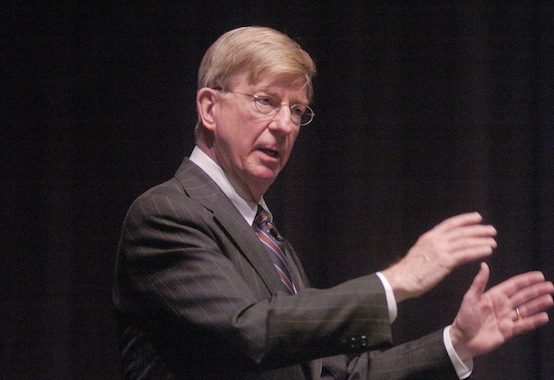
In what for me illustrates the use of confusing labels, George Will recently complained about attacks of “cognitive dissonance” in trying to understand our political terms. Although Americans identify overwhelmingly as “conservatives,” many of them vote differently from the way they describe themselves. They lean theoretically toward Thomas Jefferson, who advocated very limited government, but vote like Hamiltonians, that is, like disciples of Alexander Hamilton, our first secretary of the Treasury, who favored a strong federal state. Will quotes his favorite “conservative” senator, Daniel Patrick Moynihan, who noted a dramatic disconnect between how Americans think and how they vote. According to Moynihan, who usually gave his vote to the left despite his undeserved reputation as a man of the right, Americans are happy to violate their “conservative civil religion” as soon as they enter a voting booth.
Will’s observations about political labels are highly questionable. He stretches the term “conservative” so far that it means whatever he (and presumably the “conservative” press) wants it to mean. Judging by polls, the majority of Americans stand well to the left on social issues of where the American left and even the European far left used to be positioned. European Communist Parties well into the post-World War II era were strikingly traditional about gender roles, immigration, and gay rights — certainly in comparison to where most American voters currently stand. Our corporate income tax rates are the highest in developed world, and the percentage of our population that does not pay federal income tax seems to be higher than what one finds in most “progressive” European countries. And lest I forget, those who were ranting at the GOP convention about our duty to spread human rights globally did not sound even vaguely “conservative.” They seemed to be imitating the zealots of the French Revolution who sought to carry their “Rights of Man” at bayonet point to the entire human race. No one has ever explained to me how this radical revolutionary foreign policy is in any sense conservative.
It is equally ridiculous to treat American Democrats as “Hamiltonians.” In the late 18th century, favoring a strong nation state was not a leftist position. It was identified with mercantile power and in Hamilton’s case with distrust of mass democracy and the internationalism of the French Revolution. Not all advocates of state power should be equated with Obama partisans, any more than Jefferson and his partisans should be seen as “conservatives” in their time. In the late 18th century, the political struggle in the U.S. was between nationalists and regionalists, and it is impossible to make that struggle correspond to our present situation. Our polity is too multicultural to be compared to the early American nation state, which was relatively homogeneous culturally and religiously, and we live with a highly centralized welfare state that two national parties are trying to get hold of to accommodate their bases. It is therefore misleading to paste worn political labels onto a political present to which they have no significant relation. What we now see is a ritualized battle between two party blocs centered on the fruits of an expanding administrative state. And from what I can tell, most voters seem delighted with this arrangement and would be furious if we tried to change it.
Since the terms “conservative” and “liberal” are now mostly empty rhetorical phrases, it is not surprising that Obama voters are being classified as inconsistent “conservatives.” Why not call them Martians? The operative terms exist in order to differentiate mostly similar products. To me this overlap is far more obvious than those distinctions the media would like us to emphasize. According to Will, Americans consider themselves to be conservative rather than liberal by a ratio of two to one. But this matters about as much as the fact that some voters have black hair and others brown hair. The real difference is between those who seek to dismantle our centralized administrative state, with its apparatus of behavioral control, and those who support its continuation and inevitable growth. On one side we have the authorized but often indistinguishable “conservatives” and “liberals,” and on the other side, a small percentage of the adult population standing alone and voting for a third party that is not likely to get anywhere.
I’d be happy if we changed our current terminology to something as descriptively useful as “social democrats A” and “social democrats B.” And I make this suggestion not as a libertarian (which I am not) but as someone who favors accurate labeling. It would be nice never again to have to gaze at anything like Will’s remarks about his “cognitive dissonance” in noticing that some “conservatives” vote for the Dems. His labeling problem is certainly not mine.
Paul Gottfried is the author, most recently, of Leo Strauss and the Conservative Movement in America: A Critical Appraisal.


Comments