
What is the Cost of Living?
At The Nation, Chris Hayes notes that the State of Rhode Island has raised its minimum wage for the first time in years. It’s now $7.75, compared to $8.00 in neighboring Massachusetts, and $8.25 in Connecticut. According to Hayes, it’s not enough. Even though all these states require higher wages than the federal minimum of $7.25, “that doesn’t change the fact that there is no state where a person can afford a two-bedroom apartment working a forty-hour week on any state’s minimum wage.”
Hayes apparently believes that a minimum-wage job should allow workers to live alone with room to spare. At the risk of encouraging the stereotype of the hard-hearted conservative, I wonder whether that isn’t setting the mark rather high.
No one who works full time should have to worry about food and shelter. But is it reasonable to demand that the law guarantee single people an extra bedroom? Living with roommates is not exactly a Dickensian arrangement. And what about marriage?
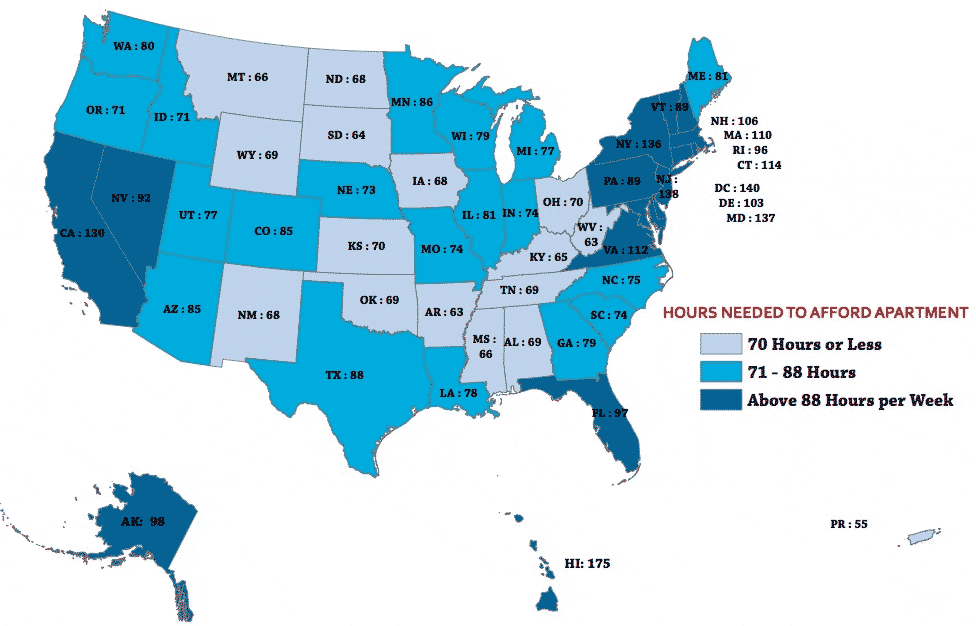
Moreover, as one commenter suggests, consider this map comparing the amount of work at the minimum wage necessary to rent a two-bedroom apartment with 30% of one’s gross income (the conventional standard for affordability). It’s extremely difficult to do so everywhere. But the cheapest places to live are not known for high levels of regulation, strong unions, or liberal social provisions. They’re mostly Western and Southern states with lots of land and few restrictions on construction.
This suggests that the most effective way to help workers in the expensive Northeast isn’t to raise the minimum wage by a few cents, or even a few bucks. Instead, it’s to make housing cheaper. Rhode Island and its neighbors can’t add more land. But they can eliminate building and zoning codes, among other regulations, that limit housing supply and drive the cost of living beyond the reach of too many of their residents.