We at 100
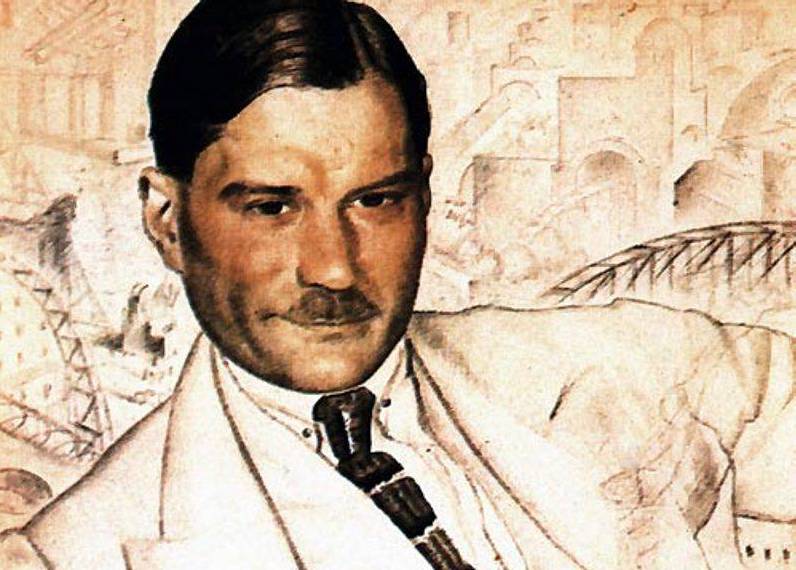
Yevgeny Zamyatin’s We is a hundred years old this year. The Russian novelist wrote the dystopian work during the Russian Civil War. Jacob Howland takes stock:
“Osip Mandelstam died in the Gulag in 1938; Isaac Babel was shot in the head in a Moscow prison in 1940. All three men were courageously defiant, but only Zamyatin’s boldness saved his life. Stalin approved his request for exile—a good word from Maxim Gorky, a champion of the official Soviet aesthetic of socialist realism, must have helped—and he spent his last years in unhappy obscurity and ill health in Paris, where he died in 1937 at the age of fifty-three.
“Mikhail Bulgakov remarked that ‘manuscripts don’t burn.’ At least, incandescent ones don’t. We was smuggled out of the ussr and first published in 1924, in an English translation. A Czech translation appeared in 1927, a French one in 1929. George Orwell reviewed the latter, misleadingly titled Nous Autres,in 1946, and used the book as a model for Nineteen Eighty-Four. Orwell claimed (but Aldous Huxley denied) that We also influenced Brave New World. We is the greatest dystopian novel of the twentieth century, but also one of the least known.”
In other news: Is Heather Clark’s 1000-page biography of Sylvia Plath the most “balanced” and “comprehensive” to date? Anna Leszkiewicz reviews: “The blurb suggests that Clark is the first feminist biographer to have ‘clear-eyed sympathy for Hughes’. She is certainly extremely cautious about drawing conclusions from some of her most damning material. This is the first full biography to have been written since the publication of volume two of the Letters, in which Plath writes to her therapist that, in February 1961, two days before her miscarriage, ‘Ted beat me up physically’ and, after Hughes’s affair, that her husband ‘was furious I didn’t commit suicide’ and ‘told me openly he wished me dead’. On this, Clark equivocates: ‘The couple was now at war.’ She awkwardly links the incident to ‘the couple’s erotics of violence’ . . . Refusing to take on the role of the child caught up in a divorce, Clark instead passes the opportunity for judgement over to Plath and Hughes’s daughter (and the current executor of the Plath estate) Frieda Hughes.”
Reimagining the syllabus: “Increasingly, syllabi have a contractual feel, with language carefully vetted by a school’s lawyers insuring that classrooms are accessible and free of discrimination. But, as William Germano, a professor of English at Cooper Union, and Kit Nicholls, the director of the Center for Writing at the same institution, argue in Syllabus: The Remarkable, Unremarkable Document That Changes Everything, serving all these purposes means that few people take the syllabus seriously for what it can be: a story.”
The publisher of Crown, who left the imprint two years ago, is back—and with her own publishing firm: “Her departure baffled many in the industry because of Ms. Stern’s track record for spotting both commercial and literary hits. A natural next move would have been to set up shop with her own imprint at a rival publishing house, but as she surveyed the landscape, she decided she wanted to build something from scratch. ‘What I really wanted to do was tend to my own obsessions and figure out how to do it independently,’ she said in an interview this week. ‘The opportunity to do something new was just too exciting.’ Ms. Stern is starting a new publishing company, Zando, with an unusual marketing and publicity model. Rather than relying chiefly on bookstores, retailers, advertising and other traditional channels to promote authors, she plans to team up with high-profile individuals, companies and brands, who will act as publishing partners and promote books to their fans and customers.”
The early twentieth-century Russian businessmen with an eye for avant-garde art: “If you want to see the very best of Gauguin and Matisse, go east. That was the case in 1914 and it’s still true today. The reason, then and now, lay in the collecting habits, both discerning and extravagantly acquisitive, of two men: Sergei Shchukin and Ivan Morozov. The first of these has already been the subject of a notable book by Natalya Semenova; the present work is its sequel.”
Speaking of art, Banksy’s parody of Monet outsells Picasso and Picabia: “Street artist Banksy’s Show Me the Monet (2005), a parody of Claude Monet’s famous Giverny scene, was the highest seller of the night, won after an eight-minute bidding spar for $9.8 million (£7.6 million) by an Asian private collector bidding with Patti Wong, Sotheby’s Asia chairman. The Art Newspaper reported that London-based collectors Roland and Jane Cowan were the sellers. It is the second-highest price ever achieved for artist at auction. Among the other highlights of the night in the modern auction was Picasso’s Tête d’Homme (1940), once owned by dealer Jan Krugier, which came with a third-party guarantee and sold for €4.4 million ($5.2 million) . . . Francis Picabia’s portrait of mythological king Minos from 1929 from a European seller sold for $4.7 million (€4 million).”
NYU removes Sackler name from institute: “Following years of pressure by students and the drug advocacy group P.A.I.N. (Prescription Addiction Intervention Now), New York University’s Langone Medical Center will remove the Sackler name from its Graduate Biomedical Institute.”
Photo: Starlings in Scotland