‘Unpatriotic Conservatives’ Redux
The Iran War is bringing back some of the lowest forms of intellectual dishonesty.

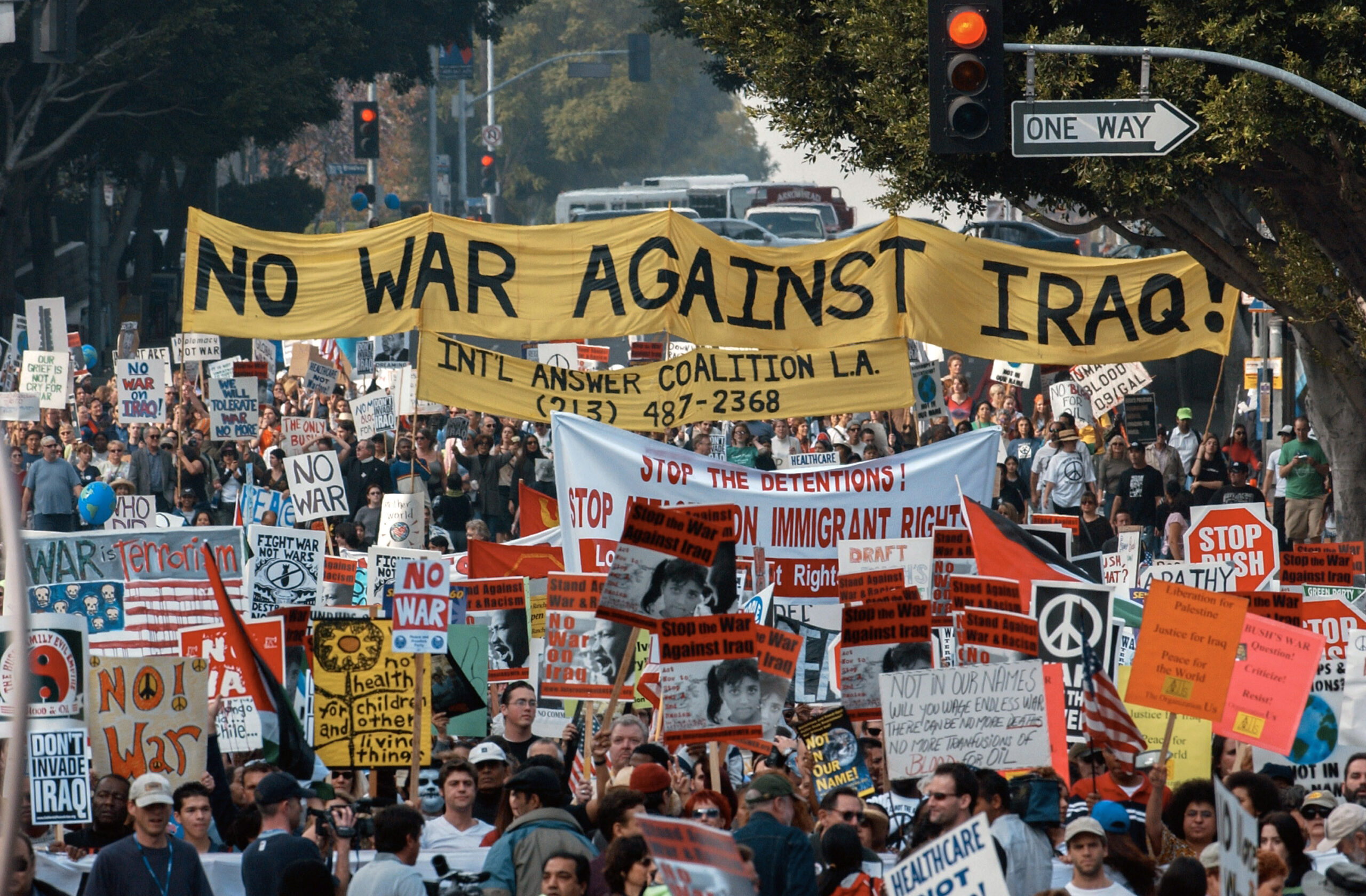
At the beginning of the Iraq War, David Frum published an article in National Review entitled “Unpatriotic Conservatives,” attacking those on the right opposed to the war—including the founders of this magazine, Patrick J. Buchanan, Scott McConnell, and Taki Theodoracopulos. Almost a quarter-century later, Frum’s arguments stand out as particularly lazy and dishonest smears. Almost everyone acknowledges that the Iraq War was a mistake sold to the American people on false pretenses, directly causing the deaths of 460,000 Iraqis and 4,506 American servicemen, destroying Iraq’s ancient Christian community, and replacing a stable government with a power vacuum that has been ripe for sectarianism and terror. Those who opposed the war now stand vindicated, even if many lost their careers due to their opposition to the Iraq War.
But, at the time, the Bush speechwriter chalked their opposition to the war not up to well-thought-out (and later vindicated) analyses of the disaster that the war would bring to the Middle East and the quagmire that it would be for United States, but instead to supposed lack of patriotism and personal opposition to the neoconservatives. “They began by hating the neoconservatives,” Frum wrote, in the part of his article that has become the most infamous. “They came to hate their party and this president. They have finished by hating their country.”
One would expect Frum’s line of argumentation to remain in the dustbin of history. But, in the midst of the current war with Iran, somehow this argument returned. The most noteworthy proponent of this argument—albeit in a more low-brow form—has been Ben Shapiro, the co-founder of the Daily Wire and a popular hawkish podcast host.
“There’s a coalition of people who are uniting to take down the United States,” Shapiro wrote in a recent op-ed, describing people who oppose the Iran War. “These people are cowards, plus liars, plus people who despise America.”
Another line of attack taken by both Frum and Shapiro is to attempt to accuse those on the right opposed to the war of not being real conservatives, as there are some on the left who also happen to oppose the war.
“They have made common cause with the left-wing and Islamist antiwar movements in this country and in Europe,” Frum wrote in 2003.
Shapiro has made similar arguments when attacking non-interventionists. For instance, in a December 2025 speech at the Heritage Foundation, Shapiro attacked the prominent conservative media presenter Tucker Carlson for his foreign policy orientation, which, according to Shapiro, “has become essentially indistinguishable from the thought of far-leftists like Noam Chomsky.”
Since the start of the war, Shapiro has continued this, calling those conservatives opposed to the war as being part of the “horseshoe right,” implying that they are somehow in cahoots with the left in opposing a foreign war.
Contra Shapiro, Frum, and others, if anything it is deeply conservative to oppose the war in Iran. America’s great conservative statesmen, from John Randolph of Roanoke to Robert Taft, have been markedly noninterventionist in foreign policy, seeking to preserve the republic bequeathed by the Founders and fighting back against attempts to turn America into an empire that, though (in the words of John Quincy Adams) it “might become the dictatress of the world” would “be no longer the ruler of her own spirit.” The principles of geopolitical noninterventionism and neutrality comprised an important part of the American tradition, and anyone who seriously seeks to conserve this tradition will recognize this. While Frum and Shapiro use the label “conservative” to describe themselves, are on matters of foreign affairs utterly disconnected from historical American conservatism.
Subscribe Today
Get daily emails in your inbox
Shapiro’s arguments, though mirroring Frum’s, are considerably less convincing. Whereas the Iraq War initially had broad support, the current Iran War only has the support of 27 percent of Americans. The original conservative opponents of the Iraq War were a small (though correct) minority, and Frum et al. could write them off as kooks. Today, it is implausible that the majority of Americans who oppose or question the war with Iran are “uniting to take down the United States” or “despise America.”
Shapiro is not the only one to make the argument that conservatives opposed to the Iran War are “anti-American.” The radio host Mark Levin often whines about those he deems to be “isolationists,” calling them “the Woke Reich” (apparently borrowing a phrase from Israel’s Prime Minister Benjamin Netanyahu). Levin also routinely attacks noninterventionist media figures, such as Carlson—who Levin says “hates America, our Judeo-Christian beliefs, President Trump, and MAGA”—and Steve Bannon, whom he accused of “aiding the enemy” for hosting, Trita Parsi, one of America’s foremost scholars on Iran.
But Shapiro, unlike Levin, is broadly intelligent. He is a Harvard Law graduate; unlike Levin, he does not write books criticizing the “Franklin School” or attacking St. Thomas More for writing a satire titled “Utopia.” One might expect him, as a former supporter of the Iraq War (he wrote an article in favor of invading Iraq in 2001, as a UCLA undergraduate), to have some level of introspection about adventures abroad, or to at least explain to the audience why they should trust him on matters of Middle Eastern war and peace. Instead he is reviving neoconservative canards about war skeptics. We’ll see how that ages.