U.S. Seizure of Venezuelan Tanker Doesn’t Only Threaten Maduro
Such moves pose a challenge to Russia and Iran.
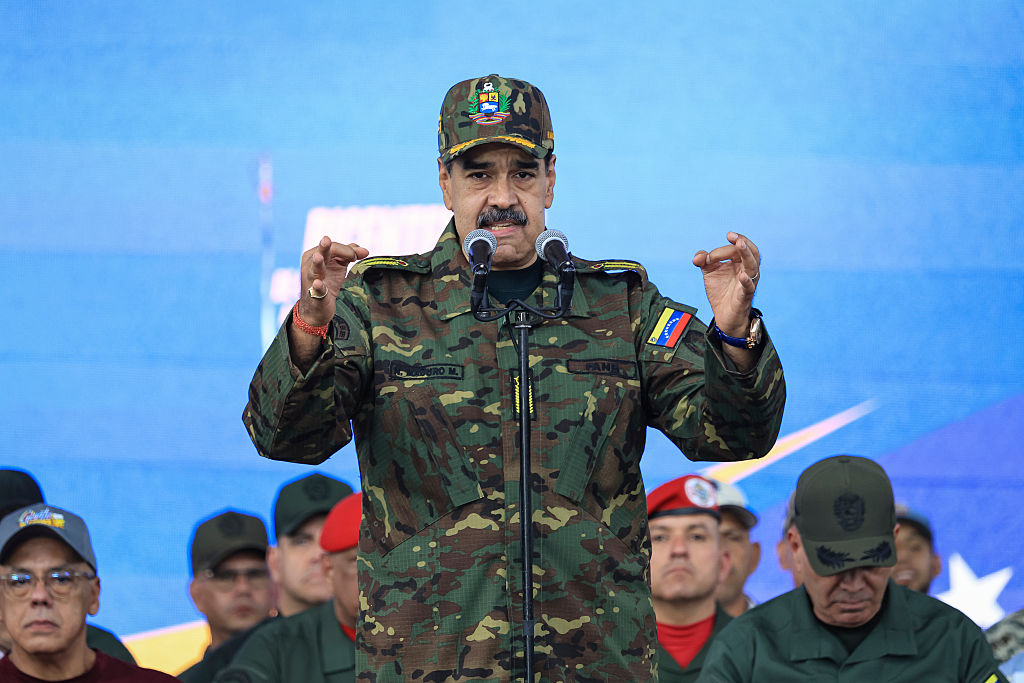

The U.S. seizure of the tanker Skipper earlier this week has been widely interpreted as a significant escalation by the Trump administration against the government of Nicolás Maduro in Venezuela. Losing the tanker, which was carrying Venezuelan crude to Cuba, is a significant blow to Maduro and will make it more difficult for the Venezuelan government to fund itself, as it is overwhelmingly reliant on oil exports for government revenue. However, the seizure is also an escalation of American economic warfare generally, including against Iran and Russia, which have also taken advantage of the world’s “shadow tanker” fleet to evade U.S. sanctions and sell energy abroad.
The Skipper was just one of thousands of such “shadow tankers,” a large group of mostly aging and obsolete tanker ships that profit from the transport of black market oil from sanctioned countries. Shadow tankers often fly false flags and manipulate the location data such ships are required to broadcast (to prevent maritime collisions) in order to give the appearance of legitimate operations and throw off law enforcement. The Skipper, for example, was at the time of its capture falsely sailing under the Guyanese flag and manipulating its location to appear as if it were near the large oil fields in Guyanese territorial waters.
Shadow tankers scoop up sanctioned oil at below-market prices in countries like Russia, Iran, and Venezuela before sailing to countries like Cuba and China to sell. Often, tankers will transfer cargoes at sea to other vessels to further obscure the origins of their illegal carriage. Their numbers have multiplied as U.S. sanctions have broadened, and they serve as a convenient method for foreign governments to reduce the impact of attempts by the U.S. to strangle their energy markets.
The Skipper was in fact originally sanctioned in 2022 not for carrying Venezuelan crude, but for smuggling Iranian oil used to support the Islamic Revolutionary Guard Corps and Hezbollah. The ship, at that point named the Adisa, was sanctioned as part of a large network of ships and companies that allegedly took Iranian oil and blended it with imported Indian oil to sell abroad as a seemingly legitimate product. The ship has also been connected with the transportation of Russian oil.
Cracking down on shadow tankers will undoubtedly make life significantly more difficult for the Maduro regime, which desperately needs the oil revenue brought by the tankers to pay for military equipment and government salaries. But if the seizures continue, it could also put a significant dent in the budgets of other states who have been targeted by American sanctions, including Russia and Iran.
For Venezuela specifically, the loss of the Skipper comes at a moment of deep financial fragility. The country’s oil sector, once the backbone of the national economy, has suffered years of underinvestment, corruption, and political interference. Production has stabilized somewhat in recent years, but only at a fraction of its former capacity, and nearly all remaining output depends on creative export arrangements that bypass or obscure U.S. sanctions. Shadow tankers have become central to this system. They allow the state oil company, PDVSA, to move crude to Cuba, China, and occasionally other buyers willing to risk secondary sanctions, often at steep discounts that further shrink Venezuela’s revenue.
Subscribe Today
Get daily emails in your inbox
The seizure of a single vessel might seem minor relative to Venezuela’s broader economic crisis, but the loss of the Skipper should be enough to make operators of shadow tankers think twice about smuggling oil in the Caribbean. Oil tankers are not trivial to acquire, and losing a ship and its cargo (aboard the Skipper, nearly $100 million worth of crude oil) is a significant financial blow. Tankers that are willing to make the journey will demand even lower prices to make up for the risk, further cutting into Venezuelan margins.
The political consequences inside Venezuela could be even more significant. Oil revenues are not just an economic resource; they are the glue that holds together the ruling coalition around Maduro. Military commanders, political loyalists, and Venezuelan oligarchs tied to the regime depend on access to the oil trade for patronage and personal enrichment. When export channels shrink or become more perilous due to American enforcement, the regime must stretch its resources further to maintain loyalty. If seizures like that of the Skipper become more frequent, they could complicate Maduro’s ability to maintain the loyalty of his allies within the country.
Even so, it’s unlikely that further seizures of shadow tankers in and around Venezuelan waters would be enough to topple Maduro. Autocrats in general are very capable of adapting to poverty in the countries they rule, and Maduro has been through worse economic pinches than the one he faces now. Such operations will, however, make his life significantly more complicated, and add additional teeth to American sanctions reaching far beyond the waters of the Caribbean.