The Israel Lobby’s Changing Fortunes
A follow-up to Mearsheimer and Walt shows a project in flux.
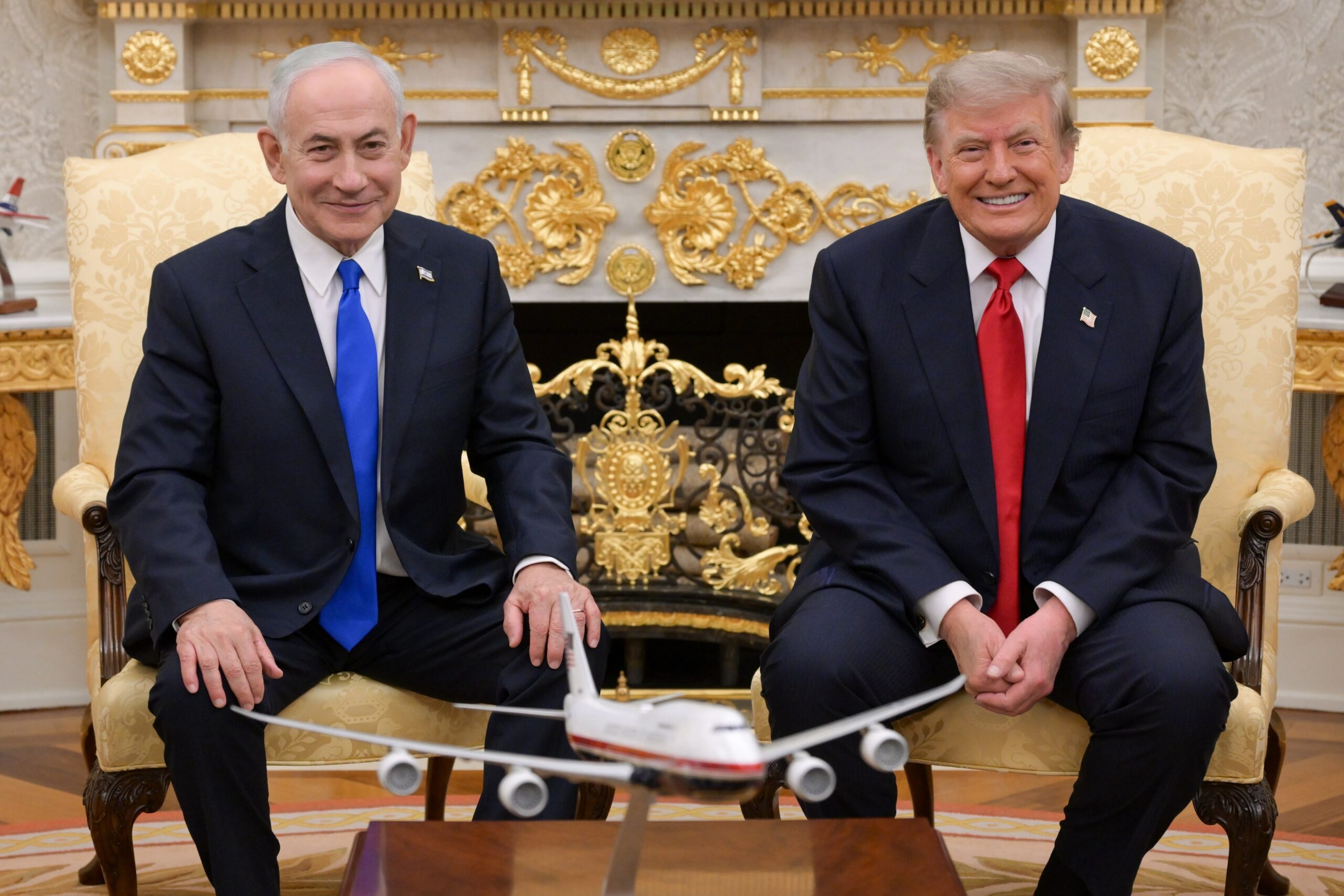

Israel’s Lobby, by Eli Clifton and Ian Lustick. Atria/One Signal. 304 pages
A natural question to ask about Eli Clifton and Ian Lustick’s Israel’s Lobby is how it differs from the magisterial work of similar name published by John Mearsheimer and Stephen Walt nearly 20 years ago. Certainly its entry into the American debate is less dramatic: Mearsheimer and Walt’s work had behind it the force of taboo-breaking, taking on a subject which had been more whispered about than debated for two generations. Despite a massive campaign to denigrate their work by the lobby’s many allies in the mainstream media (I believe The American Conservative was the only American print publication to give it a positive review), Mearsheimer and Walt’s book became not only a best-seller but a genuine international publishing sensation.
Though it wasn’t obvious at the time, Mearsheimer and Walt’s book appeared at a moment when there was still a clear open path towards a moderate future, sanctioned by a strong international consensus. This was true both for the American-Israeli relationship (they urged that America treat Israel like a normal country, while maintaining a moral commitment to defend it) and the Israeli–Palestinian conflict (they favored a two-state solution). The Iraq War, pushed relentlessly by Benjamin Netanhayu and other Israeli officials, and in great part the project of small group of passionately pro-Israel neoconservatives in American journalism and government, was already in the rearview mirror. The two authors cheered the birth of new liberal Zionist institutions like J Street, created to encourage United States support for a more moderate Israel at peace with its neighbors.
Clifton and Lustick’s impressive follow-up does not, to say the least, arrive at such a propitious time. Lustick is an accomplished Ivy-League political scientist who has produced important work on how ethnically driven conflicts can be managed or resolved. Clifton is a Quincy Institute co-founder and journalist who belongs to the cohort of American millennials who grew up when it was no longer outlandish to question the moral correctness of Zionism. Their book arrives as an erratic American president has started, at Israel’s behest, a war against the largest and most highly educated country in the Mideast, and oscillates between uttering threats of genocide and claims that the war is already won. On the home front it has become almost shockingly commonplace for entertainers and college students alike to shout slogans that call implicitly or explicitly for the destruction of Israel, something unimaginable 20 years ago. Meanwhile Israel, in response to the Hamas attack of October 7, 2023, has conducted a brutal campaign against Gaza’s defenseless civilians that is often described as a genocide and is indisputably a project of ethnic cleansing. Israel’s lobby today is both similar and quite different from the one Walt and Mearsheimer described. Is it stronger or weaker? Some of both certainly, and while it may be weaker overall, it is clearly dangerous the way all wounded creatures are.
Of the many elements which have changed since 2007, three stand out. The main institutions of the lobby, always wealthy relative to their opponents and competitors, are far richer. Israel itself has changed. Its commitment to peace with the Palestinians, if in the past more advertised than actual, has been completely submerged; no Israeli leader of consequence even pretends to want a settlement with the people who inhabit the land Israel now controls, and the country’s policy of seeking outright military domination of its entire region, though challenged by many Israeli former officials and scholars, faces no substantial political opposition. And finally, in a point emphasized by Clifton and Lustig, its lobby has more or less abandoned efforts to explain or justify Israeli policies, to convince Americans of their necessity and appropriateness. Instead increasingly Israel’s supporters in the United States seek to conflate any opposition to Israel and American support for it with antisemitism.
That is to say, to challenge seriously Washington’s special relationship with Israel is presented as a major moral failing, the kind of mark which would place one beyond the pale of respectable discourse. And while these three developments make Israel as influential as ever in Washington and particularly within the Trump administration, its actual popularity among voters, particularly among Democrats and the young of both parties, has sunk like a stone.
In a key section, the authors document how in the last generation America has seen the greater concentration of wealth in the hands of the super-rich. The percentage share of national wealth held by the top 0.1 percent rose by two-thirds. Meanwhile, two court decisions from 2010 have made it much easier for billionaires to buy national policies to their liking.
As pro-Israel think tank and advocacy money rose, so did Israel-related campaign and advocacy group contributions. When Citizens United v. Federal Election Commission was decided in 2010, no one anticipated it would weigh critically on American Mideast policy. The decision struck down limitations on campaign spending by unions and corporations, and in conjunction with the consequences of the SpeechNow.org v. FEC decision, opened the gates for increased spending by the super rich. Individual campaign spending limitations, $1,000 until 2003, later raised to roughly $3,000, suddenly became almost irrelevant as ultra wealthy individual donors began to dispense virtually unlimited funds to support or oppose candidates through so-called superPACs.
In principle this enhanced capacity of billionaires to buy policies of their choosing was available to anyone; in practice those passionate about supporting Israel used it the most effectively. Sheldon and Miriam Adelson, virtually unknown before 2012, became the most important donors in the Republican Party. They spent more than $100 million on mostly losing candidates in 2012, but “forced the relatively niche issue of Israel into the Republican primary and general election discourse and normalized the idea of political megadonors across party lines, no longer restricted by campaign finance laws, largely underwriting campaigns.”
It wasn’t just the Adelsons of course; scores of Israel-First billionaires joined them with more power to shape American policy than ever before. As Clifton and Lustick put it, “These donors form the backbone of an Israel First movement which crosses party lines…. The donors are funding both the election of politicians as well as shaping the world view of these same elected officials, creating an echo chamber of pro-Israel talking points and policy recommendations for politicians already indebted to pro-Israel donors.” To give a sense of the rising volume of the echo chamber, the authors track the exponential rise in the budgets of pro-Israel advocacy groups. AIPAC had $19.5 million in assets in 2000, nine times that amount in 2023. Similar advances were made by the Washington Institute for Mideast Policy and the Jewish Institute for National Security of America. The Foundation for Defense of Democracies, the most influential Beltway group pushing for war with Iran, increased its revenues 16-fold from 2011 to 2022.
As its American lobby has grown richer, Israel too has changed considerably. Until the last 15 years, most Israeli leaders at least paid lip-service to making a durable peace with the Palestinians, and some believed peace as necessary for Israel’s own flourishing. But no Israeli prime minister since Ehud Olmert has breathed a word about trying to accommodate Palestinian national aspirations. The authors consider this a profound shift; Israel, they claim with a borrowed phrase from an Israeli political scientist, has become a “crazy state,” increasingly dismissive of the legitimate interests and opinions of other countries.
Along the way they provide an unexpected, quite complimentary digression about Vladimir Jabotinsky, an early right-wing Zionist leader and popularizer of the so-called Iron Wall strategy; its point was to win battles so forcefully as make Arabs realize they had no hope of destroying Israel and would have to accept it in the region. But such acceptance by Arabs was actually a goal, and a corollary of the Iron Wall doctrine was that Israel should not go out of its way to kill Arab civilians. Many times ignored, such scruples did exist in principle.
Today they do not. Replacing them is a near hysteric view of Palestinian resistance. As Clifton and Lustick put it, “Palestinian resistance was understood as illegitimate, evidence of intransigence, and often as akin to Nazi antisemitism.” This justified a ramp-up in the brutality of Israeli tactics, as Palestinian enmity came to be understood as “pathological and ineradicable” and such Israeli measures as mass imprisonment, breaking the bones of protesting children, and torture of prisoners became commonplace.
This transformation in Israel had a parallel shift in the lobby’s accelerating efforts to police Israel-related discourse in the United States. In the early 2000s, the former Soviet dissident and right wing Israeli politician Natan Sharansky began to push the idea of a “new antisemitism” which would include any statement which “demonized” or “delegitimized” Israel or held it to a “double standard.” Activists following his lead soon persuaded a minor organization, the International Holocaust Remembrance Alliance, to adopt a definition of antisemitism incorporating these notions, and then pressed governments and institutions to embrace the “widely accepted” IHRA working definition. In a campaign that unfolded over years, Israel advocates eventually got the Obama State Department to incorporate the definition in an annual report. By 2018 the Trump Department of Education had adopted it, and would eventually use it as a weapon to punish pro-Palestinian academics and students at American universities. The authors provide a detailed account of the new definition’s rise and codification, a fascinating window into the nuts and bolts and high stakes of what might at first glance have seemed a somewhat niche academic debate.
Despite these efforts, the lobby has clearly become less able to police the American discourse than it was 20 or 40 years ago. Israel’s poll numbers are bad, particularly among younger Americans. The lobby hopes that by gaining control of such internet platforms as TikTok, such opinion shifts can be reversed. (Oracle’s CEO is quoted in a hacked email telling an Israeli leader, “We have to embed the love and respect for Israel in American culture.”) It is difficult to see that happening; a great part of pro-Israeli argument now increasingly rests on such claims as “God Gave Us This Land,” which is likely to be less persuasive to a diverse and fairly secular America than snappy catchphrases popular in the 1950s like “a land without a people for a people without a land.”
Meanwhile, in genuinely stunning political developments, candidates far more anti-Zionist than Walt and Mearsheimer have been able to win major elections in New York City and potentially in Michigan.
At the same time, the last several months have been a very cold shower for people who thought the Israel lobby was no longer an extremely consequential voice when Washington decided matters of war and peace. No one seriously expected that President Donald Trump would try to deliver a peace settlement between Israelis and Palestinians, which he clearly had no real interest in, and which relatively few Palestinians or Israelis seemed ready for. But it was also assumed that assuring, with American military might, Israel’s complete dominance of the Mideast was not part of an America First agenda. Trump had displayed a great deal of bravado in 2015, mocking the Adelsons’ lavish support of Marco Rubio while boasting that he didn’t need their money. In 2024, it turned out that he did.
Subscribe Today
Get daily emails in your inbox
The man who had famously denounced the Iraq war in a Republican debate and campaigned explicitly against more stupid wars would, in office a second time, turn to Benjamin Netanyahu as his most consequential foreign policy advisor and satisfy the yearnings for an American war against Iran which Netanyahu—and all the voices in the Israel lobby echo chamber—had sought for a generation. It is this unexpected and calamitous development, this demonstration that even an America First candidate could be maneuvered into a costly war by Israel and its lobby, that has rendered the more extreme slogans of the anti-Israel left—“Free Palestine” etc.—less noxious than they seemed a generation ago.
Clifton and Lustick have written an important, extremely well-researched book, which tries to capture in motion a vast and complex phenomenon which is very much in flux, and whose fortunes are changing nearly month to month. They are to some degree men of the left, and some of their formulations—putting “woke” in scare quotes or describing the AfD, the German anti-immigration party that is one of the largest antiwar parties in Europe, as “Nazi adjacent”—will seem lazy, at best, to most TAC readers. And perhaps a less progressive treatment would have noted the irony of both the lobby and the Trump administration borrowing heavily from tropes of the woke era in their efforts to portray Jewish college students as made to “feel uncomfortable” and “unsafe” by student protests against Israeli brutalities.
But it cannot be denied that it is the American Left, not the Right, that has taken the lead in trying to free the United States from, as the authors call it in their book’s subtitle, “the grip of a foreign power.” For that it, and the authors, deserve commendation.