
Inanity and Faith in Nikolai Gogol
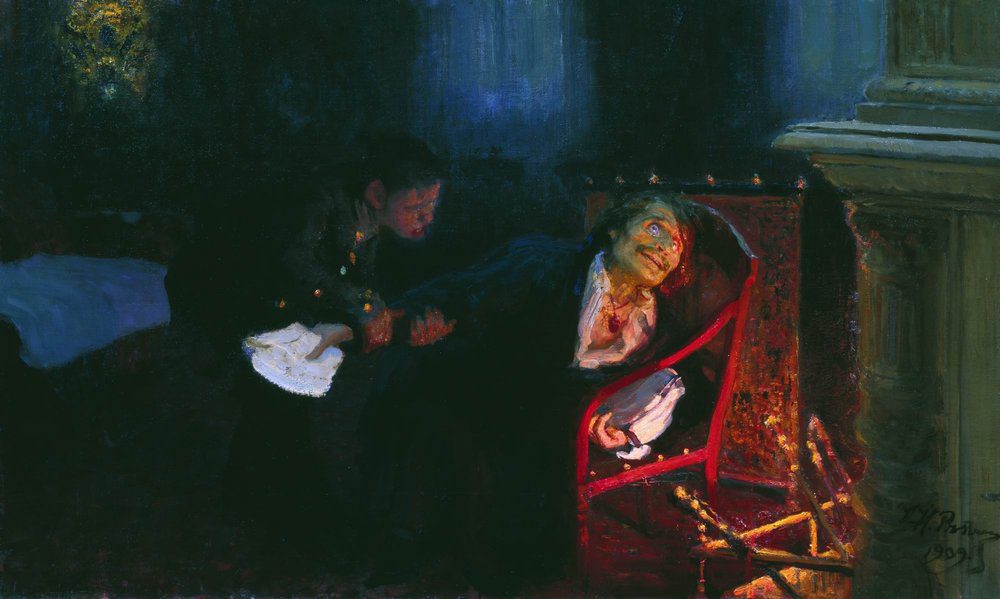
What to make of Nikolai Gogol, Russia’s “greatest comic writer,” who “thoroughly baffled his contemporaries”? “Everywhere Gogol describes a world of incandescent inanity,” Gary Saul Morson writes: “Things may look fascinating, variegated, and endlessly interesting, as the narrators of his stories sometimes suggest at their beginnings, but by the end the world’s metaphysical boredom shines through.” Perhaps this is why Gogol himself turned to religion shortly after Dead Souls:
In 1842–1843 Gogol experienced a religious crisis, wrote letters combining self-exaltation with masochistic self-loathing, and concluded that he was called to be a great moral teacher. In this mood, he published the scandalous Selected Passages from Correspondence with Friends (1847), in which he preached that social conditions, including serfdom, are God-given, that the Russian Orthodox clergy ‘alone is in a position to solve all our problems,’ and that no one can be saved without loving Russia. Convinced of the profundity of these banal ideas and of his stature as a Christian teacher, he urged people to refrain from erecting a statue to him after his death and to read over his instructive letters many times: ‘Woe to those who do not heed my word! Leave all things for a while, leave all such pleasures that tickle your fancy at idle moments. Obey me.’ Conservatives and Slavophiles were as irritated as radicals and Westernizers. As readers have observed ever since, Gogol seemed to have turned into one of his grotesque characters.
Russia’s most influential critic, Vissarion Belinsky, was especially disappointed to discover that the author he had hailed as the hope of Russian literature, and who he had assumed was a radical, turned out to be a reactionary. His open ‘Letter to Gogol’ called his erstwhile hero a ‘preacher of the knout, apostle of ignorance, defender of obscurantism.’ When Dostoevsky was arrested in 1849, one of the charges against him was circulating Belinsky’s letter.
To redeem his frivolous comic works, Gogol tried to draft a second volume of Dead Souls, in which its hero, Chichikov, was to suffer and, coming under the influence of wholly positive characters, begin to reform. If volume one was an inferno, volume two would be a purgatorio, and perhaps there would even be a paradiso. Needless to say, Gogol couldn’t force his genius in this direction. Mikhail Bakhtin called this failed attempt to take satire where it could not go ‘the tragedy of a genre.’
Gogol’s religious mania kept getting worse. A trip to the Holy Land did not alleviate his moral hypochondria. Eventually, he fell under the influence of the fanatic Father Matvey, who urged him to abandon literature as sinful. For weeks Gogol did not eat—Nabokov recounts that you could feel his spine through his stomach—and he died with doctors torturing him with leeches hanging from his gigantic nose. This ending is all the more grotesque since Gogol was obsessed with noses, snorts, sneezes, mustaches, whiskers, smells of all kinds, and countless Russian idioms involving the olfactory (Nabokov devotes a page to listing them). His last words—‘A ladder! A ladder!’—apparently expressed his lifelong wish to rise above what the narrator of Dead Souls calls ‘the slimy mass of minutiae that has bogged down our life.’
In other news: The Prix Goncourt, France’s most prestigious literary prize, will be announced on November 10th—if France does not shutdown, that is. If bookshops are forced to close because of COVID19, the jury will postpone the prize. How did the Prix Goncourt start? Anthony Cummins gives us the history in The Literary Review and short survey of the founders’ mediocre fiction: “It was conceived by the novelist Edmond de Goncourt, who left his estate to fund the Académie Goncourt, which awards the prize, after his death in 1896. Altruism wasn’t quite the goal: a panicked bid to ‘save the name of Goncourt from oblivion’ (not only his name, but that of his late younger brother and co-author, Jules), the gesture was a form of slow-burn revenge for the indifference critics and readers had shown to the Goncourts’ own fiction. Their first novel had the misfortune to be published on 2 December 1851, the day of Napoleon III’s coup d’état. This set the pattern for a sense of injustice that would dog their literary endeavours. In old age, Edmond tortured himself by prowling bookshops in search of untouched copies of his novels, always with an eye for more prominently displayed books by rivals – or, worse, friends.”
Adrian Nathan West on the life and work of Balzac: “Balzac is not a difficult author — his writing is clear and vivid, and he always aims to entertain — but one does, on encountering him, wonder where to begin. No one knows how much he wrote for certain. The most complete edition of his works in French runs to 25,000 pages and excludes much that can reasonably be attributed to him. His masterpiece, The Human Comedy, intended as a comprehensive portrait of the Paris of his time, consists of 91 finished novels and stories and many more drafts.”
Rachel Lu reviews Mark Regnerus’s The Future of Christian Marriage: “In every country Regnerus visits, young people have a sense of swimming upstream in their efforts to marry and form families. From Warsaw to Lagos to the suburbs of Austin, Texas, young Christians are asking many of the same questions. How can they extricate themselves from a sexual landscape that prioritizes pleasure over long-term fulfillment? What is it reasonable to expect from a potential spouse, and how much should a person be willing to sacrifice for marriage? How can young people establish a secure social and financial foundation, in preparation for family life? To some extent, young people have always wrestled with these sorts of questions, but culture and tradition used to provide more guidance in this regard. As Regnerus sees it, the obstacles to marriage have become ever more daunting as older traditions are undermined by a global ‘monoculture’ that subjugates everything to the demands of the state and of markets.”
Niall Ferguson reviews Nicholas Christakis’s Apollo’s Arrow: The Profound and Enduring Impact of Coronavirus on the Way We Live: “In 2002 the Cambridge astrophysicist and Astronomer Royal Lord Rees predicted that, by the end of 2020, ‘bioterror or bioerror will lead to one million casualties in a single event’. In 2017 the Harvard psychologist Steven Pinker took the other side in a formal bet. As the terms of the wager defined casualties to include ‘victims requiring hospitalization’, Rees had already won long before the global death toll of Covid-19 passed the one million mark in September. Sadly for him, the stake was a meagre $400. Nicholas Christakis has given his rapidly written yet magisterial book about the pandemic the title Apollo’s Arrow. The allusion is to the plague the god unleashes against the Achaeans for kidnapping the daughter of his priest Chryses in Book One of Homer’s Iliad. An alternative title might have been Rees’s Bet. In a report from 1998 the US Department of Defense observed that ‘historians in the next millennium may find that the 20th century’s greatest fallacy was the belief that infectious diseases were nearing elimination’. Pinker was only one of many scholars who subscribed to this belief in the twenty-first century. ‘Disease outbreaks don’t become pandemics’ any more, he argued in Enlightenment Now, because ‘advances in biology … make it easier for the good guys (and there are many more of them) to identify pathogens, invent antibiotics that overcome antibiotic resistance, and rapidly develop vaccines’.”
Photos: Copenhagen’s Copenhill