Billy Remembers
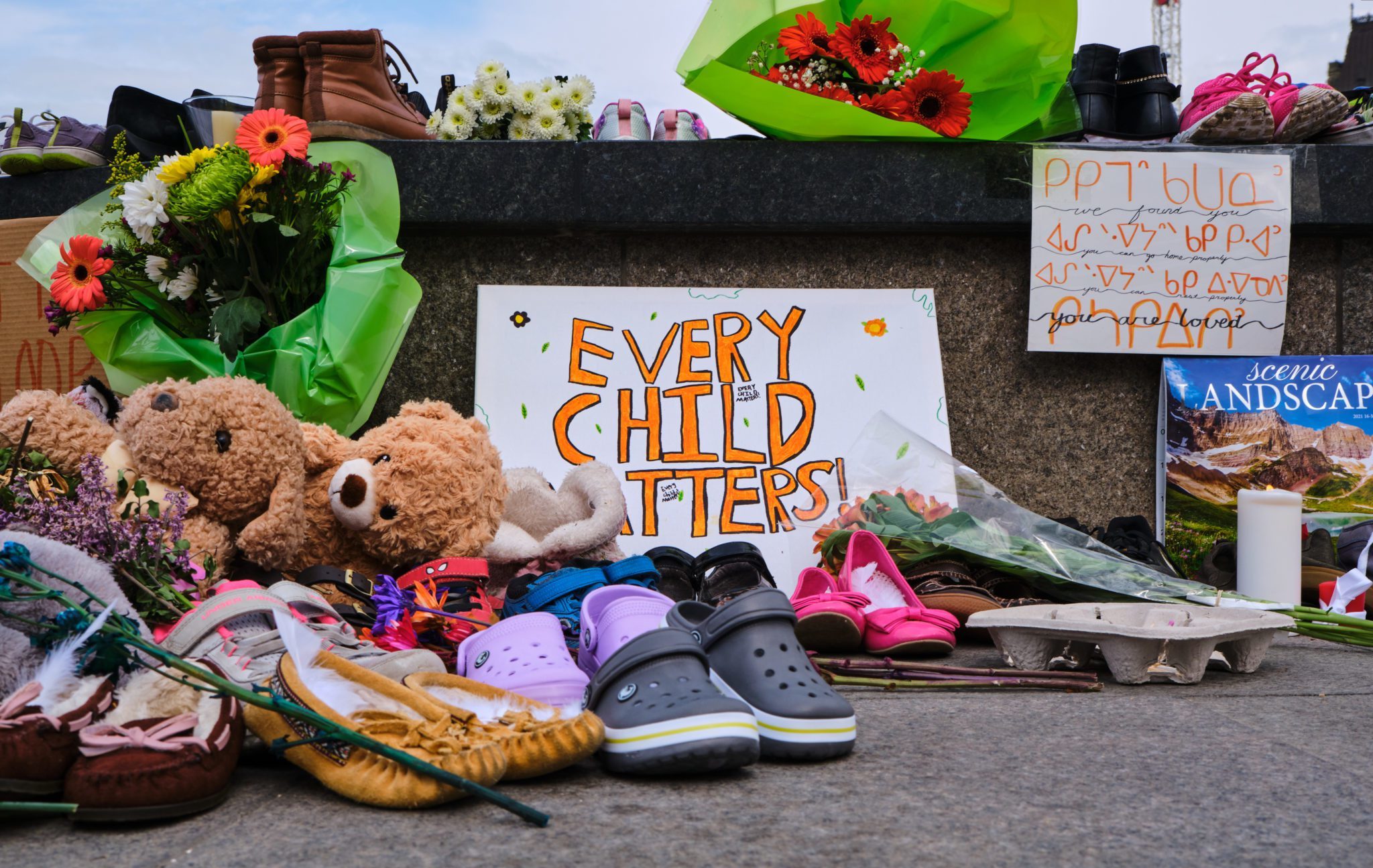
In the 2006 documentary film Unrepentant, in grainy footage of a protest, a bandana-clad man identified as “William Combes, Kamloops Residential School (Catholic Church)” is interviewed. William “Billy” Combes, who was then living a hard life on the streets of Vancouver’s Downtown Eastside (he died in 2011), states: “They want evidence. As a seven-year-old child, I witnessed myself the burial of a child, and I didn’t know what was happening at that time. I was with another student, and I asked him, ‘What’s happening here? I see them digging a hole in the orchard,’ and he said, ‘They’re burying another one.’”
Standing behind Combes is Kevin Annett, a controversial defrocked United Church Minister, who has been disseminating the stories of Combes and others about the residential schools for about 25 years. One of these stories, recounted by Annett, claimed that Queen Elizabeth II and Prince Philip took a group of students from the Kamloops Indian Residential School (KIRS) on a picnic and then abducted them. Thorough fact-checking has shown that the Royals did not even travel to Kamloops in 1964.
While the Queen Elizabeth abduction story probably would be regarded with skepticism by most, many similar improbable accounts of “murders” and “missing children” are being repeated by Tk’emlúps te Secwépemc “Knowledge Keepers” and are now accepted as “truth.” Knowledge Keepers, after all, cannot be questioned, because to do so would be perceived as “disrespectful.” This raises questions about the extent to which the “oral tellings” of the Knowledge Keepers, which have been provided as evidence for the existence of “secret burials” at KIRS, have been influenced by the lurid stories circulating over the past 25 years. These stories were given additional momentum in May 2021 and are now firmly ensconced within the Canadian consciousness.
Upon closer examination, the circulation of these stories has some similarities with the moral panic started by the book Michelle Remembers published in 1980. The case involved Michelle Smith, who, after engaging in recovered memory therapy, made sweeping claims about the satanic ritual abuse that she claimed to have endured. The book presented itself as being factual, but scrutiny of its contents did not corroborate its claims. This did not prevent it from instigating a social contagion, leading to a satanic abuse moral panic in the 1980s that resulted in over 12,000 unsubstantiated accusations being made. The hysteria eventually subsided, but not before a number of innocent people had their lives ruined.
The satanic abuse moral panic was made possible by the implantation of false memories. Research in psychology has shown that it is easy to manufacture memories, especially in people who are emotionally disturbed. The most famous example of this was the McMartin preschool trial in 1983. In this case, the claims made about those accused of satanic abuse, Peggy McMartin and Ray Buckey, were eagerly and uncritically reported by the media. Michelle Smith and others identifying as “survivors” of satanic abuse also met with the complainants, and were thought to have influenced their allegations against McMartin and Buckey. Furthermore, interview techniques using leading questions dramatically increased the incidence of remembered sexual abuse. Pressure was used to obtain disclosures, since interviews rewarded testimonies about abuse and discouraged denials. Similar cases of mass hysteria, in fact, have appeared periodically throughout history, from the Salem Witch Trials to the Hammersmith Ghost Hysteria.
The current accusations of “Knowledge Keepers” about “secret burials” at KIRS take on a similar flavor. Furthermore, it is important to point out that these allegations have resulted in the extraction of numerous forms of compensation from governments, incentivizing indigenous organizations to enthusiastically promote them. Although it is widely recognized that the residential schools caused a great deal of harm, and serious injustices were committed against many members of the indigenous population, pretending to believe things that are highly unlikely to be true will do nothing to address the serious problems that we face. If we are to accept that reconciliation cannot occur without truth, wild accusations must be examined critically. In order to develop evidence-based policy, we need to enter into honest discussions to find out what actually happened at KIRS.
‘215 Murdered Children’
On October 18, 2021, Justin Trudeau, the prime minister of Canada, travelled to Kamloops to meet with the Tk’emlúps te Secwépemc (formerly the Kamloops Indian Band) with an “Orange Shirt Day” pin firmly and visibly fastened to his lapel. The meeting was a strange sight, as the prime minister was being chastised openly by his hosts while sitting a few feet away from them for failing to attend their Truth and Reconciliation Day ceremony a few weeks before. The day after the meeting, a full page “Petition to Prime Minister Justin Trudeau from the Tk’emlúps te Secwépemc Family Heads” was published in The Globe and Mail. The open letter stated, “In May of 2021, evidence of a horrific act of genocide was laid bare to the world, with the confirmation of at least 215 unmarked graves of little ones who attended the Kamloops Indian Residential School.” The petition demanded that “real acts of reconciliation” take place, including funds for DNA analysis, a permanent memorial, “supportive infrastructure in this sacred area,” guaranteed revenues for services, a recognition of indigenous rights and title, and “reconciliation progress” reporting.
The meeting and petition came about as the result of a long sequence of events that began with a press release announcing the “confirmation of the remains of 215 children who were students of the Kamloops Indian Residential School.” This announcement resulted in sensationalist media coverage that often referred to the discovery of a “mass grave.” The New York Times, for example, headlined its article “‘Horrible History’: Mass Grave of Indigenous Children Reported in Canada.” “An Indigenous community says it has found evidence that 215 children were buried on the grounds of a British Columbia school,” the story says, adding that the remains “included those of children as young as 3.”
And it was not just the media that made these claims. There was an outpouring of grief and recriminations in universities. At my (now former) employer, Mount Royal University, President Tim Rahilly stated, “The discovery of 215 innocent children found buried in unmarked graves at the site of a former residential school in Kamloops is nothing short of devastating. My heart goes out to everyone in our campus community feeling the impact of this discovery and the intergenerational trauma of residential schools.” Rahilly recommended that we look at the statement of Dr. Linda Manyguns (who had not yet started using lower case letters to express her opposition to oppression). Manyguns offered her “condolences and support to the Tk’emlúps te Secwépemc First Nations upon the discovery of the remains of 215 children, buried at the site of the former Kamloops Indian Residential School,” asserting, “We must face the horror” and “commit to finding the others who went missing.”
The president of my faculty association also weighed in on the matter. He stated that he “was horrified by the discovery of the bodies of 215 children at Kamloops Residential School” and that “as President of the MRFA, I want to express my support and solidarity with our Indigenous colleagues, who are reeling from yet more evidence of the residential school system and its genocidal intent.” One of these indigenous colleagues, Gabrielle Lindstrom, a former indigenous studies professor at MRU and now an educational development consultant in “Indigenous Ways of Knowing” at the University of Calgary, maintained on Twitter that “215 little ones” had been “murdered” at KIRS.

This statement was supported by numerous MRU professors. One colleague even argued a month later that “the murders of ‘hundreds’ (thousands?) of indigenous children in Canada’s catholic residential schools” meant that people should not be “blame[d]” for the burning of churches.

Because such statements were widely supported across the country, with almost no critical analysis, one could be forgiven for thinking that the claims about the “bodies of 215 children” had been substantiated. This is not the case.
What will be shown below is that there is no evidence to support the existence of remains at KIRS, not to mention the extraordinary claim of 215 “murders.” In a similar manner to the satanic abuse panic following Michelle Remembers, the recollections of Billy Combes and others, after being widely disseminated, are likely to have been absorbed into the memories of Tk’emlúps te Secwépemc “Knowledge Keepers” and the wider public consciousness. This has been facilitated by indigenous organizations intent on increasing compensation from the government, as well as “woke” academics, journalists, and politicians who assume that the indigenous “genocide survivor” identity must be accepted without question.
What Is the Basis for These ‘Knowings’?
In a May 27, 2021, press release, Chief Rosanne Casimir stated, “We had a knowing in our community that we were able to verify,” and, “To our knowledge, these missing children are undocumented deaths” with some being “as young as three years old.” It turned out, however, that there was no verification. Instead, a July 15, 2021, presentation by Dr. Sarah Beaulieu, the academic who had undertaken the survey of the area, stated that burials had not been confirmed but “targets of interest” had been identified with Ground Penetrating Radar (GPR). During her presentation, Beaulieu cautioned that definitive statements about specific numbers, or even conclusions about the existence of any burials, could not be made until excavations were undertaken.
Dr. Beaulieu’s presentation was supplemented by another press release from the Tk’emlúps te Secwépemc. This one noted that the survey was undertaken for three reasons: the oral histories of Knowledge Keepers had recollected “children as young as 6 years old being woken in the night to dig holes for burials in the apple orchard”; “a juvenile rib bone” had surfaced nearby; and a “juvenile tooth was excavated from a shovel test pit during an impact assessment conducted by Simon Fraser University’s archaeology department.” It was maintained that while “a juvenile tooth is not an indicator of loss of life,” the other discovery of the “juvenile rib bone” meant that “this possibility should not be discounted.”
Media coverage has noted that the existence of the rib bone and tooth was confirmed by Beaulieu, who said it had helped investigators determine where to search. With respect to the rib bone, it was claimed to have been found by a tourist in the early 2000s. The tourist evidently provided the bone to the band, and it was then “identified as human.” Other accounts maintain that the bone was “found beneath the apple orchard” and “in the soil during another dig.” As the source for the information about the rib bone was Dr. Beaulieu, I tried to contact her by email several times in October 2021. My emails were not answered.
This silence about the “juvenile rib bone” is troubling. Generally, if a human bone is found, one does not just hand it over to an indigenous group. Finding human remains is a serious matter, and the police would need to investigate so as to determine the identity of the deceased person and if foul play had occurred. Questions need to be answered as to whether or not the bone has been determined to be human. If so, did the Tk’emlúps te Secwépemc involve the police in investigating this matter, and what were the results of the investigation?
Although the Simon Fraser University archaeology department’s response to an inquiry on July 27, 2021, did not provide any information about the rib bone, except to say that they believed that a “community member” had found it, they did shed some light on the claim about the tooth. It was noted that this was identified as a possible human tooth in another dig by Dr. George Nicholas but had now been determined as not human (evidently Dr. Beaulieu was not aware of this when she gave her presentation). In response to attempts to get additional information about the tooth, the following reply was provided on July 28, 2021, by an archaeology department member: “I have been strongly advised by the TteS legal team not to respond to any queries from the public regarding the search for unmarked graves in Kamloops.” It was asserted that this request had been extended to include the entire archaeology department.
Although it is impossible to know what has prompted a department of a public university to make such statements, this could be due to the federal government’s Tri-Council Policy Statement: Ethical Conduct for Research Involving Humans (TCPS2). In its chapter on “Research Involving the First Nations, Inuit and Métis Peoples of Canada,” there is encouragement of “respectful relationships” and “the “ongoing efforts of Indigenous peoples to preserve and manage their collective knowledge and information generated from their communities.”
This close relationship between SFU and the Tk’emlúps te Secwépemc requires scrutiny. The Tk’emlúps te Secwépemc partnered with Simon Fraser University’s Department of Archaeology from 1991 to 2005. This partnership excavated all over the reserve for development purposes, including an area that overlapped with Beaulieu’s GPR work. This is why, when Beaulieu belatedly learned about the project after May 27, she had to revise her estimate of 215 initial “targets of interest” down to 200. This revised number was relayed during her July 15 oral presentation, described below. This revision is important because it shows that the SFU Department of Archaeology did not consider 15 “targets of interest” identified by Beaulieu as being “probable burials.” It is possible that the other 200 are similarly questionable.
The possibility of the politicization of the SFU archaeology department is disturbing. Simon Fraser University is a public institution, and its ability to discuss research findings should not be controlled by the Tk’emlúps te Secwépemc or any other private entity. It also raises questions about whether the archaeological research undertaken about indigenous “unmarked graves” has been compromised by a particular agenda. To what extent are the claims of Dr. Beaulieu and the other archaeologists working for indigenous organizations, about their “confidence” in the probability of finding unmarked graves, valid? To make this determination, it is necessary to examine the degree of certainty provided by GPR.
How Much Certainty Is Provided by GPR?
On July 15, 2021, the Tk’emlúps te Secwépemc hosted a public presentation and media event to present the findings of the Beaulieu GPR survey. The event exuded a politically charged atmosphere with many territorial land acknowledgements, prayers, and references to the ancestors. Chief Casimir spoke of the need to find the “truth” about the “missing children… whose remains were placed in unmarked graves.” She explained that “we are not here for retaliation, we are here for truth telling” so as to “bring peace to those missing children, families, and communities.” This would require “follow[ing] the evidence and the science” while “pay[ing] heed to what oral tellings survivors share with us.” Casimir also pointed out that this would take a great deal of time and resources and that “cultural and wellness supports” were available to help audience members deal with this “historic dark chapter” and the intergenerational trauma that it had created.
Beaulieu had been selected to do the survey because of her professional interactions with Dr. Eldon Yellowhorn, an indigenous studies professor and past president of the Canadian Archaeological Association. Beaulieu gave her presentation on the report she had written about her use of GPR in what used to be the apple orchard at KIRS. Beaulieu explained that GPR was able to determine “subsurface anomalies,” many of which were now “targets of interest.” It was noted that oral histories had “guided” the use of GPR; claims about children being woken in the middle of the night to dig clandestine graves, it was implied, were true, and GPR provided the “special spatial specificity to this truth.”
While it was cautioned that the existence of remains could not be confirmed without excavation, a number of factors, in her view, made this a likely conclusion. Beaulieu pointed to the tooth and rib bone, “depressions in the orchard that correlate with the subsurface anomalies,” the “east-west configuration of the subsurface anomalies” consistent with “typical Christian burial traditions,” and most importantly the oral histories of the Knowledge Keepers.
During her presentation, Beaulieu showed three slides of examples of the information that GPR had revealed. These slides showed how the GPR image for a “probable burial” differed from the representation of metal object anomalies, rocks, and tree root systems. Essentially, with burials, one could see the edge of the vertical shafts where digging had occurred, and the dome on top of it from the soil disturbance caused. In her answer to a journalist from the Toronto Star, Beaulieu also stated that the “probable burial” anomalies were fairly shallow, between 0.7 and 0.8 metres below the surface, and this fit with the Knowledge Keepers’ accounts of burying children and the fact that smaller bodies require less soil to be dug up. There was no discussion of how a clandestine grave might differ from holes that were dug for other purposes. She also did not mention how an image for a burial that was 50 to 70 years old (the “oral tellings” had stated that KIRS burials had occurred in the 1950s and 1960s) would differ from ones that were more recent.

Beaulieu’s presentation was followed by remarks from Dr. Lisa Hodgetts, president of the Canadian Archaeological Association, and Dr. Kisha Supernant, an archaeologist from the University of Alberta. Hodgetts, referring to herself as a “settler,” stated that she was grateful to the Tk’emlúps te Secwépemc for allowing her to “bear witness” to the “pain and trauma” being suffered by “intergenerational survivors.” She encouraged all Canadians to hold governments and the churches accountable for the “thousands and thousands of missing children,” asserting that funding should be provided to indigenous groups to “chart their own path and own pace” for further collaborative and respectful work to “find missing children.”
Supernant, the chair of the association’s Working Group on Unmarked Graves and director of the Institute of Prairie and Indigenous Archaeology, stressed the need to work collaboratively and respectfully with indigenous communities. Supernant commended Beaulieu’s work, confirmed that there were a “number of highly probable burials,” and referred to the “knowledge held in communities by knowledge keepers.” Again the need for more resources to undertake this work was stressed.
These presentations by archaeologists were followed by comments from RoseAnne Archibald, the Grand Chief of the Assembly of First Nations, and statements from three former KIRS students and Knowledge Keepers, Evelyn Camille, Leona Thomas, and Mona Jules. Although all talked about the destruction of culture and self-esteem caused by the schools, only Camille discussed the “missing children.” Camille asserted that many children died from trying to cross the river and freezing to death when trying to make their way back home. She believed that many children had been “murdered” but that the “remains should be left undisturbed.” Instead of excavating, Camille recommended “say[ing] prayers for the remains that are found” as this would “guide them home to finish their journey.”
Grand Chief Archibald, after hearing these remarks, maintained that the Tk’emlúps te Secwépemc case had enabled the world to learn “how 215 innocent children died and were buried in unmarked graves” and that this “crime against humanity” constituted “genocide.” She completely ignored the caution expressed by Beaulieu and the other archaeologists and argued that “this ground penetrating technology is revealing evidence, undisputable proof, that crimes were committed.” On the basis of these “probable burials,” Archibald argued that the “crimes have to be investigated” and “the criminals must be held to account.” In “looking for ways to heal the trauma,” Archibald recommended that Canadians call politicians to demand “reparations,” “justice,” and “action.” Similar comments were made by Don Worme, the legal counsel for the Tk’emlúps te Secwépemc. According to Worme, “I think what we can say firstly is that it is undeniable that those are graves. There is no question that there have been children gone missing. Our knowledge keepers from this community have told us so. We believe them.”
These comments by Worme and Archibald show an astounding disregard for Beaulieu’s tentativeness—that remains cannot be established until excavations are completed. Even worse, it appears that excavations will never be done because it is to be a “community driven process,” and many argue that the “bodies” should not be disturbed. This raises questions about why people who actually think that “murders,” “genocide,” and “atrocities” occurred would not demand that forensic examinations be undertaken. If “the criminals must be held to account,” as Archibald asserts, isn’t the first step in this process to determine whether or not the “probable burials” actually contain the remains of indigenous children? Or is the intent to convict people of “murder” on the basis of the “oral tellings” of the “Knowledge Keepers”?
Time and time again one sees assertions that GPR is being used to “confirm” the existence of children’s remains. The burials in question would be over 50 years old, when it is recognized that there are “limitations of detecting graves for extended postmortem intervals.” One scientific paper in Nature maintains, in fact, “Finding hidden bodies, believed to have been murdered and buried, is problematic, expensive in terms of human resource and currently has low success rates for law enforcement agencies.” It points out that “there is a general reduction in geophysical anomaly amplitude with increase in time since burial, so the sooner geophysical surveys can be undertaken the greater the chance of discovery.” This means that it will be more difficult to see indications of graves the longer bodies have been in the ground. Detection will be particularly difficult if bodies are buried without a covering; clandestine burials with unwrapped bodies are difficult to detect after ten years have elapsed.
It also is irresponsible not to point out that burials, even if they are “probable,” do not necessarily involve human remains. In the literature on excavations being undertaken on the basis of GPR, there are many instances of the investigations finding other materials that are buried. In the case of the search for three boys who went missing in 1966 from South Australia, for example, a “subsurface anomaly that was consistent with the size, shape and depth of a burial that could have contained three small children” was found, but this turned out to be animal bones and garbage. Therefore, it seems unlikely that Dr. Beaulieu would be able to make specific claims about “probable burials” involving the 215 (and then 200) “targets of interest” after a period of 50 to 70 years had elapsed. As there has been a refusal to release her report, there is no way for the findings to be scrutinized by objective observers.
The ‘Tellings’ of the ‘Knowledge Keepers’
As was mentioned above, the Tk’emlúps te Secwépemc press release on July 15, 2021, stated that Knowledge Keepers recall “children as young as 6 years old being woken in the night to dig holes for burials in the apple orchard.” But who are these “Knowledge Keepers,” and how reliable are their recollections? Do the recollections concern hearsay, or are they eyewitness accounts? To what extent have they been influenced by the stories that have been circulating for years in testimonies like those found in the film Unrepentant? Even the use of the description “Knowledge Keeper” should be disputed, as knowledge claims must be constantly challenged on the basis of the evidence available. What does it mean to say that knowledge is “kept”?
Chief Casimir has never identified the Knowledge Keepers, nor has she specified what was said in their oral histories beyond what was asserted in the July press release. It is possible that the names of the Knowledge Keepers are in Dr. Beaulieu’s written report, but Chief Casimir has refused to release it. Four women are identified as Knowledge Keepers on the Qwelmínte Secwepemc website: Colleen Seymour, Jeanette Jules, Mona Jules, and Rhona Bowe. It also appears that some of these Knowledge Keepers are closely related, and they could have influenced the accounts of one another. This would impact their reliability.
In looking at the oral histories about secret burials at KIRS, the first eyewitness account of burials is claimed, by Kevin Annett, to have been made in 1998 (a search for earlier testimonies has found no reference to murders or secret burials). Annett asserts that Jessie (sometimes spelled Jesse) Jules made these allegations when he spoke at a United Nations–affiliated International Human Rights Association of American Minorities tribunal held on June 12–14, 1998, which was organized “to investigate genocide in Canadian Indian schools” (the “Judicial Findings” from this tribunal can be found online). According to Annett, even though Jules feared that he would be punished by his home reserve if he “mentioned the dead kids,” he told the tribunal that
fellow Kamloops students were starved to death in underground chambers at the school and forced to sleep with children dying of tuberculosis after they tried running away. He named Catholic priests like Brother Murphy who sodomized kids with cattle prods and beat a boy named Arnold to death with a club. Jessie saw another priest push a young girl named Patricia out a window to her death. He even drew us a map of where he buried children at night at the order of the priests.
In addition to having the first account of “buried children” at KIRS attributed to him, Jules is significant because of an alleged connection to Billy Combes (the footage of whom in Unrepentant is the first recorded testimony of secret burials at KIRS). On page 95 of his book Fallen: The Story of the Vancouver Four (2017), Annett claims that Combes wrote a poem stating that his friend Jessie witnessed a secret burial with him. Combes is also quoted by Annett in the 2010 version of Hidden From History: The Canadian Genocide as stating the following: “A friend of mine and I were out scavenging for food, since they never fed us regular. We saw Brother Murphy dragging this bag towards a hole near the orchard. He turned it over and a small body fell into the hole, and he started throwing the dirt in.” Combes also claimed, in Annett’s account, to have witnessed Brother Murphy killing a child by throwing her off a balcony, as well as him burying a child in the apple orchard with another priest.
As the clearly fictional claim regarding Queen Elizabeth abducting children indicates, however, one needs to be skeptical about the accounts Annett relays. The stories Annett attributes to Combes are not even mentioned by him in his interview with The Globe and Mail in 2007. It is also not known if these stories had any direct influence over the KIRS Knowledge Keepers. Questions must be asked about how much the circulation of these grisly tales over social media and other fora has influenced the memories of those who attended KIRS. There is only one early account—in the book Behind Closed Doors, which was published in 2000—that has appeared independently of Annett’s claims. In this book, Eddy Jules, presumably related to Jessie/Jesse Jules, was interviewed. His recollection implied that there was something untoward at KIRS, but this was hearsay and did not mention the apple orchard. In an account written up in the book on page 63, Eddy Jules states the following:
When I was in Senior B I used to hear about girls getting pregnant down the other end of the building. They’d get pregnant, but they would never have kids, you know. And the thing was, they’d bring somebody in from over town who’d do an abortion, I guess. We used to hear it. It used to be really scary, hearing them open up the incinerator after what was going on. They’d open up the incinerator in the big boiler, and we would hear this big clang, and we’d know they would be getting rid of the evidence.… It was a very, very scary thing. We’d wonder how many kids got thrown into that incinerator. We’d hear a clang and then they cranked the fire up.… I think most of the kids realized what was going on, but there was nothing we could do. We couldn’t say anything because no one would believe us. All of us that were going to school would hear the clang, and we would say, ‘Oh, that’s probably so and so’s friend, and they gave her an abortion.’
This hearsay changed substantially when Eddy Jules was interviewed by Morgan Hampton twenty years later on September 30, 2021. Unlike the account in Behind Closed Doors, Jules now claims to be an eyewitness to an event where he went into the medical room and saw “blood all over the floor.” According to Eddy Jules:
The door was ajar and there was this young girl laying there and this old non-native guy with glasses was holding something in his hands, and all the blood was on the floor. The girl, I never saw her after that day, and I realized what he was holding was a little baby that he just aborted, and it probably belonged to one of the men that worked there. He used a coat hanger, so I think that while he was pulling the baby out, he killed this young girl and she disappeared.
Eddy Jules then claims to have seen the janitor throwing a fetus into the furnace. With respect to the secret burials, Hampton notes that Jules and other attendees had alluded to them for years, even though this was not mentioned in Behind Closed Doors. Eddy Jules now asserts that he was 11 years old when he saw a light in the apple orchard in the middle of the night. He also recounts that a student with a cleft palate was going to have an operation, but “years later we found that he was murdered, killed, because he pissed some guy off at the Residential School that didn’t like the way he sounded.”
Apart from the interconnected testimonies of Billy Combes and Jessie/Jesse Jules, as well as this recently changed memory of Eddy Jules, there are no eyewitness accounts related to murders or burials. Dr. Ronald Ignace (who is related to Mona Jules), for example, said absolutely nothing about burials in his lengthy account of KIRS in Behind Closed Doors. On June 5, 2021, in a Toronto Star interview, however, Ignace claimed to know all about them. He recounted that, when he was a student at KIRS in the 1950s and 1960s, he had heard stories “for years” about students who were directed by staff to “dig some holes” in the middle of the night so that apple trees could be planted, and it was wondered why these plantings never occurred. Although Ignace, who has a PhD in anthropology, had no firsthand knowledge of burials, Chief Casimir’s announcement of Beaulieu’s GPR results led him to assume that remains must have been found in the apple orchard. This caused Ignace, when he visited the surveyed site, to go up to one of the 200/215 stakes and make an offering of tobacco and say a prayer. Observing these stakes led him to conclude the following:“It’s heartbreaking to see all of our people surreptitiously buried in the dark of night in shallow graves.” According to Ignace, “It’s mind-boggling how they could…do something as evil as that.”
Mona Jules, Ron Ignace’s aunt, also did not mention any secret burials in Behind Closed Doors (although she was interviewed anonymously, identification can be determined when she talks about the death of her sister, Nellie, at KIRS). On July 15, 2021, however, Mona Jules made the following remark: “In doing my research about the residential school and the death of those children, back in the 1500s, the Pope had ordered the death of children that were gathered up and put in those schools, if they were not Catholic, to kill them. That was a cold, terrible command, coming from someone in a high position.” Mona Jules had forgotten the title of the document from which she obtained this information, but maintained that it had the words “field study” in it. She then went on to state that “after hearing about those children, children being found along the orchards and other places, I often wondered what would have happened if I hadn’t been able to say my night prayers in my language, would my life have been snuffed out because I wasn’t Catholic?” Mona Jules is identified as one of Tk’emlúps te Secwépemc “Knowledge Keepers.”
Another former student, Mary Percival, also now claims that she heard about the burials. While Percival didn’t mention burials during her testimony at the TRC hearings in 2014, her recollection in 2021 was that students were told to stay away from the apple orchard because it was claimed “that children who died after running away from the school were buried there.” In spite of this, Percival asserts that she often picked apples and played in the orchard. But if the apple orchard was levelled in 1962 or 1963 to build the new dormitory/hostel (now the Band Administration building), as Celia Haig-Brown says it was in Resistance and Renewal, then how could Percival, who only arrived at KIRS in 1962, have spent time playing in the orchard with other children and eating apples?
Even more of these kinds of stories have emerged with the airing of the Fifth Estate episode “The Reckoning: Secrets unearthed by Tk’emlúps te Secwépemc” on January 13, 2022. In this program, nine indigenous people connected to KIRS are interviewed—Harvey McLeod, Norman Retasket, Diena Jules, Jennifer Yvonne Camille, Michael LeBourdais, Audrey Baptiste, Ted Gottfriedson, Rosanne Casimir, and Manny Jules—and it is claimed that the residential school “was a place of horror for the children forced to live here.” Only two eyewitness accounts are provided. Audrey Baptiste states that she saw four boys hanging in a barn, and that one of them never showed up for class the next day. Jennifer Yvonne Camille mentions seeing a coat hanger and blood in the furnace room. All the references to burials concern hearing stories about holes being dug, unnamed people going missing, and being warned not to go near the apple orchard. Although this program supposedly prides itself on “in-depth investigations,” no critical questions are asked. The tone and interview style indicate that all stories should be believed.
The most surprising circumstance is that a CBC piece associated with the Fifth Estate episode uncritically recounts the allegation about a baby being thrown into a furnace. According to Harvey McLeod, he was approached by a man who claimed to have done this after hearing about the “discovery of the suspected unmarked graves.” According to McLeod, this man confessed that “he was given a box to put in [the furnace]. He didn’t know what it was and then he was going to put it in there, and a baby fell out.” Even more strange is the fact, noted in the piece, that “former TRC chair Murray Sinclair issued a statement on June 1, 2021, on his facebook, after the discovery at the Kamloops Indian Residential School. He says that survivors shared stories about the furnace to the TRC.” According to Sinclair, “Some of the survivors talked about infants who were born to young girls at the residential schools who had been fathered by priests, having those infants taken away from them and deliberately killed, sometimes by being thrown into furnaces, they told us.”
None of these stories, however, were ever published in the TRC reports. If the TRC thought that this had occurred, surely judges like Sinclair would have thought it necessary to bring it to the attention of law enforcement. The omission seems to indicate that the stories were not seen as being credible at the time, as they smacked of the kinds of improbable claims being disseminated by Kevin Annett. It is shocking that what were once considered to be lurid tales attributed to a conspiracy theorist are now being credulously retold by Canada’s publicly funded broadcaster.
Inadvertently, a major inconsistency is revealed in the Fifth Estate episode, which should make everyone take pause. It is now claimed that the search for the unmarked graves did not occur because of the recollections of the Knowledge Keepers or from finding a juvenile rib bone and tooth, as was stated in the July 15 Tk’emlúps te Secwépemc press release. Instead, it was museum administrator Diena Jules who was the “driving force” behind the effort to find the unmarked graves. She initiated the search because the band received some grant money in 2019 to upgrade the community’s Heritage Park. Because Covid-19 meant that some of the money could not be spent, Jules suggested that the band should use the funds to “look for the kids” because she wanted, for her own comfort, “to confirm where they are.”
The fact that the story has changed so much in only a few months is another indication of the questionable nature of this narrative. If the “truth” is really desired, what is needed is actual investigative journalism. All of these claims must be fact-checked and scrutinized alongside other forms of evidence.
Other circumstances that cast doubt on these testimonies are that there were three indigenous teachers on staff at KIRS during the 1950s and 1960s: Joe Stanley Michel (now deceased), Benjamin Paul, and Mabel Caron (still living in Kamloops). These three indigenous staff members are featured in the 1962 CBC documentary The Eyes of Children (now considered, without explanation, to be a “propaganda film” by The Fifth Estate). Joe Stanley Michel was the first KIRS graduate in 1950 (register #589) and returned to KIRS to teach there from 1953 to 1967 and lived with his wife, Anna Susan Soulle (also a KIRS graduate, register #666), and young family in a teacherage next door to the school building. Michel and Soulle were also interviewed in Celia Haig-Brown’s Resistance and Renewal (1988), and did not mention burials. Would all of these indigenous people have kept silent about these alleged clandestine graves?
The Eyes of Children offers a stark contrast to the macabre tales being told: footage of children enthusiastically crowding around one of the priests, playing sports, and being taught dancing by a nun. Three indigenous teachers, Michel, Paul, and Caron, can be observed giving classes and providing training in a machine shop. While one can be taken aback by the piousness of some of the scenes, and perhaps argue that the footage was sanitized to exaggerate the happiness of the children, it is hard to believe that the children in this documentary would have been murdered or their babies thrown into a furnace.
Besides, is it really plausible to suggest that 215 or 200 children are “missing” when their names are unknown and there are no family members looking for them? How could so many children have been “murdered” in residential schools when no killers have been identified? As Hymie Rubenstein has pointed out, there is “not a single known victim, not a single identified murderer, not a single grieving parent looking for a child who went missing while attending a residential school, and not a single body.”
The questionable nature of the evidence for assuming that there are 215 or 200 secret burials in an apple orchard—a likely nonexistent juvenile rib bone, a report of GPR that will not be released and cannot even be discussed by the SFU archaeology department, and the highly questionable memories of people who have been made aware of the stories being circulated in various fora—makes one wonder why this narrative has gained so much currency in universities and media outlets across the country. With respect to indigenous leaders, this can be explained by what I have called “neotribal rentierism,” where compensation is extracted for wrongs that have been committed in the past. This rent-seeking has been assisted by “woke” non-indigenous academics who assume that, to combat oppression, they must “shut up and listen” and unquestionably accept the indigenous “genocide survivor” identity.
Neotribal Rentierism and Reified Postmodernism
In The Globe and Mail on October 25, 2021, it is stated that “two human-rights-tribunal orders that would result in billions of dollars in compensation for Indigenous children” will be “closely watched” in the context of “the Liberal government’s commitment to reconciliation.” There is reference to a “legal battle” taking place and that this is occurring while “the issue of reconciliation with Indigenous peoples has come into greater focus for the country with the revelations of unmarked burial sites of former residential school students.” As was seen in the Tk’emlúps te Secwépemc’s open letter, referred to at the beginning of this piece, this is just one area of funding that can be demanded on the basis of the “unmarked burial sites.” It is part of wider rent-seeking efforts that rely upon characterizing Canada as a perpetrator of genocide.
The problem of trying to get to the truth of the “secret burials” is made worse by the fact that archaeologists are becoming increasingly concerned about their relationships with indigenous organizations. We are told that the three hundred million dollars that has now been released to “search” for these “secret burials” must be “community led,” requiring that they conform to the political demands of indigenous organizations. This was seen in the connection between the Tk’emlúps te Secwépemc and the SFU archaeology department discussed earlier. Because of some undetermined connection, presumably due to a constraint from a funding arrangement or the desire to develop “respectful relationships,” the Department of Archaeology at SFU has decided that it should not publicly discuss the findings about the unmarked graves.
These constraints on academic discussion do not just pertain to the discipline of archaeology. It is linked to wider developments in the academy, which concern how universities have been captured by what Helen Pluckrose and James Lindsay call “reified postmodernism,” known colloquially as “wokeism.” According to Pluckrose and Lindsay, postmodernism was originally a relativist framework that focused on subjectivity in opposition to objectivity so as to contest the Enlightenment’s promotion of science, reason, and the pursuit of a universal truth. Its ability to disarm the academy, however, meant that postmodernism gradually became “reified,” leading to the aggressive demands that identities perceived to be oppressed be “made real.”
In the case of the “Knowledge Keepers’ tellings” and other testimonies about the “215 secret burials” in the apple orchard at KIRS, the identity that must be made real is the notion of being an indigenous residential school (genocide) “survivor.” This is why there were so many uncritically accepted references to “mass graves,” “denialism,” and “murdered” children in universities across the country. If one questions the claim that the residential schools were genocidal, or argues that they provided educational benefits to students, it is asserted by one’s colleagues that this is tantamount to being a Holocaust denier.

And just as teaching that the Holocaust did not occur would likely result in dismissal for academic incompetence, some professors claim that one should be fired for challenging the residential schools (genocide) “survivor” identity. The university’s widespread promotion of “decolonization” and “reconciliation” is now morphing into demands for affirmative acknowledgments from professors, as some indigenous students, faculty, and staff claim that being exposed to dissenting positions creates a “culture of fear” and challenging the “genocide” narrative “conveys a tolerance for violent and lethal behaviour.”
 While these kinds of intellectual constraints around the discussions of cases like KIRS are destructive for academic freedom and open inquiry, a more disturbing consequence is the impact that this is having on indigenous peoples themselves. The acceptance of these lurid and highly improbable stories is causing increasing anger and bitterness about the past, as well as an inability to communicate, when what is needed are honest conversations about how to solve the educational, health, and housing problems facing indigenous communities. As has been said many times, there can be no “reconciliation” without truth.
Because of the accusations of “genocide” that have emerged with the moral panic brought about by the circulation of stories about “secret burials,” “murders,” and “mass graves,” the actual problems facing marginalized indigenous people are not being addressed. We are, once again, heading down a path where funds will be dispersed to alleviate problems that are not caused by a lack of money. As Evelyn Camille pointed out in her statement at the July 15, 2021, public presentation about the Beaulieu report, the residential school settlement of billions of dollars is just perceived as “[throwing] a few silver coins” at indigenous people instead of actually addressing their suffering.
Much indigenous deprivation—low educational levels, poor health, and high rates of violent criminality, alcoholism, sexual abuse, and suicide—is due to being economically isolated and receiving substandard services, especially a poor quality education. None of this will be rectified by spending billions of dollars on the allegations about “unmarked graves.” This only benefits a tiny elite of indigenous and non-indigenous rent-seekers to the detriment of ordinary indigenous people. Money will be paid out to lawyers and consultants in what Albert Howard and I have called the Aboriginal Industry, and new grievances will ensure that funds are diverted to complex agreements and bureaucratic processes that benefit no one. Portraying the residential schools as “genocidal” is at best a distraction; at worst, it acts to disguise the serious educational challenges that face any nation-state trying to incorporate isolated and marginalized tribal cultures into a modern economy and society.
Frances Widdowson was an Associate Professor, in the Department of Economics, Justice, and Policy Studies at Mount Royal University in Calgary from 2008-2021. She is currently working on a manuscript entitled The Woke Academy: How Advocacy Studies Murder Academic Disciplines and Effective Policy Development.