America: A Forgotten Idea
As we celebrate the semiquincentennial, we should remember who we were.
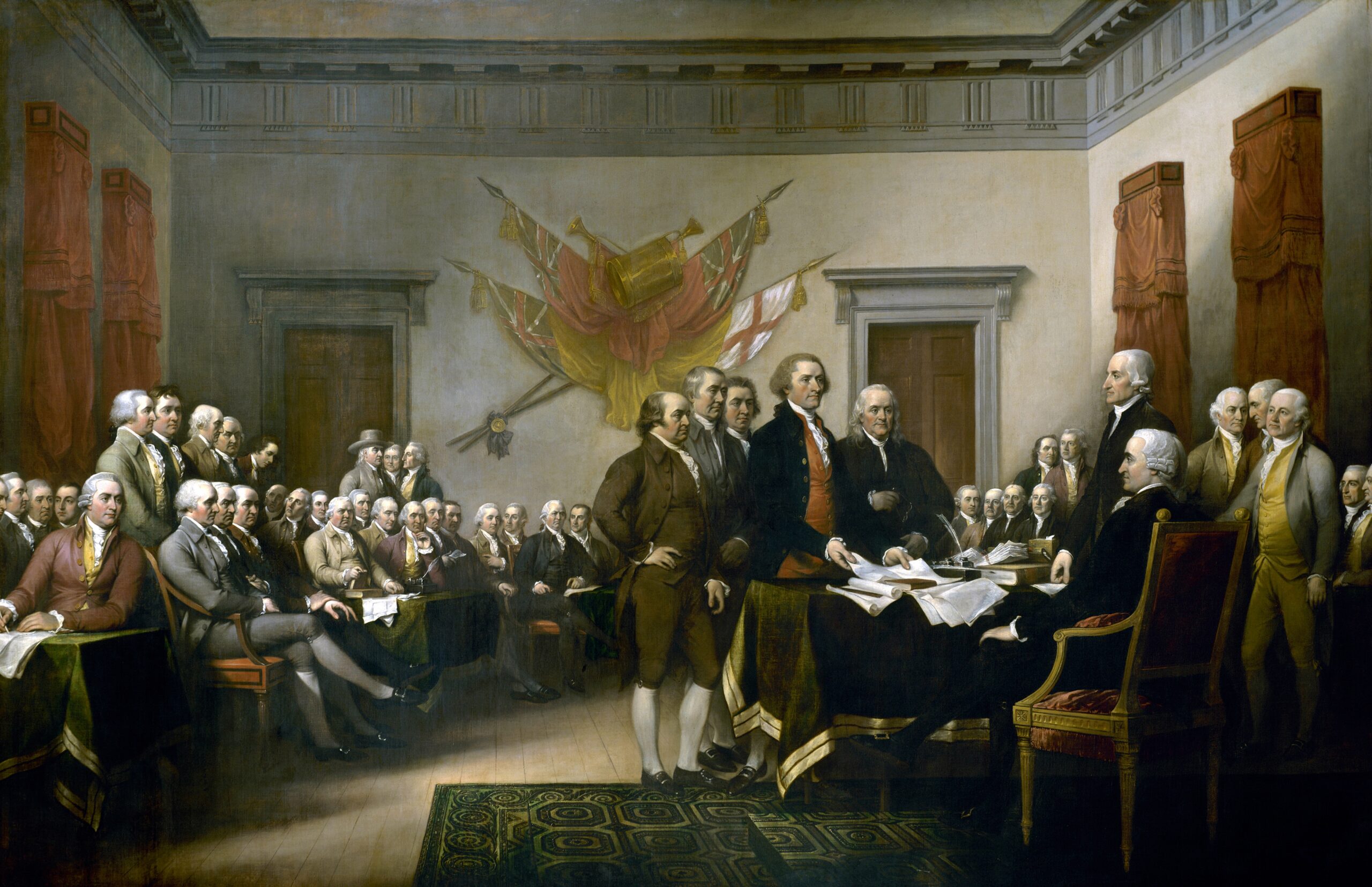
Twelve score and ten years ago, the 56 signatories to the Declaration of Independence made a break in history. They signed their death warrants on July 4, 1776, to secure unalienable rights to life, liberty, and the pursuit of happiness, i.e., the opportunity to march to your own drummer without fear of domestic predation or foreign aggression—the summit of civilization.
The end of government and civil society was to be justice, making everyone’s station in life correspond to character and accomplishments, simpliciter. Justice was to be promoted by the Constitution’s separation of powers and checks and balances to prevent any political faction from oppressing another.
The Declaration marked a break in history. Unalienable rights meant rights that cannot be taken away by any government whatsoever—including republics. The Declaration implied the sovereignty of each individual to live undisturbed absent encroachment on the unalienable rights of others. Government legitimacy ends when it roams beyond the defense of unalienable rights and optimizing justice.
No previous government or nation had recognized and exalted unalienable rights. None had celebrated justice as the summum bonum. None had acknowledged individual sovereignty to develop faculties and to pursue dreams or ambitions unhandcuffed by gratuitous laws or coercion. The Founders crafted an unprecedented government because they knew an important truth: No person or institution possessed the saintliness necessary to direct others how to live.
The electrifying idea of America has attracted the ambitious and talented, and it originated in the minds and actions of the best of men. No other country sported in one generation such giants as George Washington, Benjamin Franklin, John Adams, Thomas Jefferson, James Madison, Alexander Hamilton, and Patrick Henry. Mr. Jefferson maintained that “the mass of mankind has not been born with saddles on their backs, nor a favored few booted and spurred, ready to ride them legitimately, by the grace of God.”
Their counterparts in Great Britain during the struggle for independence were comparatively dolts or midgets. They have disappeared into the dustbowl of history: Lord North, Marquess of Rockingham, Earl of Shelburne, the Duke of Portland, the Earl of Sandwich, Lord George German, and Charles James Fox. King George III was intermittently deranged.
Subscribe Today
Get daily emails in your inbox
Our forefathers were imperfect, as left-wingers often remind us. But the Declaration and Constitution ushered in a system of government that through amendments or otherwise—including the Civil War—transformed the United States from a tiny acorn into a mighty oak over its first century. During those first spellbinding hundred years, immigration was virtually limitless. If you embraced and practiced the idea of America, you were an American. Then came the prejudiced Chinese Exclusion Act of 1882. The United States forgot that the idea of America was its most valuable asset because it generated unsurpassed human capital.
The idea of America was replaced in thought by retrograde, primitive, atavistic white supremacy, racial or gender spoils, tribalism, quotas, xenophobia, Judeo-Christian dogmatism, majority tyranny, and “my political party right or wrong.” We made a Faustian bargain: The idea of America honoring individual merit for an Empire mindlessly heroizing power or wealth for their own sakes irrespective of justice or morals. Higher life forms were made subservient to lower life forms. President Donald Trump is a perfect expression of this catastrophic plunge, like Lucifer’s fall from heaven.
As we prepare to celebrate the 250th anniversary of the signing of the Declaration, we could do well to remember the principles it codified and that made our nation great.