A Revisionist Adam Smith
Turn to Glory Liu’s incisive study of Adam Smith to vaccinate yourself against the bacilli of bad history lessons coming your way in 2026.
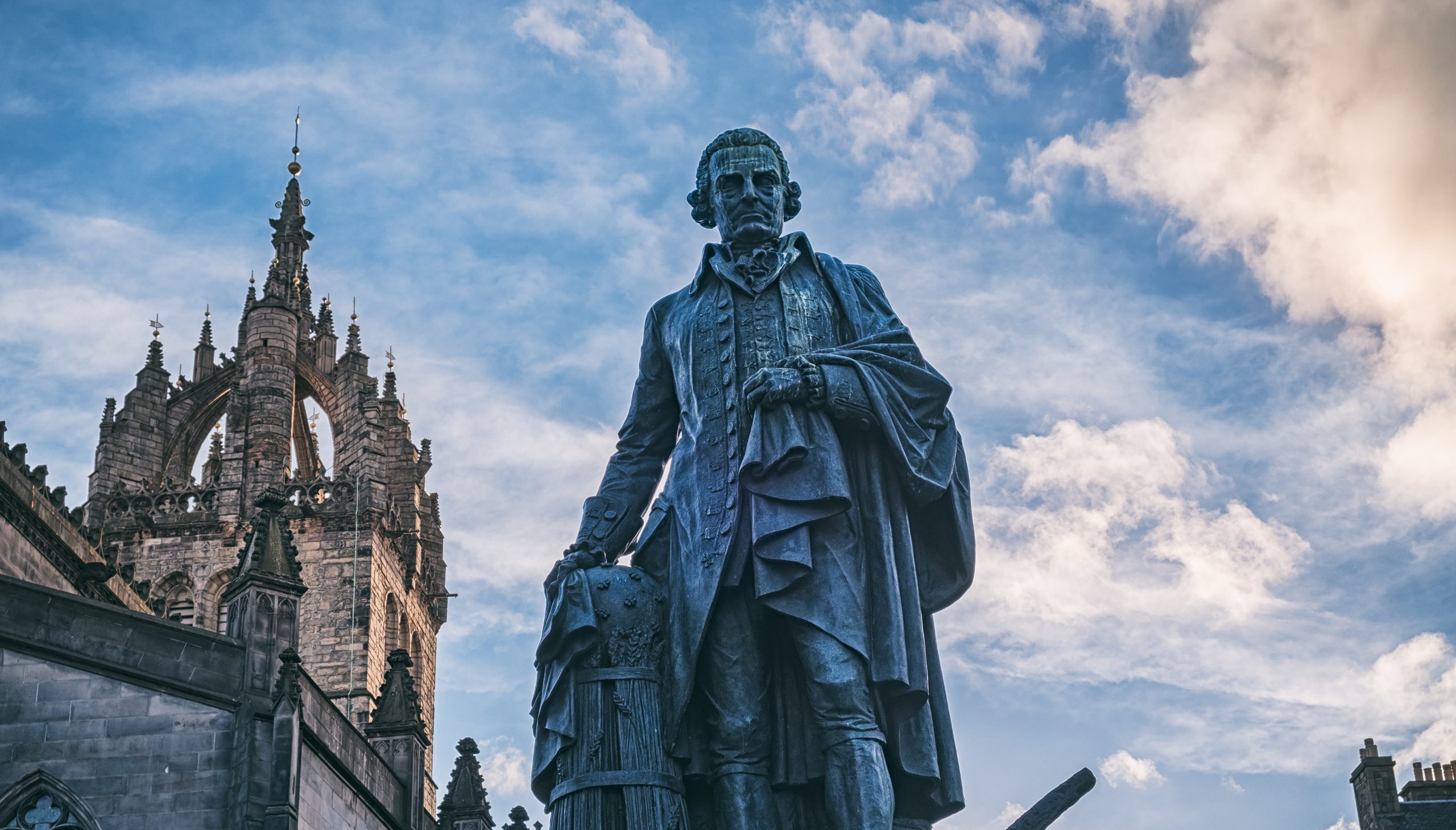
Adam Smith’s America: How a Scottish Philosopher Became an Icon of American Capitalism, by Glory Liu, Princeton University Press, 384 pages.
Start preparing now for the United States’s 250th birthday party in 2026. If you remember our Bicentennial, when the Concorde made its first commercial flight and the Starland Vocal Band’s “Afternoon Delight” topped Casey Kasem’s charts, then you probably also remember CBS’s Bicentennial Minutes. Each night at 9 p.m., fading stars like Jessica Tandy and Darren McGavin regaled captive viewers with triumphalist stories about the Revolutionary Era. In the platitudinous final episode, President Ford urged us all to “keep the Spirit of ’76 alive.”
Before American elites insisted we start hating ourselves, the “Spirit of ’76” evoked powerful sentiments related to individual liberty and self-determination. Now, fifty years later, the woke revolutionaries will be the ones who dictate how we celebrate our forthcoming semiquincentennial. They will harp on America’s racist, sexist, and imperialist sins while they scorn its admirable deeds.
Ignore the left’s diabolical legerdemain, for 2026 also marks the 250th anniversary of Adam Smith’s most famous work, An Inquiry into the Nature and Causes of the Wealth of Nations.
Smith’s thought, aptly embodied in his “invisible hand” self-interest metaphor, spurred early America’s transformation from the embryonic “cradle of Hercules” into today’s emporium of abundance. His writings on political economy informed the Founders, 19th century tariff debates, and the Chicago School’s neoliberal movement, among others.
Harvard lecturer Glory Liu’s important new book, Adam Smith’s America: How a Scottish Enlightenment Philosopher Became an Icon of American Capitalism, disputes this simplistic Bicentennial Minute version of Smith. Liu scoffs at Smith’s instrumental value as “an emblem for think tanks.” She explores how our “reductive, sloganized, and often politicized versions of Smith came about in the first place.” Liu challenges Smith’s reputation as the father of economics and dismisses the Wealth of Nations’s foundational status as a “belated construction.” Those who still own Adam Smith neckties from his 1976 bicentennial will profit from her archival sleuthing, coherent argument, and revisionist conclusion.
Novel claims require convincing proof, which Liu provides plenteously. She makes her compelling case chronologically by examining “inflection points in the process of [Smith’s] canonization.” Fellow Scotsman Dugald Stewart kicked off Smith’s canonization. His hagiographic 1794 tome, Account of the Life and Writings of Adam Smith, LL.D., appeared just eighteen years after The Wealth of Nations rolled off wooden printing presses. Stewart fell shy of Vatican standards; he provided no proof of verified miracles. Nonetheless, his fulsome praise and philosophical imprimatur provided intellectual materiel for Smith’s classical liberal disciples to push their free market agenda forward.
The Founding Fathers admired Smith’s works as “guidebooks for enlightened statesmanship.” Hamilton found inspiration for his own writings on money, banking, and the economy from Smith’s “deep-seated skepticism” of government competence in the financial realm. Smith’s corpus empowered John Adams as he “grapple[d] with the troubling socio-psychological influence of wealth on society.” And if you listen closely enough—and Liu did—you can even hear Smith’s Scottish burr in the most famous of all the Federalist essays. Madison’s prescient warning about factions in Federalist 10 expanded on Smith’s counterintuitive contention that more religious sects would increase competition among them and thereby render them “less dangerous” to the nascent republic.
American statesmen from across the ideological spectrum adopted Smith as needed during the early Republic. They likened Smith’s scribblings on the fledgling science of political economy to “an indispensable roadmap for a polity, economy, and society on the cusp of transformation.” As more and more Americans went off to college “seeking a secular and practical education” in the antebellum period, universities did their part to spread Smith’s gospel. Liu notes how northeastern university presidents—most of whom trained as ministers or preachers—proudly took it upon themselves to teach their schools’ political economy courses. Using what she calls “reception history,” Liu amassed thousands of syllabi and student notebooks to show how Smith’s thought affected students over the decades. As a professor who can’t even find last semester’s syllabus when I need to update it, I stand in awe of her organizational proficiency, let alone her well-supported inferences. Liu has set an evidentiary and methodological standard serious scholars should emulate.
While Liu details how the 19th century tariff debates “fundamentally altered the way Americans engaged with Smith’s ideas,” the Chicago School’s very own engagement with Smith rightly takes up more of her argument. Friedrich Hayek, George Stigler, and, later, Milton Friedman “reimagined” Smith to prepare for “their ideological battles over the content and future of liberalism” after the Depression pushed policymakers leftward. Their neoliberal policies eventually went global, most notably in Chile as Pinochet’s vilifiers love to complain.
Hindsight suggests the Chicagoans likely overdosed on Smith. The police should have given Stigler a breathalyzer test after he praised Smithian self-interest as “Newtonian in its universality.” Friedman told the university’s trustees his department’s empirical approach to economics “rejects alike facts without theory and theory without facts.” According to Liu, Friedman “turned Smith’s ideas...into positive science—as opposed to normative and philosophical—insights.” Did someone say “Follow the science”? Milton Friedman, meet Dr. Fauci.
But Friedman’s fanaticism didn’t stop there. Liu accuses him of weaponizing the “scientific validity of the invisible hand” into an argument for markets and against government interference. Unfortunately, she lets her politics intrude when she says Chicago’s “greatest consequence” was its reframing of “the problems of American capitalism and modern society” as “stemm[ing] from government.” Those of us outside the academy—and me trapped inside it—consider that Chicago’s greatest contribution.
Subscribe Today
Get daily emails in your inbox
Liu’s negative characterization of Chicago will come as little surprise to those who bother to read her introduction. There, she warns us about “[o]ne unavoidable and unfortunate consequence of this book’s approach and its emphasis on the process of canonization.” As one who sacrificed many a sunny day in a musty archive far from home, I thought for a second that Liu might rue her extended separations from family and friends or other social hardships that archival research imposes on academic historians.
Instead, wokeness’ gravitational pull compelled her to apologize for the simple historical reality that “the voices featured in this book are overwhelmingly white, male, affluent, and highly educated.” Let’s hope that disclaimer propitiates her tenure-review committee enough to grant her a lifelong sinecure, and the rest of us a reprieve from such virtue signaling in her next book. Serious historians learn from serious history books likeLiu’s insightful work. Tenure committees are pompous and silly, not serious, so we learn nothing from them. One wishes Adam Smith’s “invisible hand” would slap them.
Adam Smith doesn’t come to mind much anymore, thanks to a combination of our historical amnesia, cultural ignorance, and mayfly attention spans. Jeff Bezos, Elon Musk, and Kim Kardashian now rank as America’s icons of capitalism, not some dead, white, European moral philosopher who wrote with a quill pen and never posted anything on Instagram. Turn to Glory Liu’s incisive study of Adam Smith to vaccinate yourself against the bacilli of bad history lessons coming your way in 2026.