America, the Colonized Empire
A new film on Nigeria and the British Empire holds surprising relevance for citizens of the United States.
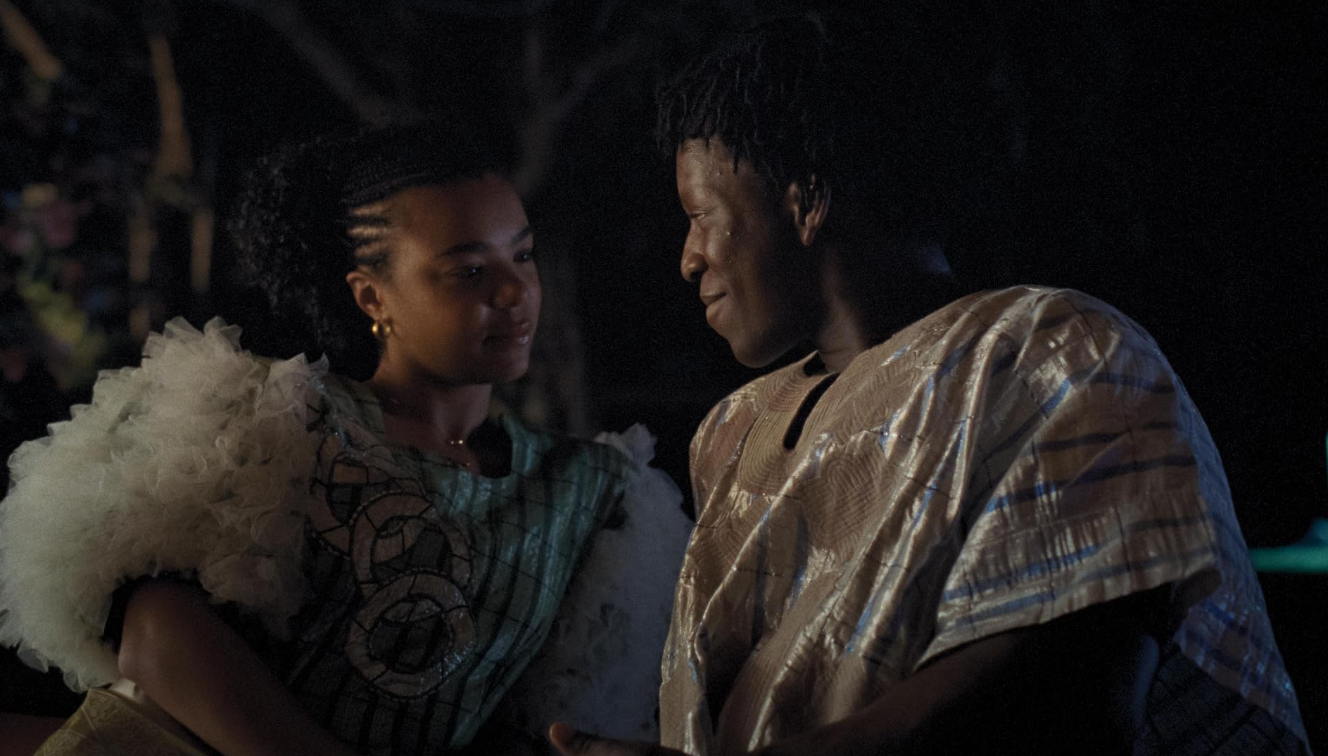
An American sitting in the Lincoln Center’s Alice Tully Hall on a Sunday evening for an early screening of the new film Clarissa might be forgiven for expecting, however wrongly, a standard “foreign” film on topics of distant concern.
Directed by twin brothers Arie and Chuko Esiri and set to hit theaters on December 11, the film reimagines Virginia Woolf’s 1925 novel Mrs. Dalloway, transposing the day-in-the-life story to contemporary Nigeria. I got the chance to see it on October 4 and found it surprisingly relevant to the concerns of a growing number of Americans.
The Lincoln Center always includes plenty of non-English language films in its New York Film Festival, and Clarissa has subtitles throughout its 135-minute runtime. So, it took this American audience member—dutifully reading the subtitles—a few minutes to realize, hey, they’re speaking English, albeit in a posh British accent.
This isn’t a case of Hollywood depicting citizens of the Roman Empire speaking the Queen’s English due to all the best actors being British, nor to a desire by the filmmakers to add a sense of gravity and elegance to the dialogue. The land and peoples that would become modern Nigeria were colonized, conquered, and controlled by the British Empire for more than 100 years. The British also provided (or imposed) Western education and English instruction, which was not distributed equally, and left the Nigerian elite sounding like their British overlords.
Nigeria gained its independence in the 1960s and the British Empire is no more, but the presence of the latter is still felt in the former through not just the accents, but also the habitus—the manners, mores, and traditional obligations—which orders the lives of the film’s main characters: the protagonist Clarissa (portrayed as her contemporary self by the British actress Sophie Okendo and as her young self by the British actress India Amarteifio) and her circle of privileged friends.
At the midpoint of Woolf’s novel, a traumatized veteran of the First World War, Septimus Smith, sits under a skylight, a few minutes past noon, in the office of the villainous psychiatrist Sir William Bradshaw. In the book, the implication is that the therapeutic state is the god of this world. Clarissa swaps Bradshaw for a benevolent female psychiatrist. The villain role is subtly filled by the long shadow of the British Empire and the inertia of the Nigerian social order.
Americans should be able to empathize with both sides of the equation. America replaced Britain as the global superpower after the Second World War. It has tended to present itself as a vast apparatus of benevolent hegemonic order, but its imperial adventures have been well-documented. And like the British Empire, it has spread its version of English globally. In his book How To Hide An Empire, the historian Daniel Immerwahr recounted a representative story from the Philippines following America’s defeat of the Japanese there in 1945:
Oscar Villadolid, a boy at the time, remembers a familiar scene from the aftermath of Manila’s “liberation.” A GI came down his street handing out cigarettes and Hershey bars. Speaking slowly, he asked Villadolid’s name. When Villadolid replied easily in English, the soldier was startled. “How’d ya learn American?” he asked. Villadolid explained that when the United States colonized the Philippines, it had instituted English in the schools. This only compounded the GI’s confusion. “He did not even know that America had a colony here in the Philippines!” Villadolid marveled.
America is an empire, the empire (for the time being), and it too casts a long shadow. While Woolf’s Septimus was a shell-shocked veteran of the late British Empire, Clarissa’s Septimus is traumatized from “his experiences fighting the country’s Boko Haram jihadist insurgency,” in the words of the film’s press materials.
According to Libertarian Institute Director Scott Horton, the American Empire helped make the indigenous Islamist insurrectionist group Boko Haram even more destructive than it would have been. First, the U.S. backed jihadists against the Libyan government, helping topple it in 2011. That jihad then spread to Mali, to which Boko Haram traveled in pursuit of both further Islamic indoctrination and weapons and tactics training. Saudi Arabia and Qatar, both Major non-NATO allies of the U.S., have both been accused of funding Boko Haram since at least 2014.
On the other side of the equation, the United States was also a colony that broke away from the British Empire. It took America a long time to get out of Britain’s shadow. According to Gareth Porter and John Kiriakou in their book The CIA Insider’s Guide to Iran, in 1953 President Dwight D. Eisenhower wanted to work with Iran’s Prime Minister Mohammad Mosaddegh. Eisenhower was eventually undermined by the Anglo-American deep state of the time, and the U.S. did what Britain wanted, backing a coup that ousted Mosaddegh. We’re still dealing with the fallout of that decision today.
These days, Britain has been reduced to a pathetic vassal of its former colonies. But that doesn’t mean America is fully independent. The imperial center has been colonized by another foreign power, its ostensible client Israel. Walk through the halls of power in Washington, DC, and the Israeli flag is everywhere. Our elite are beholden to Israel and its lobby. Our children are thrown into its service on the frontlines of futile wars.
Subscribe Today
Get daily emails in your inbox
Eli Clifton and Ian Lustick detail this intolerable situation in their new book Israel’s Lobby: America in the Grip of a Foreign Power. Promotional copy for the book summarizes the sick state of affairs:
The greatest story in geopolitics and in American domestic affairs is how the far-right government of a small Middle Eastern country came to hold a controlling interest in United States foreign policy. Israel’s lobby is now in a position to police the speech of American politicians, college students and journalists, and coerce and persuade the White House to back unpopular, costly, and ultimately national security-threatening policies.
As our government gears up for more “kinetic action” against Iran, Americans are starting to notice that our elite all speak like Zionists. Clarissa does not just speak our language. In a deeper sense, it speaks to us.