How Israel Conquered the Latin American Right
From Bukele to Bolsonaro, the region’s conservatives have learned to love Zionism.
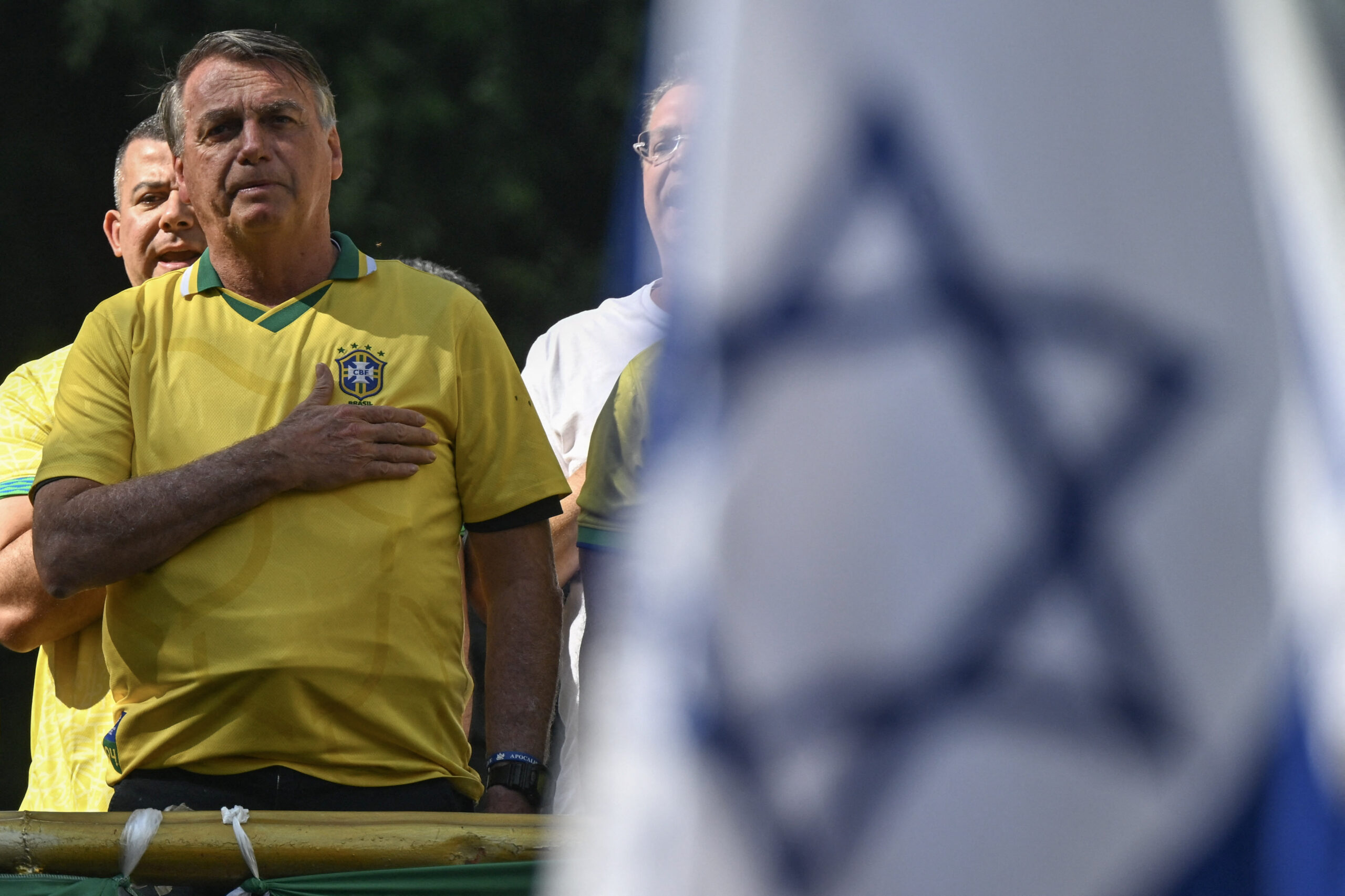
Among the first acts of Colombia’s new president Abelardo de la Espriella was to formally recognize Israel’s claim over the Golan Heights. Months earlier, Brazilian presidential candidate Flávio Bolsonaro—who is currently locked in a tight race with the incumbent Lula da Silva—had met with Israeli settlers in the occupied West Bank, for whom he expressed his “full support.” (Bolsonaro the younger also stated that as president, his first international visit would be to what he and Israeli supremacists call “Judea and Samaria.”)
From Santiago to Tegucigalpa, Latin America’s latest wave of right-wing governments have deepened relations with Israel—even as most of the region’s residents remain skeptical.
Outside of a few Central American countries, public perceptions of Israel are overwhelmingly negative in Latin America. In 2026, Pew found that 60 percent of Chileans, 56 percent of Colombians, 55 percent of Argentines, 54 percent of Brazilians, and 50 percent of Peruvians had an unfavorable view of Israel (favorable views ranged between just 21 and 29 percent). In the same countries, nearly two-thirds of respondents said they had “no confidence” in Israeli Prime Minister Benjamin Netanyahu. What, then, explains the stark discrepancy between public opinion and the positions of right-wing governments?
There are basically three factors at play. As I argued in the last edition of this magazine, the first centers on the self-hatred of Latin American elites, and the related worship of purportedly more developed countries—most notably, the United States and its allies. From the perspective of highly educated, right-wing businessmen and politicians, support for Israel is a low-cost, high-visibility way of signaling fealty to Washington and especially the Trump administration. The second finds its motive force from evangelical pulpits, Pentecostal megachurches, and the Zionist outreach that has quietly built a religious infrastructure for pro-Israel politics. In many states in the region, Israel’s multinational lobby has cultivated an evangelical electorate with considerable political sway. Finally, security ties with Israel have helped some of the region’s governments to accomplish their own strategic goals (including, in some cases, the surveillance of political opponents).
***
Of all of the region’s right-wing leaders, Colombia’s Abelardo de la Espriella is arguably the emphatically and cynically pro-Israel. For years, de la Espriella—a millionaire lawyer for drug traffickers—was a self-described atheist, until he converted to Catholicism prior to launching a presidential bid. In tandem with his newfound religiosity, he also acquired a fervent Zionism, mediated by an elite network of diplomats, Jewish community leaders, and evangelical pastors. In 2025, the then-candidate met privately with the Israeli Foreign Minister Gideon Sa’ar, who later thanked de la Espriella for his recognition of Israel’s sovereignty over the Golan Heights. And by June 2026, de la Espriella was saying he believed that Netanyahu had done what was necessary in Gaza to defend Israelis and that Colombia would “restore and strengthen its relationship with the State of Israel like never before.”
An investigation by the Colombian publication Revista Raya found that during the election, Colombia’s Evangelical Confederation, Cedecol, organized prayer vigils in favor of the now president. Cedecol’s vice president, the pastor Rodrigo Barreto, also met personally with Israel’s President Isaac Herzog during the World Cup. (Notably, the confederation also promotes pilgrimage packages to the Holy Land through a partnership with the Land Tours, an international travel agency whose Colombian representative campaigned openly for de la Espriella.)
Evangelical pastors such as Raúl Rubio, who has worked with the Israeli land development organization Keren Kayemeth, have played prominent roles in the new president’s campaign and government. Last November, Rubio addressed a de la Espriella rally at Bogotá’s Movistar Arena, promising the crowd that the candidate would restore ties with Israel. Days later, de la Espriella pledged to relocate Colombia’s embassy to Jerusalem, a move that now appears to be in motion.
Unsurprisingly, the former Israeli consul in Colombia, Kobi Valer, spent years cultivating relationships with conservative politicians, including arranging trips to Israel for Colombian journalists and influencers during the Gaza offensive. In the wake of de la Espriella’s victory, Israel’s Diaspora and Antisemitism Minister Amichai Chikli celebrated the result on X as marking not just the “collapse of populist socialist ideologies” but “the strengthening of Israel’s position on the continent.”
On security, five decades of arms deals and cooperation with Israel have brought arguably as much harm as good to Colombia. In the 1980s, an Israeli mercenary firm headed by former IDF colonel Yair Klein trained the death squads that later coalesced into the infamous, far-right paramilitary United Self Defense Forces of Colombia (AUC); the group’s founder, Carlos Castaño spent part of the ’80s training in Israeli military schools before returning home to Colombia. A Colombian court later sentenced Klein in absentia to more than a decade in prison for his role in creating the AUC; he served time in a Russian prison, but ultimately avoided extradition to Colombia. Decades later, Klein said that the landowner and future right-wing President Álvaro Uribe was among those who helped finance his activities, a claim Uribe has denied.
Since 1994, moreover, Colombia’s state arms manufacturer, Indumil, has produced the Galil rifle using Israeli components. In 2024, former president Gustavo Petro revealed that Colombia's police intelligence directorate, DIPOL paid Israeli spyware firm NSO Group $11 million in cash for Pegasus software during the preceding Duque administration. The purchase was partly financed by Washington and allegedly used to intercept the communications of journalists and opposition figures (purportedly including Petro himself).
In contrast to de la Espriella, the Zionism of Chile’s José Antonio Kast seems comparatively deep-seated, if still a product of elite opinion on the Right. A member of the conservative Catholic Schoenstatt Apostolic Movement, Kast slammed his progressive predecessor Gabriel Boric for severing ties with Israel. Among his first acts as president-elect was a phone call with Netanyahu—a striking gesture in a country home to the largest Palestinian diaspora outside the Middle East and least positive attitudes in the region towards the Jewish state. Unlike in Colombia, moreover, it’s hard to argue that Kast’s Israel overtures have served any meaningful strategic interest.
In narcoterror-stricken Ecuador, President Daniel Noboa has been among Israel’s most active defenders. In May 2025 he toured the Western Wall in Jerusalem, telling Netanyahu that Israel and Ecuador “have the same enemies,” whom he pledged to “fight to the end.” Days later, Noboa condemned the supposed threat posed by the Muslim Brotherhood inside Ecuador. In a move clearly aimed at toadying to Jerusalem and Washington, the banana tycoon-turned-president officially designated the group as a terrorist organization December 2025. For context, the number of Muslims in Ecuador is thought to be in the neighborhood of 500-2,000, or roughly 0.01 percent of the population. If there is indeed an Ecuadorian branch of the Muslim Brotherhood, its membership likely numbers in the single digits.
More consequentially, Noboa’s embrace of Zionism has come with Israeli hardware attached. In 2022, the Ecuadorian government signed a $65 million contract with Israeli firm Elbit Systems for more than 130 armored vehicles, which have since been deployed in the country’s ongoing drug war. During a 2025 trip to Jerusalem, Noboa told reporters he had discussed cooperation on security at Ecuadoran ports and border crossings with Israeli and Emirati officials.
Arguably the most bizarre defender of Israel in the Americas is Argentina’s self-proclaimed anarcho-capitalist president, Javier Milei. Since taking office in December of 2023, Milei has visited the Holy Land three times, and last year became the first Argentine head of state to address the Israeli Knesset. Milei is also the engineer of the so-called “Isaac Accords” (a play on Trump’s Abraham Accords), which aim to deepen ties between Israel and Latin America. Netanyahu has called Milei “a great friend of Israel”; during the summer World Cup, the prime minister personally relayed his well-wishes to “Javier”, playing on the phonetic similarity between Milei's first name and the Hebrew word for friend—chaver.
For his part, Milei has described the U.S.-Israel bombing campaign against Iran as “the right thing to do,” framing Argentina and Israel as “brothers in suffering.” In 2024, the Milei administration signed a multi-year defense cooperation agreement with Israel, establishing contracts for cyber capabilities, drones, munitions, and communications equipment. The following year, the Argentine president was awarded the Genesis Prize—otherwise known as the “Jewish Nobel”—for his unwavering support of Israel. Milei subsequently donated the $1 million cash prize to the newly established American Friends of the Isaac Accords.
The Argentine president has even expressed an intention to convert to Orthodox Judaism after leaving the presidency—a stunning statement considering that, until 1994, Argentine presidents were constitutionally obligated to profess the Catholic faith.
Outside of Central America, Brazil poses the clearest illustration of the religious roots of support for Israel. Since 1990, self-described evangelicals have grown from under 9 percent of the Brazilian population to nearly 30 percent, becoming in the process a key conservative voting base. In 2016, the former President Jair Bolsonaro (2019–23) was baptized in the Jordan River, a move that helped consolidate his support among evangelicals. At the time, the powerful evangelical caucus in congress—a group that currently includes around 40 percent of the Chamber of Deputies and 25 percent of the Senate—was demanding the relocation of Brazil’s embassy to Jerusalem. Wary of jeopardizing halal meat exports to Arab markets, Bolsonaro stopped short on the embassy move, though he did deliver on other priorities such as appointing the evangelical pastor André Mendonça to the Supreme Court.
Jair’s sons Eduardo and Flávio—the latter of whom is in the midst of his own presidential campaign—have made repeated pilgrimages to Israel, meeting with Netanyahu and Knesset Speaker Amir Ohana. In February, Eduardo stated alongside his brother that “it’s hard to find a point where we disagree with Israel.” On the campaign trail, Flávio has repeatedly referred to Brazil’s so-called Judeo-Christian heritage with eyes on evangelical voters.
Funnily enough, the criminal underworld of the Bolsonaros’ political base of Rio de Janeiro offers a disturbing coda to the influence of evangelical Zionism. One of the city’s most powerful drug gangs is the evangelical Terceiro Comando Puro (TCP), which uses the Israeli flag on its drug packaging and dubs a cluster of favelas it controls the “Complexo de Israel.” The TCP’s leader, Álvaro Malaquias Santa Rosa, alias “Peixão,” has framed his activists in explicitly Pentecostal terms, presenting himself as operating by divine will. Another prominent evangelical gang, the Povo de Israel, originated inside Rio’s prison system, growing to roughly 18,000 incarcerated members, or 42 percent of Rio’s prison population.
Of the region’s many Zionists, by far the most sincere are the right-wing leaders of Central America’s increasingly evangelical republics. Evangelicals represent around 40 percent of the population in Costa Rica, El Salvador, Honduras and Guatemala, making them the largest religious group in many places. Unsurprisingly, this has correlated with a marked shift toward Israel on the part of the region’s governments. In 2018, Guatemala relocated its embassy to Jerusalem, and Honduras followed suit in 2021.
In the case of Honduras’s far-right National Party, loyalty to the Jewish state has seemingly paid outsized rewards. Under autocratic president Juan Orlando Hernández (JOH)—who was sentenced to 45 years in an American prison for trafficking 500 tons of cocaine—Honduras’s relationship with Israel went far beyond purely religious sympathies. In December 2016, Hernández traveled to Jerusalem for the second time in just over a year to finalize a $209 million military cooperation agreement with Israel’s Defense Minister Avigdor Lieberman—the largest in Honduras’ history, including upgrades to the country's aging F-5 and A-37 fighter jets, a new offshore patrol vessel, Skylark drones, and, tellingly, millions of dollars’ worth of cybersecurity and surveillance systems.
With the Nationals out of power following the 2021 election of the left-wing Xiomara Castro, Israel nonetheless remained a factor in Honduran politics. A cache of leaked audios published earlier this year by Spain’s Canal Red—dubbed Hondurasgate—purported to show that Israeli officials working alongside the Trump administration helped engineer JOH’s pardon as well as a disinformation campaign in favor of now-President Nasry Asfura. “The prime minister of Israel is going to support us,” a voice alleged to be that of JOH is heard saying in one recording, crediting Israeli officials with securing his release and pardon. The recordings also describe Asfura’s own 2025 election—won after Trump threatened to cut off U.S. aid unless the National Party prevailed—as a placeholder arrangement ahead of JOH’s planned return to the presidency. The pair further detailed plans for a new U.S. military base in Honduras and legislation favorable to Israeli and American AI investment.
By far the most curious and uniquely cynical case in Central America is that of El Salvador’s Nayib Bukele. A descendent of Muslim and Christian Palestinian immigrants, Bukele’s father converted from Christianity to Islam in the 1980s, became an imam, and founded four mosques in El Salvador. Nonetheless, the Salvadoran strongman built much of his career by courting evangelical voters. Amid questions over his faith, Bukele declared himself alongside allied pastors as a devout disciple of Jesus Christ. Despite his Palestinian ancestry, the millennial president has been an ardent defender of Israel’s campaign in Gaza, drawing an explicit parallel between Hamas and the infamous MS-13 street gang. (Nevertheless, El Salvador has yet to relocate its embassy to Jerusalem.)
Perhaps the most ambiguous instance of Israel’s outreach in Latin America is its involvement in Mexico. Prior to the 2018 election of the former President Andrés Manuel López Obrador (AMLO) of the ruling left-wing Morena party, Israel maintained a close diplomatic and commercial relationship with centrist and right-wing governments in Mexico, based in part on the sale of Israeli arms and surveillance technology. Parts of this relationship have survived under Morena, mostly thanks to Mexico’s entrenched federalism.
During the administrations of Felipe Calderón and Enrique Peña Nieto in the late 2000s and 2010s, Mexico deepened security ties with Israel, becoming the first foreign client of Pegasus spyware in 2011 (the deal was reportedly struck at a strip club between NSO representatives and Mexican officials). Mexico also acquired Israeli surveillance drones, including the Hermes 450 and Dominator XP. Peña Nieto’s government deployed Pegasus not so much against the country’s infamous cartels but allegedly against journalists, human rights lawyers and AMLO’s 2018 campaign.
Just months after attending former Israeli prime minister Shimon Peres’s funeral in Jerusalem, Peña Nieto met with Netanyahu in Mexico City where he accepted an Israeli offer to help Mexico “develop” Central America. Critics read the statement as offering cover for furthering Israeli arms sales with Mexico’s southern neighbors. By the time AMLO took office in 2018, Mexico was dubbed the “most prolific user” of Pegasus, a practice that has evidently continued under Morena.
As with the leadership of the Democratic Party in the United States, some left-wing parties in Latin America have maintained relatively good relations with Israel. In the case of Morena, a surprising minority of its members—mostly at the state level—has kept up relations with Israeli counterparts. In keeping with Mexico’s historic policy of nonintervention, both AMLO and the current President Claudia Sheinbaum, who is Jewish, have generally avoided commenting on events in the Middle East, including whether Israel’s offensive in Gaza was a genocide until 2025.
Subscribe Today
Get daily emails in your inbox
In September of 2024, Morena governor Salomón Jara presided over a handover ceremony for assault rifles purchased from Israel Weapon Industries for Oaxaca’s state police. Under Mexican law, only the military-run Department of Defense, Sedena, may legally buy or sell arms. Sedena, however, is obligated to purchase orders made by individual state governments ,meaning that Mexico’s 32 governors (irrespective of party) can effectively set their own procurement policies. Oaxaca officials, for instance, claimed that the assault rifle deal ran through Sedena; AMLO later insisted that the contracts had been signed directly by the state. Whether at the state or national levels, Mexico has purchased at least $50 million in equipment and services from Elbit Systems, Israel Aerospace Industries and Rafael Advanced Defense Systems, including Elbit’s Hermes 900 drones.
Right-wing Zionism in Latin America ultimately boils down to three interrelated factors. On one level, support for Netanyahu acts as a credential to be flashed at Washington and potentially cashed in for rewards: security assistance, bailouts, tariff relief, diplomatic cover, or pardons. On another level, particularly in Brazil and Central America, support for Israel taps a genuine and rapidly expanding religious constituency, one with significant political clout. Finally, there are countries—most notably Colombia, Ecuador, and Mexico—for which Zionism serves a more strategic purpose, by securing access to munitions, defense equipment, and intelligence capabilities. (Of course, security ties with Israel have just as often led to public harm, particularly when used by incumbents to persecute opponents.)
Outside Central America, the cold electoral truth is that the recent triumphs of Latin American conservatives have occurred in spite of their Zionism, not because of it. Right-wingers in the region would do well to recall a previous generation of conservatives—and yes, many of their leftist peers—who have adhered to a more pragmatic foreign policy. They could also point to longstanding support from the Catholic Church in favor of a two-state solution and Palestinian Christians. For the moment, however, it seems that the Latin American right is standing firm in its support for Israel. Time will tell if this trend endures.