On Iran, Republicans Want to Have It Both Ways
Caught between voters and the White House, vulnerable GOP candidates try to oppose the war without opposing the war.
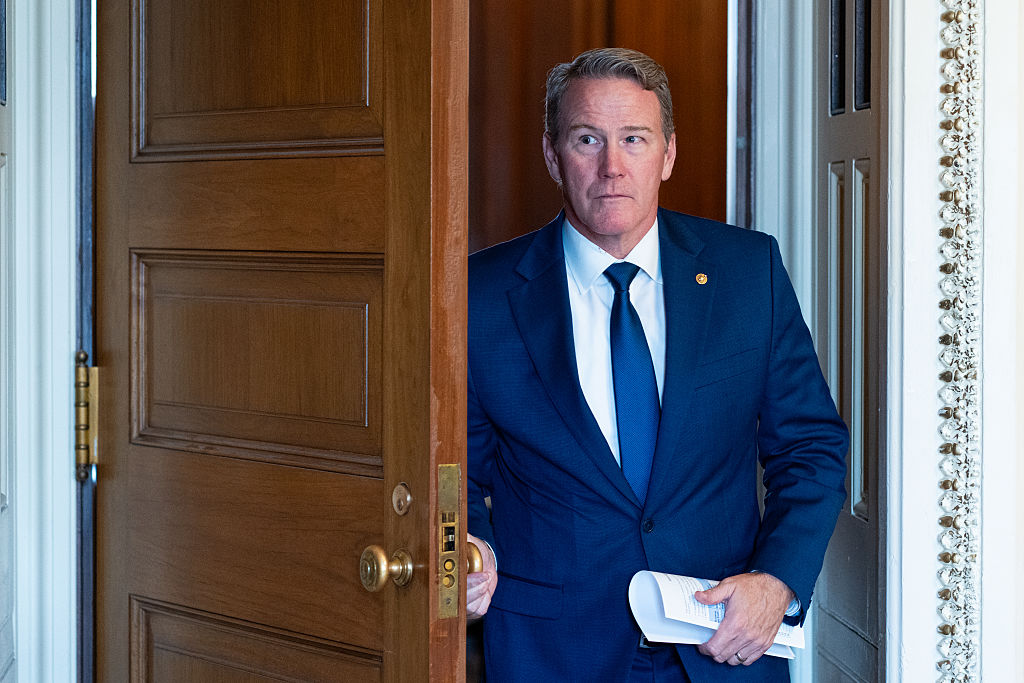

When J.D. Vance was elected to the Senate from Ohio in 2022, he won his race by a healthy 6-point margin. Four years later, his successor in that seat—Sen. John Husted (R-OH)—is down by between 4 and 8 points, depending on the poll.
Midterms are always hard for the party in power, and GOP candidates this year face a number of headwinds. But let’s be honest: It’s the war, stupid. Voters in Ohio, like voters across the country, are furious at paying more for gas (and everything else) because the president got us into an unwinnable Mideast conflict at the behest of a foreign country. They’re tired of bearing the costs, and they’re tired of being lied to.
So Husted has sought to distance himself from this debacle. “The war needs to come to an end as quickly as possible so that we can lower gas prices,” he told POLITICO this week. “I don’t know anybody who doesn’t want this war to end.”
Of course, Husted is not just “anybody.” He is a sitting United States senator, a member of the body charged by our Constitution with deciding whether or not the country goes to war.
And, as fate would have it, that body had before it yesterday a measure to end the war Husted says he wants to end. Naturally, the junior senator from Ohio was a “yes.” Right?
Alas, no.
Husted joined 48 of his GOP colleagues (plus Democrat John Fetterman) in voting down H.Con.Res.89, a concurrent resolution that would have “direct[ed] the President to remove the use of United States Armed Forces from hostilities against the Islamic Republic of Iran.”
In other words, he says it is imperative for the war to end, and is resolutely opposed to any measures to effect its conclusion.
Unfortunately, Husted is far from unique. Rep. Ashley Hinson (R-IA), who is running for the Senate in Iowa, made headlines this week by calling for an “immediate end” to the Iran War. But she, too, refuses to do anything to bring this about, voting against a war powers resolution in the House as recently as last week.
Mike Rogers, the GOP’s Senate candidate in Michigan, at least has the luxury of not having been in Congress for the launch of our latest Mideast quagmire. So his statement in a video this week that “the war with Iran needs to end, and end quickly” might seem a bit more credible. But it amounted only to the expression of a vague wish; it was no more a call to action than my hoping aloud it won’t rain this weekend and spoil my camping trip. (And anyway, Rogers is a confirmed forever-war fan, even boasting after last year’s Iran strikes that he “was for all this when it wasn’t very cool to be for all this.”)
A few Republicans, for what it’s worth, have had the courage of their convictions on Iran. In last week’s House vote, seven GOP lawmakers actually supported an end to the war: Reps. Thomas Massie (KY) and Warren Davidson (OH), who have been consistent stalwarts for America First, but also Reps. Nancy Mace (SC), Brian Fitzpatrick (PA), Tom Barrett (MI), Mariannette Miller-Meeks (IA), and Zach Nunn (IA). (These last four are running in tight reelection campaigns.)
But that is seven out of 218. Barely 3 percent of House Republicans can be bothered to cast even a symbolic vote to reject the executive’s unconstitutional usurpation of Congress’s war powers and direct an end to the least popular war in American history.
Subscribe Today
Get daily emails in your inbox
Instead, the overwhelming approach has been to try to trick voters into thinking vulnerable GOP candidates are somehow “breaking” with the administration on Iran. To vaguely say the war is bad while studiously avoiding even the appearance of action—lest the White House take notice—and hope that voters don’t think too hard about what it is legislators are supposed to do.
The elevation of appearances over reality is an enduring feature of our politics, of course, and it’s not just restricted to war. Capitol Hill is far more of a stage for social media antics than a place to conduct affairs of state, a sad fact which has led at least one especially wise and persuasive columnist to conclude that Congress is fake.
But voters aren’t (always) as dumb as politicians think they are. And come November, I expect most will see through the ruse.