
Carlson’s Christian Charity Is Not Statecraft
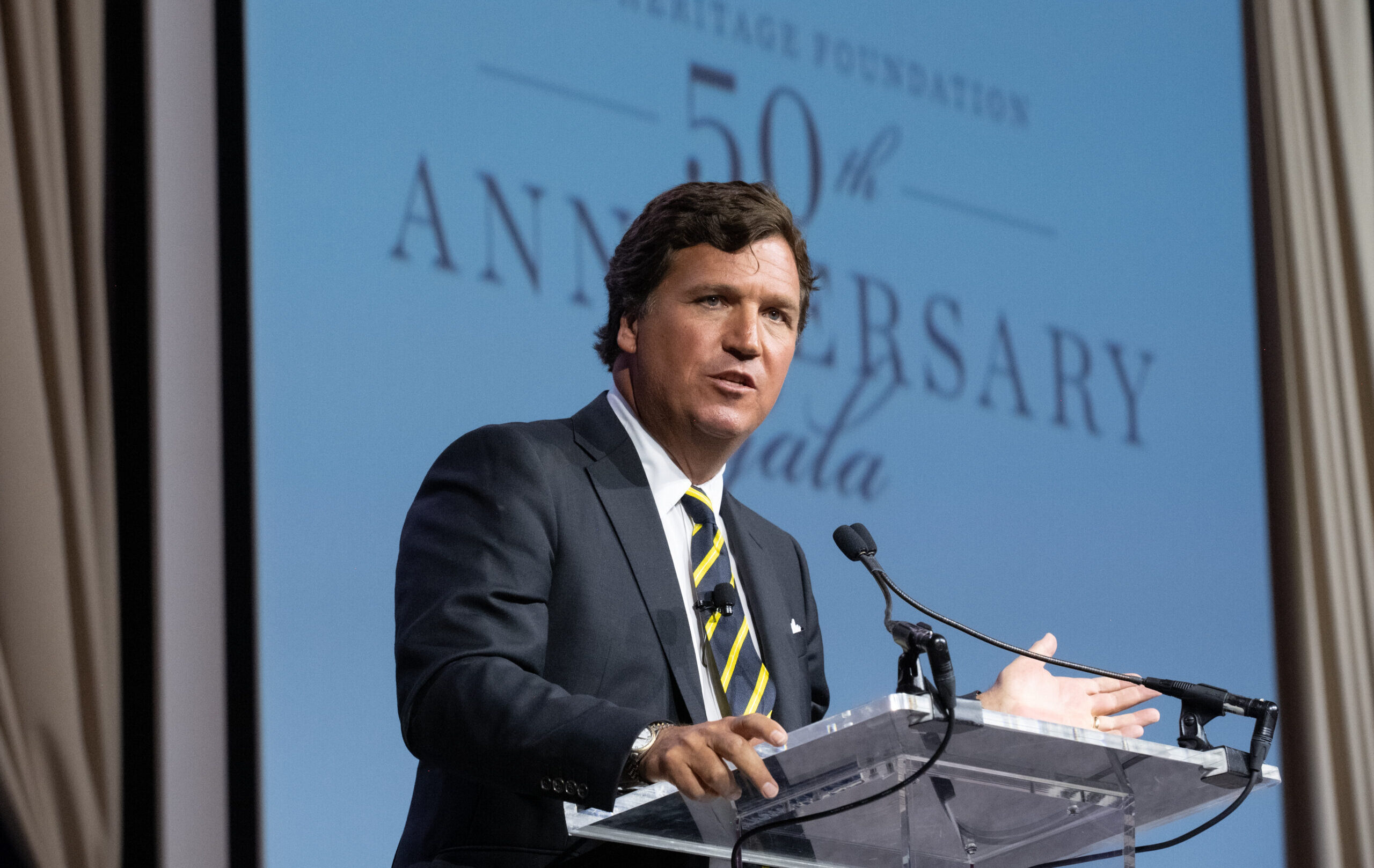
Tucker Carlson, in a recent interview with The American Conservative that sparked significant controversy, was right to insist that Christianity rejects collective guilt at the level of individual moral judgment. But when reflecting on the supposed phenomenon of “rising Islamophobia,” he made a fundamental and dangerous mistake by attempting to translate that moral axiom into political principle. Individual morality cannot be policy. States do not govern souls; they govern populations.
Immigration, war, and internal security are necessarily decided at the group level, taking into account statistical risk, historical experience, and civilizational compatibility. Emotional language about “hatred” of one group or another is irrelevant to these decisions. A state that governs as a confessor rather than as a sovereign will not survive. This category error runs throughout Carlson’s argument and is most clearly exposed in his assertion that he does not know anyone “who’s been killed by radical Islam” in the last twenty-four years.
Public policy cannot be made on the basis of personal acquaintance. Islamic threats are not evenly distributed. They strike first at journalists, soldiers, aid workers, police, dissidents, and civilians unlucky enough to be in the wrong place. The absence of Carlson’s personal proximity to violence is not evidence of its irrelevance; it is possibly evidence of insulation. But in this case, even the claim itself is false.
In 2014, Steven Sotloff, a freelance journalist who had written for The Daily Caller—which Carlson co-founded in 2010—was captured by ISIS in Syria and publicly beheaded. Sotloff was not a soldier. He was not a combatant. He was a young American reporter working in the orbit of Carlson’s own media enterprise. His murder was part of a deliberate campaign of ideological terror carried out in full view of the world. That Tucker overlooked, or perhaps forgot, the murder of Sotloff only reinforces the danger of basing national policy on anecdote, memory, or emotional framing.
Terrorism itself is not even the core issue of Islamic extremism. Civilizations rarely collapse from spectacular violence alone. They erode through demographic pressure, parallel legal systems, self-censorship, intimidation, and the gradual replacement of one moral order by another. The grooming gangs of Britain and the increases in rape rates across Europe due to Islamic immigration speak plainly enough.
Which brings us to the very question Carlson glosses over: Islam itself.
Whatever Western civilization and Christian charity are, they are not Islam, much less Islamic extremism. Western civilization emerged from Christianity’s separation of God and Caesar, the primacy of individual conscience, and the subordination of political authority to constitutional law. Islam is a comprehensive civilizational system that fuses religion, law, and governance. It places the community above the individual, religious law above secular authority, and collective obligation above personal conscience.
Collective punishment is not an aberration within Islam; it is embedded in its jurisprudence and historical practice. Apostasy and blasphemy are criminal. Loyalty is owed first to the ummah, the community of believers, not to the nation-state. These are not extremist distortions; they are mainstream doctrines openly taught in Islamic law. Their application on American soil, being revealed concurrent with Tucker’s words, is self-evident in the fraudulent predations of the Somali population of Minnesota.
None of this is a moral condemnation of individual Muslims. It is a structural observation about the belief system that is Islam and the political implications of that system. Confusing those two categories is how serious analysis becomes impossible. Carlson treats any discussion of group behavior as though it were an accusation of inherited guilt. That is false. States routinely make, and should make, group-based judgments because groups behave differently. Insurance companies do it. Militaries do it. Epidemiologists do it. Immigration policy has always done it. Only in the late-modern West has acknowledging the obvious reality of group differences been declared immoral.
Subscribe Today
Get daily emails in your inbox
The United States historically succeeded in part because it selectively admitted people from cultures that could be absorbed into an Anglo-American civic framework that encompassed secular law, free speech including sacrilege, religious pluralism, and loyalty to the nation over sectarian identity. These are all concepts Carlson claims to value. Large-scale Muslim immigration has repeatedly failed this test in Europe and is beginning to fail it here. How and why is he glossing over such an obvious pattern?
There is a final irony that deserves to be stated plainly. For decades, Americans were sent abroad to fight men animated, in large part, by Islamic extremism. Now, having declared those wars misguided or immoral, we are told that adherents of that same ideology should be welcomed wholesale and treated as future citizens without discernment. Even if the wars were wrong, it does not follow that the ideology was benign, or that importing it strengthens the nation.
The American people—and yes, we are a people—can hold two truths at once: that every human soul has dignity, and that not every belief system is compatible with the American way of life. Christian charity governs how individuals treat one another. Our statecraft should govern whether a people endure and thrive. Carlson’s confusion of Christian morality with the necessities of statecraft is a category error that could easily doom the nation. The lessons of Europe are writ large. We import extremist adherents of Islam at our own risk.