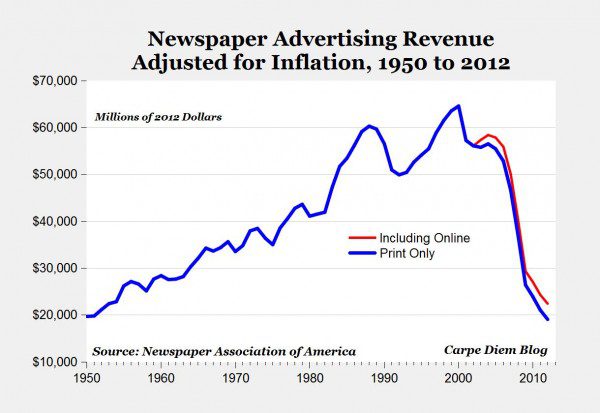
Holy crap. Fifty years of gains, wiped out in a decade. This is a total collapse of the newspaper business. Says economist Mark Perry:
It’s another one of those huge Schumpeterian gales of creative destruction.

Holy crap. Fifty years of gains, wiped out in a decade. This is a total collapse of the newspaper business. Says economist Mark Perry:
It’s another one of those huge Schumpeterian gales of creative destruction.
What’s the creative part? ROI for print advertising remains 10 times that of digital, with digital GOING DOWN! Online advertising is tanking. GM pulled all ads from Facebook because it’s a money loser.
As Eric Schmidt stated, the Internet is mankind’s greatest experiment with anarchy.
bob c:
I think online advertising is quickly closing the gap. See here: http://latimesblogs.latimes.com/entertainmentnewsbuzz/2012/04/internet-advertising-hits-record-31-billion.html
Internet advertising has recently hit $31 billion in expenditure. And who knows whether that count is exhaustive or accurate?
Darrell: Where’s your evidence that digital/internet advertising is declining? That GM–one company–pulled its advertising from a single website is hardly indicative of a trend. Ads are everywhere on the internet.
It’s all Rod’s fault.
I’m only half joking.
Just look at the posts here on Groeshel. They are hearfelt, thoughful and thought provoking, well-researched posts discussing the role of enchantment in religion, wondering whether pedophiles are people too and discussing the factual backgroud of Groeshel’s history at a level that is far out of reach of newspaper reporters.
Rod’s output in just a few days on a serious subect is far deeper, far better thought out and far better researched than anything in rpint. Why, why would I even bother with the New York Times when there a valuable resource like Rod available?
And that’s true for every single bit of the unvierse of human interest–politics, engineering, science, poker–you name it and several somebodies are writing thoughtful blogs on that subject. They are “covering” the subject far better in much greater depth and expertise than the subject is covered by traditional media.
See, it’s Rod’s fault.
Beyng:
MIT Technology Review. The ROI for digital advertising is declining. So, the old paper model is being replaced by gossiping on daily blogs for free and begging with tip jars.
Right now, when I scroll up, I see advertisements for a certain cancer charity sponsored by a doped-up cyclist of some renown.
There is a simple solution to that problem: It’s called
adblock.
The other huge source of revenue that papers lost was the classified, Craiglist killed them…
I take this opportunity to pat myself on the back for being a paid subscriber to The American Conservative.
In support of Rod, I encourage all of you to make the same decision. Pay up, folks!
On my smartphone, I have apps for the NY Times, Chicago Tribune, Chicago Sun-Times, the Financial Times, and 2 local Chicago TV stations. I don’t pay a subscription fee, and there is a good amount of content. So, I still read the morning paper, I just read it on my phone.
A couple weeks ago, the New York Times’s Public Editor simply came out and admitted that his paper has a left-wing bias. I think it was the same week that NBC news reported that Neil Young had been the first man to walk on the moon.
Remind me why we need the old media again? If they can neither report facts without a consistent ideological bias nor even get the most basic and well-known of facts straight, then I fail to see why we need them at all. The sooner they’re sitting on history’s ash heap, the better.
Now Peter, Rod does not need the money because the cost of living in the asteroid belt is pretty low.
(Forgive me Rod, I just could not resist it.)
Curious observation from the graph: the 1991 recession, which was otherwise a mild recession, hit the newspapers really hard, much harder than more serious recessions in the 70s and 80s.
Any guesses why? 1991 was before the Internet could have made even a small dent in the print business.
Darrell Judd,
Declining ROI ≠ Decline in advertising. If anything, you’ve demonstrated the reverse: the ROI on most activities is going to decrease as the activity itself increases. In other words, for example, if GM were the only advertiser on the internet, it’s ROI would likely be much higher than if it were competing for attention among thousands of other ads plastered all over your browser. As, indeed, they are.
Nergol,
I’m with you to an extent. I have no use for the “elite” journalistic outlets like the NYT. What I do lament is the wholesale destruction of local dailies. I think that local papers–truly and really local papers like the one I grew up with (the Virginian Review)–are essential institutions in thickly-constituted local communities. Without them, many local events aren’t covered at all, and citizens depend for their news upon the same cabal of cosmopolitan agenda-setters that everyone else is subjected to. While the NYT and its ilk has been substantially replaced by blogs and the like, efforts to fill the vacuum left by local media (e.g., AOL Patch) have met with mixed success.
JonF: probably the same reason fancy coffee shops and business which specialize in accessories are hard-hit during recessions. That is, that when people are concerned about the economy, they deny themselves (for a time) all the little luxuries that seem to cost too much, praising themselves for austerity and thrift and belt-tightening all the while. It’s the same reason that restaurants in general suffer but fast-food restaurants do better than they normally do in times of an uncertain economy.
Will newspapers go away entirely? No; you can’t house-train puppies on or line birdcages with the Internet. Smart newspapers would add a “Pets” section somewhere between their “Lifestyles” section and the car ads, in recognition of this often-unappreciated demographic of dedicated subscribers.
I kid (a little). But my in-laws, who recently moved to Texas, can’t wait to sign up for their local paper–my mother-in-law is an inveterate coupon-clipper and finds online coupons frustrating. She’s the sort of person newspapers still rely on to subscribe.
Nergol: Are you suggesting that new media are free of “ideological bias”? That’s rich.
But more to the point, while of course there’s little excuse for getting facts wrong, bias is a perfectly respectable and traditional characteristic of newspapers. Plenty of good papers, local and national, have an editorial point of view, and they should be up front about it. The thing to do is have lots of papers, so many editorial points of view can be available. This is one of the great losses to lament in the disappearance of local papers. I remember when most cities had at least two dailies, typically of contrasting political stances.
“will/when online advertising ever gain any of the value that print once feasted on”
How much real value was there in the first place? I suspect that a lot of the money was wasted in the first place. Did an ad on C13 of the afternoon daily really produce results? The brutal part about online ads is, you can tell how many people read them. It’s not many.
This might be bad for some peoe. But not for advertisers. Advertising got a lot cheaper. That’s progress, right? I think so.
Yeah yeah. What about all those newspapers that are closing? Bad if you work there. But I have more access to more info than the richest man in the world did 10 years ago. That’s a win.
A loss for poor saps who work at newspapers? Yeah. I know. I was one. Life goes on.
There are not a lot of newspapers closing. Some are scaling back days of print but not many. The revenue model is obviously changing dramatically and newsrooms are having to be retooled. personally, as a career newspaper copy editor, i think there was a lot of fat to be cut at many newspapers. for example, 40,000 circ newspapers do not need copy editors poring over wire copy looking for AP style problems. the resources need to be aimed at local reporting that readers think is valuable and cannot find much of any other places. and i would argue that online ad researcher cannot necessarily be measured. what can be measured is how often the ad appeared on an active page. there are no guarantees anyone looked at it and there are no guarantees that the person who did see it lives anywhere near where the product is sold. Newspaper print advertising, done right, can be amazingly effective. one of our local grocery stores decided to drop their weekly insert and their shoppers went nuts. a few weeks later they were back on a weekly schedule.
When I see that graph of the rise and fall of the media, I see victory.
Never before has an industry – the liberal media complex – ever so dominated peoples minds and voice since 1950. Not enough bad things can happen to this industry. I feel for the people, but then again, they’ve earned it. It’s like trying to feel sorry for big oil after rigs are shut down after an oil spill.
The day I first saw the Drudge Report reporting on the buried Clinton-Monica story was the first day I knew the LMC was broken for good, and it was so sweet. The only way to break something is to kill them in their pocketbook, and it worked.
It is what it is. Unfortunately, the entire paid media ecosystem (why do I want write “egosystem” here) is collapsing with it — the magazines, the quality TV.
The Internet is amazing. It might be less so when all the professional content’s gone. Ah well, at least we English speakers will always be able to get the Beeb.
This is what you get when people are willing to give away the part of a product people want for free. The commentary, advice, and classifieds are all available free online. Most of the hard news is as well. For all its unfortunate faults the news media provided an important but unappreciated service: serving as an independent check on powerful institutions. From tyrannical governments abroad, to corrupt counties at home. I understand how the ideological conformity within newsrooms made them oblivious to the legitimate concerns of those with different viewpoints (i.e. broadly cultural, social, religious, and political conservatives) and thus why we conservatives aren’t exactly heartbroken over their collapse. But let’s not pretend that we aren’t losing something important in the process. Rather than making the news media better, we’ve seemed to have killed it. I suspect that we will eventually regret this development.
Gee, PM, I want to know what industry you’re in so I can rejoice when it hits hard times. This is affecting real people, with families, obligations and feelings. And a God’s plenty of those people aren’t “liberal” in the slightest (in fact, many of us are even socially conservative and pro-life). Plus, I hate to break it to you, but the decline of newspapers has nothing to do with people “breaking the liberal media with their pocketbooks” and everything to do with the fact that they A) can find the news they want for free and B) the news they seem to want is gossip about the Kardashians and Beyonce.
Ah well, at least we English speakers will always be able to get the Beeb
The problem is, with the way England is going (increasing Muslim immigration), before too long the Beeb will become the Ha-Beeb. (Sorry, couldn’t resist.)
What Anonymous said!
I was a (fairly conservative, Christian, pro-life) newspaper copy editor for seven years, and I did my best, but with fewer and fewer editors being asked to do more and more things (design pages, update the website, even write stories when there were no night reporters around), sadly accuracy was bound to take a hit. (And even the AP, the people who bring you the Stylebook, aka the “journalist’s Bible,” can’t get its own reporters to follow it!)
I don’t blame people for being mad at media bias, and I have no use for publishers and editors who can’t figure out how to make money, but a little empathy would be nice.
Whoops – I should’ve lowercased “bible” in that post, per AP!
Clearly I’m out of practice
A friend teaches at the Unix TX j-school. On the first day of class, she tells her students
“the jobs you came here to be trained for no longer exist. people want news, people want commentary, people want good writing. people do not want newspapers. therefore advertisers do not want newspapers”
the $64k question: will/when online advertising ever gain any of the value that print once feasted on