Why Virginia Is Still Toppling Statues
Dixie is dead, even if a few stray spirits remain to be exorcised.

Thirty years ago, the New York Times journalist Peter Applebome wrote a book about the South. The title, Dixie Rising: How the South Is Shaping American Values, Politics, and Culture, said it all. Applebome surveyed the landscape of the mid-1990s and saw the Southerners Bill Clinton, Al Gore, Newt Gingrich, and Trent Lott occupying the commanding heights of government; he saw states below the Mason-Dixon line booming economically and demographically; he saw the old liberalism of the Northeast in flight before the conservatism of the Bible Belt; and he saw cultural products like country music and NASCAR breaking containment to go nationwide. He concluded, naturally enough, that the South had conquered America.
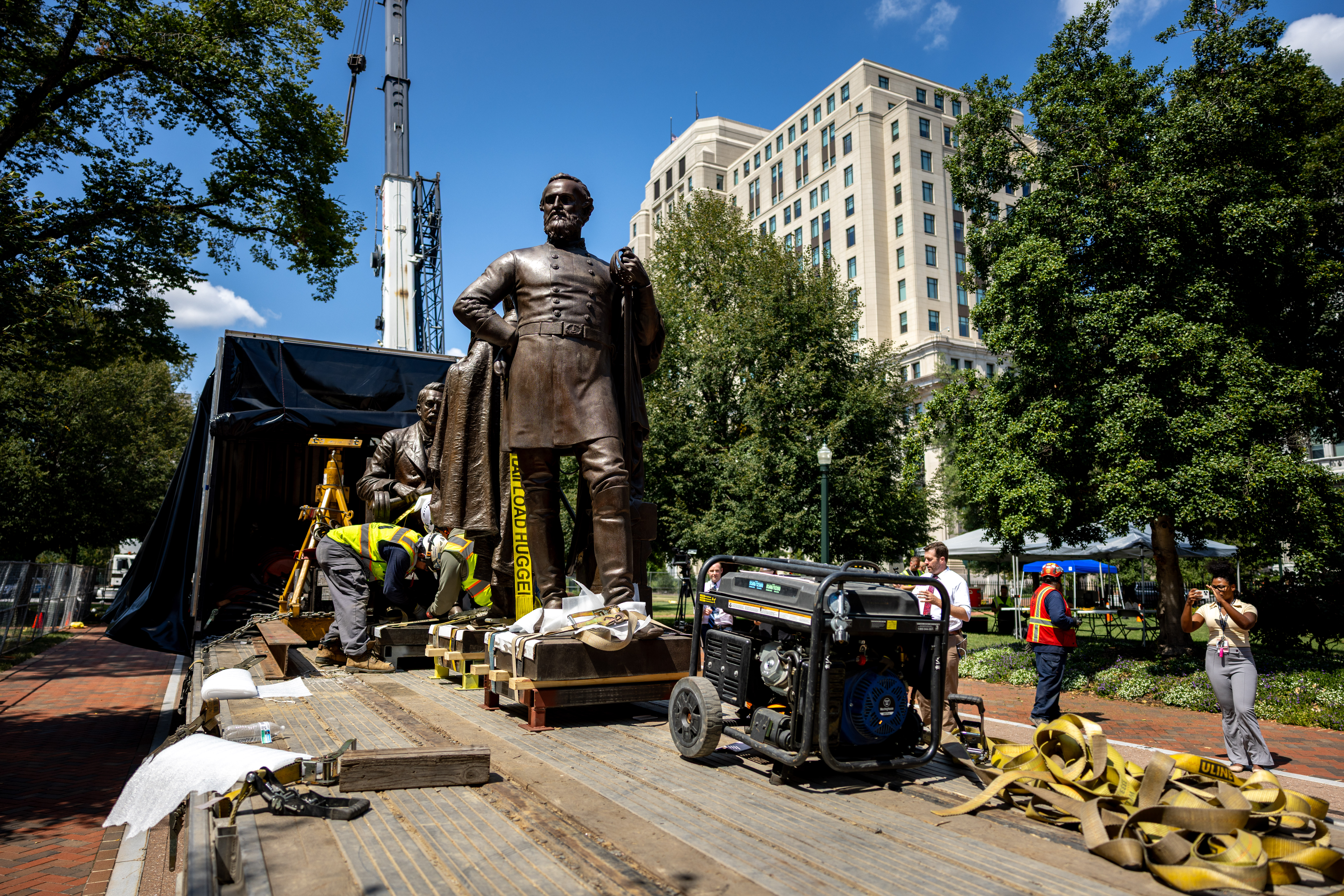
I happened to be reading this book last week, when I heard that Virginia had removed three more Confederate statues—the last, apparently, still standing on state-owned land—from Richmond’s Capitol Square. One was Stonewall Jackson; the other two were the lesser-known Hunter Holmes McGuire (a surgeon who advocated for treating wartime doctors as non-combatants) and William “Extra Billy” Smith (a general and governor, whose goofy nickname derived from an obscure antebellum episode involving postal routes).
That Applebome’s decades-old thesis might need revision was suggested by the reason this news caught me by surprise: not because there was anything peculiar about yet another enactment of the damnatio memoriae, but because there remained any graybacks still left to topple.
For the iconoclasm unleashed by 2020’s Great Awokening left no corner of the state untouched, effacing the physical traces of the Confederate States of America wherever it found them: Alexandria and Abingdon, Hampton Roads and Harrisonburg, Waynesboro and Williamsburg. Six years on, I had assumed its progress was basically complete.
There was, moreover, a certain naturalness about the phenomenon; in many ways, it constituted a logical—if unexpectedly sudden and frenetic—culmination of a trend long underway. I grew up in Northern Virginia, which for decades has been the state’s richest, most populous, and most culturally amorphous area. By the time I was old enough to form memories, accents from elsewhere were heard far more frequently than Southern twangs, and, insofar as anyone I knew considered our locality’s past, there was a hazy sense it began at some point between the Second World War and the Reagan administration. Yet if NoVa was an outlier, it was also a leading indicator: The rest of the state was moving inexorably toward the vaguely Mid-Atlantic-feeling, transplant-filled suburbs of Arlington and Fairfax.
But even this most un-Virginian corner of the commonwealth retained a few residual connections to an older history. We drove on Lee Highway and Pickett Road, and attended high schools named for J.E.B. Stuart and Stonewall Jackson. At my public elementary school, all sixth-graders took a field trip to Gettysburg; on reaching that bloody ground, we were each assigned the identity of a specific soldier in the Army of Northern Virginia, and then led in a reenactment of the charge that brought the Confederacy to its high-water mark.
And the further south you went, of course, the stronger and more organic the linkages became: the great battlefields of Manassas, Fredericksburg, and Chancellorsville; Richmond’s stately Monument Avenue; the charming town of Lexington, where both Lee and Jackson were laid to rest.
I asked Jim Bacon, a veteran Virginia journalist who knows the state backwards and forwards, what he made of all this.
He agreed that 2020 wasn’t entirely de novo. “In Virginia, these kinds of conversations have been happening for decades,” he told me. “As far back as the ‘90s, for example, there was a big controversy over whether to put up a statue of Arthur Ashe on Monument Avenue.” (Some thought a statue of Ashe, a black tennis legend, would be out of keeping with the Civil War-era focus of the area’s existing statuary; others feared the location would tar Ashe’s memory by associating it with the Confederacy.)
But the tenor of the debate changed markedly in the last 10 to 15 years. “We moved from the relatively benign argument that we should put up new statues,” Bacon said, “to the idea that we needed public reinterpretation. And then that morphed into, ‘we need to take the statues down.’”
According to Bacon, there were two factors at play. The first was an essentially political animus, one which grew from a national progressivism that was supercharged after the killing of George Floyd. But the second was a change in the makeup of the state—the huge influx of new residents from elsewhere in the country (especially the Northeast), not to mention immigrants from further abroad. “They just don’t have the linkages to Virginia’s past,” Bacon said of these more recent arrivals, “they don’t care about the Civil War, the heritage. Half the legislators in the General Assembly were born out of state. So the demography makes this inevitable.”
Which brings me back to Applebome’s book. For these changes are not unique to the Old Dominion; they are observable in virtually every other state below the Mason–Dixon line. And they are, in large measure, a consequence of the South’s very success. Economic dynamism brought massive in-migration, which turned native Southerners into minorities in towns and cities across Dixieland. Plus, the region’s newfound political and cultural ascendance–and the accompanying packaging of its ideologies for export—led to a kind of homogenization, a removal of the particular and a detachment from the past. Not to say this is wholly or even necessarily to be regretted; the influx of new blood and the exchange of backwards-looking insularity for optimism and openness to change helped to excise much of the ugly racism that blighted the South even after the end of Jim Crow.
Subscribe Today
Get daily emails in your inbox
But the result is what the writer (and regular TAC contributor) Scott Greer terms “Sunbeltism,” which he argues has largely supplanted the old South. “Instead of evoking the Lost Cause and plantations,” he explained in a recent article, “it calls to mind sunshine, suburbs, and strip malls…. Sunbeltism is optimistic, conservative with a small c, and present-oriented. ‘Life is good’ is its defining motto.” And although it seems uniquely suited to the Age of Trump, it is also compatible with political liberalism: Virginia is now solidly blue, and North Carolina and Georgia are moving slowly but surely to the left.
Sunbeltism has become hegemonic over American life. So, inasmuch as it represents a fundamentally Southern phenomenon, Applebome’s thesis may still hold true. But it has produced a reality that would have been unrecognizable to previous generations, and one that confirms the long-held surmises of many a gloomy regionalist.
“The mischief is,” the great journalist Marshall Frady opined as far back as 1975, “that in its transfiguration into What-A-Burger drive-ins and apartment wastelands, the South is being etherized, subtly rendered pastless, memoryless and vague of identity.” Thus, he observed with a tinge of melancholy, “the old pipe-organ range of prodigal possibilities for life there—both gentle and barbarous, good and evil—has contracted to the comfortable, monotone note of middle C.”