The ‘Trump Corollary’: What Has the President Added to Monroe?
Monroe wanted to keep European powers out. Trump may want to keep Latin American countries down.
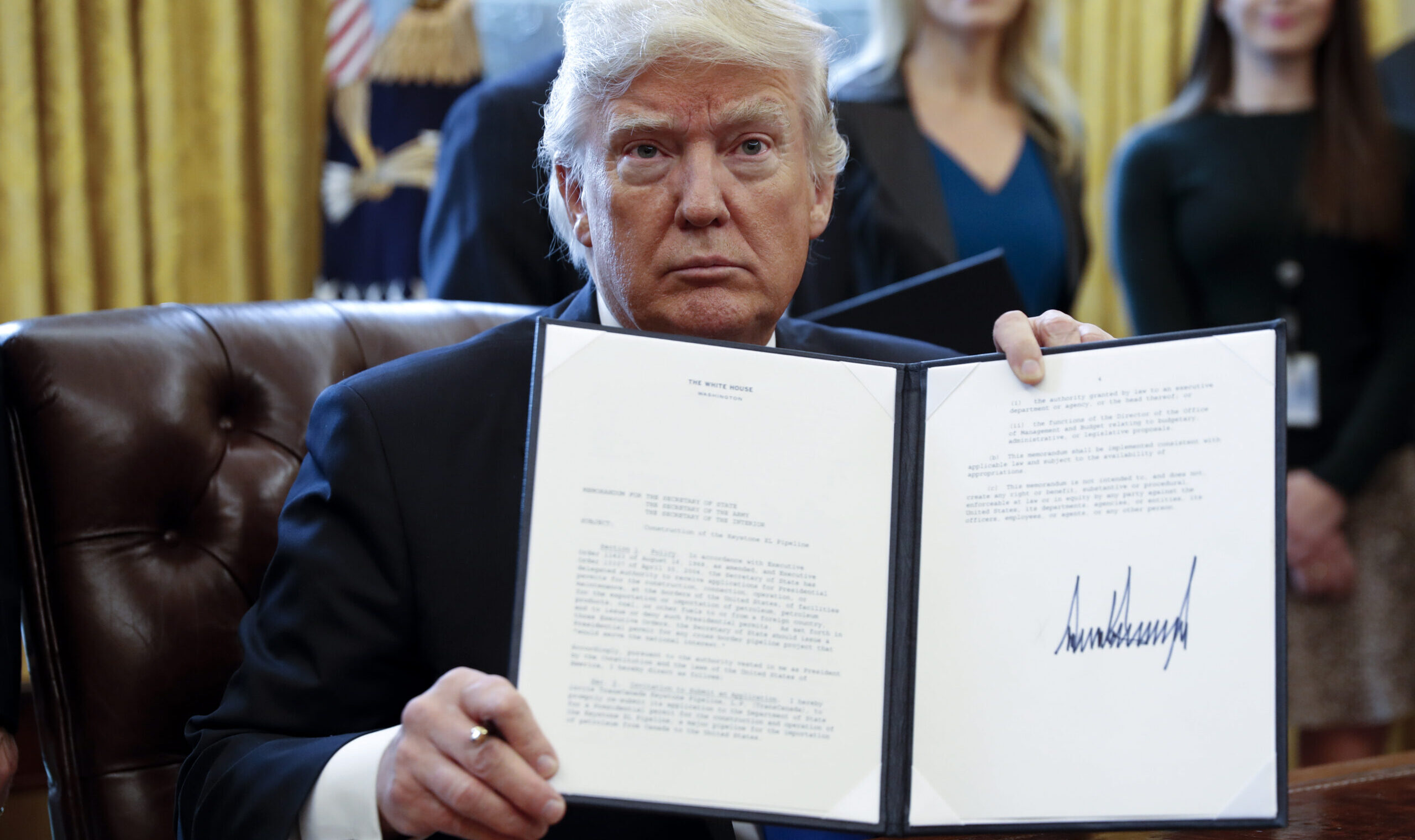
In December 1823, James Monroe, the fifth president of the United States, articulated what has been named the Monroe doctrine, which would mature into an essential principle of American foreign policy. One of Monroe’s predecessors and America’s third president, Thomas Jefferson, said it set the nation’s “compass.” A series of subsequent presidents would add corollaries that made the doctrine more muscular and suited it to the needs of the day. The latest president to add a corollary is number 47: Donald Trump.
Monroe never actually formalized a doctrine. Rather, the “Monroe doctrine” was ambiguously embedded in five sentences of his 1823 “Annual Message” or State of the Union Address.
Monroe begins by distinguishing between the events in Europe to which Americans are “interested spectators” and events “in this hemisphere” with which “we are of necessity more immediately connected.” He then places a protective fence around the Americas to keep European powers out.
By the time of the Annual Message, most of the new Spanish-American nations of the New World had declared their independence. Monroe said that it is “a principle… that the American continents, by the free and independent condition which they have assumed and maintain, are henceforth not to be considered as subjects for future colonization by any European powers.”
And the U.S., under the new doctrine, wouldn’t oppose only recolonization by European powers, but also less aggressive forms of influence. Monroe declared “that we should consider any attempt on their part to extend their system to any portion of this hemisphere as dangerous to our peace and safety” and that “we could not view any interposition for the purpose of oppressing them, or controlling in any other manner their destiny, by any European power in any other light than as the manifestation of an unfriendly disposition toward the United States.”
Monroe then concluded that it was “impossible that the allied powers should extend their political system to any portion of either continent without endangering our peace and happiness.” That, with all its ambiguity, is the entirety of the Monroe doctrine.
Spanish-American nations welcomed Monroe’s pronouncement as a fraternal pledge. In the recently published America, América: A New History of the New World, Greg Grandin quotes Simón Bolívar, the founding father of Latin American independence and unity, as celebrating that “The United States of the North have solemnly declared that they would view any measures taken by continental European powers against America and in favor of Spain as a hostile act against themselves.” Seen this way, Monroe’s doctrine amounted to a sort of Western hemispheric Article 5. But America’s southern neighbors would quickly find out how wrong they were, as a who’s who of U.S. presidents would invoke the Monroe doctrine to justify all manner of interference, embargo, coup, or war.
Theodore Roosevelt would be the first to append a corollary, stating clearly for the first time that America claimed the right to intervene in Latin America to enforce the doctrine. Lyndon Johnson would add another one, asserting America’s right to intervene in the domestic affairs of nations in its hemisphere to ensure that no communist government be established. Kennedy invoked the Monroe doctrine to justify illegal U.S. intervention in Cuba, claiming, “The Monroe Doctrine means… that we would oppose a foreign power extending its power to the Western Hemisphere.”
On the 202nd anniversary of the Monroe doctrine, Trump became the latest president to add a corollary.
In his announcement of the new “Trump Corollary,” Trump set the historical context for his policy. But he was wrong, as William LeoGrande, Professor of Government at American University and a specialist in U.S. foreign policy toward Latin America, pointed out to me, when he asserted in his December 2, 2025 Presidential Message on the Anniversary of the Monroe doctrine that the Monroe doctrine is “a bold policy that… confidently asserts United States leadership in the Western Hemisphere.”
“It does no such thing,” LeoGrande explains. “It simply asserts that a European effort at recolonization would pose a threat to the U.S.”
Trump misrepresents the Monroe doctrine to suit the more aggressive needs of the day. For all of the fanfare and bravado of the announcement, the Trump corollary is never clearly defined. The entire corollary is expressed in 19 words: “That the American people—not foreign nations nor globalist institutions—will always control their own destiny in our hemisphere.”
Trump says that his announcement “reaffirms” the promise of the Monroe doctrine and “reasserts” the policy. But, though he says that the Monroe doctrine is “reinvigorated by [his] Trump Corollary,” he never says how it is reinvigorated or what his corollary adds or changes.
The corollary seems to be a more aggressive restatement of the original. The doctrine has always been used to justify aggression and intervention in Latin America, but, like so much of what Trump does, the corollary has the brazenness to say out loud what previous presidents have kept clandestine.
“In the past,” Grandin told me,
policymakers invoked the Monroe doctrine as a doctrine of collective interest, or mutual hemispheric defense, even if they did so hypocritically. Trump, as usual, says the quiet part out loud, his so-called corollary openly admitting the doctrine is an instrument used to ensure U.S. hemispheric dominance.
If the corollary is in any way transformational, it is in its aggressiveness. The Monroe doctrine, though it is ambiguous and notoriously difficult to pin down, seems to set its parameters around European interference in our hemisphere. The Trump corollary seems to make no distinction between European nations and Latin American nations. It says that no “foreign nations” or “global institutions” will stand in the way of America controlling our “own destiny in our hemisphere.”
Washington, evidently, now claims the right to act militarily in Latin American countries to advance its geopolitical and economic interests in the hemisphere.
This more aggressive, interventionist reading is supported by the discussion of the Western Hemisphere and the Trump corollary in the White House’s recently released 2025 National Security Strategy (NSS).
The NSS explicitly says that the U.S. will “assert and enforce a ‘Trump Corollary’ to the Monroe Doctrine… to restore American preeminence in the Western Hemisphere, and to protect… our access to key geographies throughout the region.” It does not limit itself to preventing European nations from recolonizing or allying with Latin American countries, but promises to deny “non-Hemispheric competitors the ability to… own or control strategically vital assets, in our Hemisphere.” The document thereby asserts the right, not only to security preeminence, but self-serving commercial preeminence.
It does not bode well that one of the few concrete examples the NSS gives for how the “United States must reconsider our military presence in the Western Hemisphere” is the “obvious” one to “defeat cartels, including where necessary the use of lethal force to replace the failed law enforcement-only strategy of the last several decades.”
Subscribe Today
Get daily emails in your inbox
The NSS aims to reverse the “major inroads” that “[n]on-Hemispheric competitors have made… into our Hemisphere… economically.” It stresses that “[t]he United States must be preeminent in the Western Hemisphere as a condition of our security and prosperity—a condition that allows us to assert ourselves confidently where and when we need to in the region.”
The Trump corollary to the Monroe doctrine is brief and ill defined, but we know enough to see that advocates of U.S. foreign policy restraint should be worried. It seems to be best interpreted as a more muscular and aggressive expression of the original doctrine, bringing hemispheric dominance more to the fore.
The danger for Latin American countries, and especially, at this moment, Venezuela, is that the updated Monroe doctrine can be used as a justification not only for barring non-hemispheric countries from interfering in the Western Hemisphere, but for U.S. intervention in Latin American countries that get in America’s way.