The Russia–China Partnership Was Made in America
U.S. strategic planners unwisely drove Moscow into Beijing’s arms.
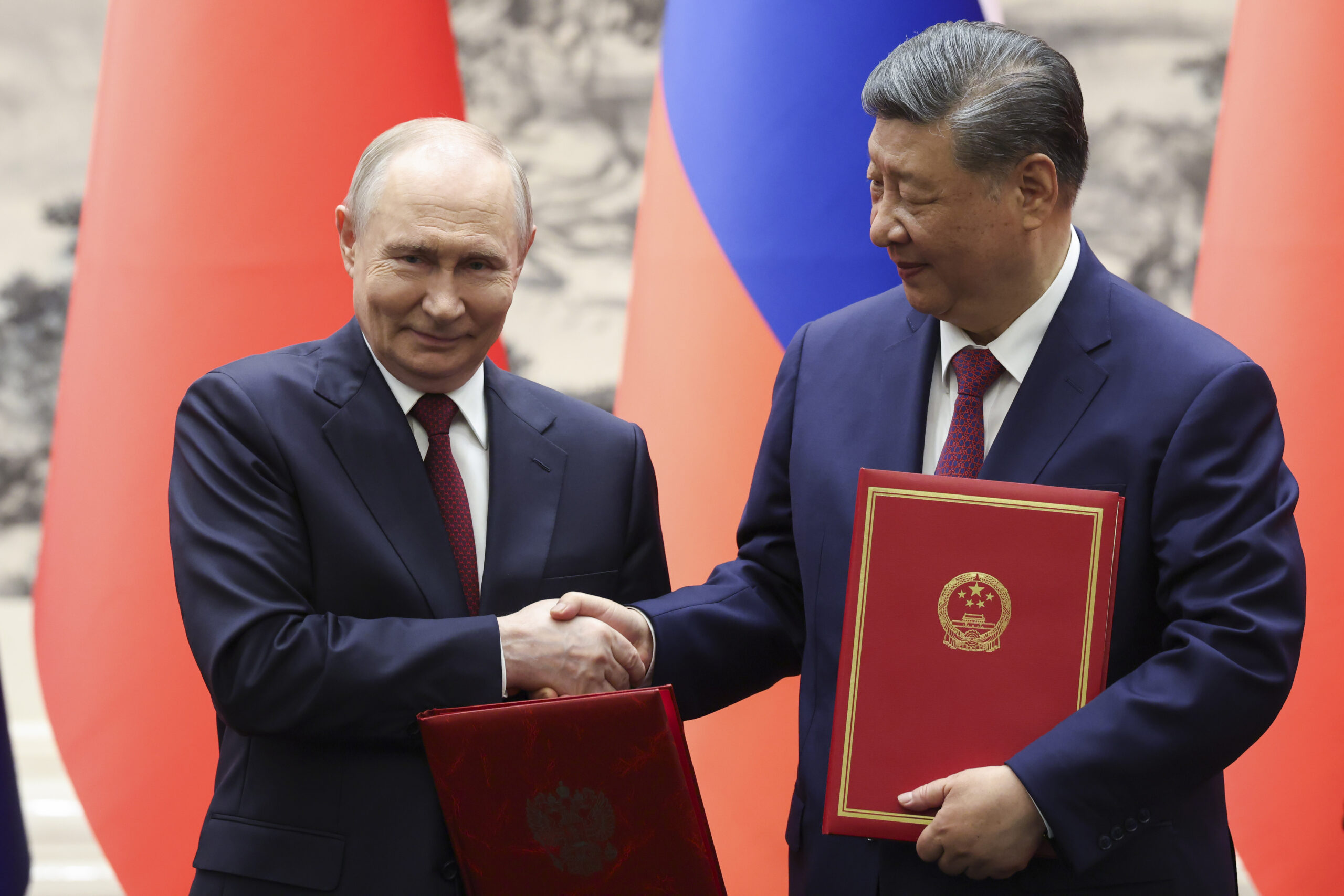
Last month’s summit meeting between Vladimir Putin and Xi Jinping—during which the leaders signed over 40 cooperation agreements and deepened their nations’ strategic partnership—provides just the latest sign that diplomatic, economic, and military cooperation between Russia and China is robust and continues to rise.
That trend is profoundly distressing to political and media elites in the United States, most of whom are fervent defenders of America’s fading global hegemony. But they can hardly claim that Russian–Chinese cooperation was unforeseeable, considering Washington’s own clumsy and inept policies have been its chief cause, as many warned would be the case. Hostile measures that successive, post-Cold War U.S. administrations pursued toward Moscow virtually drove Russia into Beijing’s arms.
Putin and other Kremlin leaders repeatedly reminded U.S. officials about the implicit assurances that President George H. W. Bush and his top advisers had given Moscow that NATO would not expand eastward after incorporating a newly unified Germany. Instead of continuing a conciliatory course, however, Bush’s successors took several provocative steps, including admitting Moscow’s former Warsaw Pact clients into NATO, along with several successor states from the wreckage of Yugoslavia. Those actions moved NATO and its military capabilities several hundred miles closer to Russia’s border.
Russian leaders issued increasingly pointed warnings to their Western counterparts that such behavior threatened to revive Cold War tensions and animosity. The Kremlin was especially adamant that Washington not seek to add Ukraine as a NATO member or even as an informal military asset of the alliance. When President Barack Obama’s administration blew through even that bright red light by helping to overthrow Ukraine’s elected president in 2014 over his moderately pro-Russian tilt, Moscow seized Crimea and supported separatists in eastern Ukraine. Putin’s government subsequently escalated the confrontation with Kiev and its Western backers in February 2022 by launching a larger invasion of its neighbor. The result was a full-on U.S.-led proxy war between NATO and Russia.
Washington made every effort to intensify the needless confrontation, pursuing a global crusade to isolate Russia diplomatically, economically, and strategically. That attempt failed miserably, as most nations in Asia, Africa, and Latin America refused to join the anti-Russian campaign.
The People’s Republic of China (PRC) was one of the key governments that President Joe Biden’s administration tried to enlist against Russia, but Beijing had no intention of bailing out the United States from its latest geostrategic folly. Instead, Xi moved to increase bilateral cooperation with Moscow. Among other steps, China boosted imports of Russian oil and natural gas. Beijing’s move (along with a similar step by India) effectively sabotaged the U.S.-NATO economic strangulation strategy directed against Moscow, which has been largely based on depriving Russian companies of their usual markets in Central and Eastern Europe.
Washington probably was even more perturbed by the steps Beijing and Moscow took to strengthen their security cooperation with respect to mutual strategic concerns in several areas of the world. Joint Russian and Chinese military exercises, especially those involving air and naval forces, became both larger and more frequent.
Washington’s handling of relations with Beijing over the past decade has been only marginally better than U.S. strategy with respect to Moscow. During both the first Trump administration and Biden’s stint in the Oval Office, Washington largely ignored Beijing’s concerns about deepening U.S. diplomatic and military cooperation with Taiwan. Indeed, by the end of Trump’s first term, American and Taiwanese bilateral security collaboration had nearly reached the point of reviving the old Cold War military alliance that had existed between Washington and Taipei. Nasty tensions erupted over other issues as well, including the outbreak of the Covid pandemic, which originated in China.
Although many experts expected that Joe Biden’s electoral victory in 2020 would usher in a softer, more conciliatory U.S. stance toward Beijing regarding the sensitive issue of Taiwan’s geopolitical status, there proved to be little substantive difference between Biden’s approach and Trump’s. Both administrations embraced a hardline overall military policy toward the PRC and a firm (albeit still unofficial) U.S. commitment to protect Taiwan’s security. Both administrations also deliberately forged a strong bipartisan consensus in Congress to sustain that policy.
Trump’s second term began with a surge of protectionist trade policies targeting most of the world, with an especially intense focus on China. The president has since softened his position somewhat, and trade tensions with Beijing have eased. Trump also has adopted a more pragmatic stance with respect to Taiwan, and he has explicitly cautioned the hardline government of Taiwan’s President Lai Ching-te’s not to create a crisis by ignoring the PRC’s strenuous objections to any moves toward formal Taiwanese independence. Despite such modest conciliatory gestures on Washington’s part, both economic and strategic relations between the United States and China remain frosty.
Subscribe Today
Get daily emails in your inbox
Turning the U.S. into a worrisome adversary of both Beijing and Moscow required extraordinarily incompetent policy management on the part of America’s political elite. In a typical multipolar international system, two countries with such different histories, cultures, and ideological orientations as Russia and China would be prime candidates to have difficult relations. Add to those factors the existence of a lengthy border that historically served as an arena for bitter disputes and even outright warfare on multiple occasions throughout several centuries, and the ingredients are present for a very contentious, if not rabidly hostile, relationship. Indeed, some PRC officials and many Chinese civilians still complain about Russia’s forcible seizure of Chinese territory along the Amur River during the 18th and 19th centuries. Fighting erupted along the Amur again as recently as 1969, even though both Moscow and Beijing had communist governments at the time.
However, U.S. leaders have given neither state much incentive to believe that its large neighbor poses the primary menace to its national interests. Instead, both Russian and Chinese officials have understandably concluded that the United States represents the principal threat. Such a conclusion is especially logical in Russia’s case, given Washington’s belligerent, utterly uncompromising approach on an array of issues over several decades.
A smart U.S. foreign policy team would have eased pressure on Russia, since China is the more likely candidate to challenge America as the leading global power. Instead, the United States has inadvertently pushed Russia into a bilateral alliance directed against it, with China operating as the senior partner in that alliance. Most analysts believe Moscow doesn’t enjoy playing second fiddle to its more powerful neighbor, so U.S. planners, if they change their own tune, may yet succeed in weakening the Russia–China strategic partnership.