Spirit of ’76
Things used to be weirder—not least the Democratic Party.
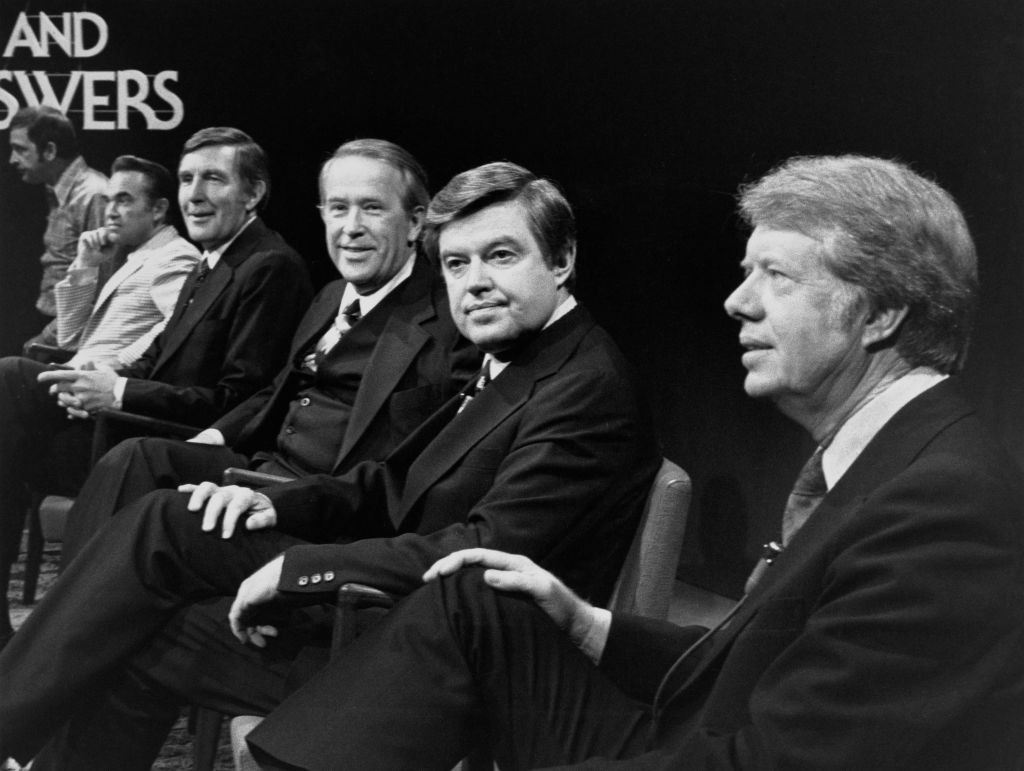
I’m so old that not only do I remember rotary phones, Kay Lenz, and Comet Kohoutek, I even recall those halcyon days when the Democratic Party welcomed—well, tolerated—an often entertaining discordance of voices, and politics was actually sort of interesting.
As we greet the semiquincentennial of the American Revolution, looking vainly for today’s Thomas Jefferson (he’s probably the volunteer fire chief in Tippecanoe or the assistant dogcatcher in Butte) but seeing only Lindsey Graham and Chuck Schumer, we might take a moment to observe the semicentennial of the 1976 Democratic presidential primary season. The duopoly parties had yet to be nationalized; significant regional variations persisted, so a Democrat in Cheyenne spoke differently than one in Cambridge.
Jimmy Carter, the Annapolis-trained micromanaging engineer who’d have made a greater contribution to the public weal had he stayed on the peanut farm in Georgia, won the palm, but the field included far more intriguing candidates:
- The former Senator Fred Harris, the fiery Oklahoma populist, was a one-time Hubert Humphrey acolyte who had been radicalized—just how sincerely one could never tell—into a Dust Bowl anti-monopolist, “a George Wallace without racism,” as he was dubbed. Fred took aim at corporate welfare and carried his own luggage.
- California’s Governor Jerry Brown, then in his Linda Ronstadt-wooing ascetic phase, spoke of limits and government austerity, taking special delight in ripping his predecessor, Ronald Reagan, as a spendthrift. Brown, later unfairly mocked as “Governor Moonbeam”—a phrase disavowed by its coiner, Chicago columnist Mike Royko—slept on a mattress on the floor of a Sacramento apartment, shunning the governor’s mansion that had been constructed at Reagan’s behest.
- The Kennedy-in-law Sargent Shriver, former head of the Peace Corps, had as a young man been a supporter of the America First Committee and an admirer of the Catholic pacifist and saint-in-waiting Dorothy Day. “Peace” was not, in 1976, a dirty word in American politics.
- Idaho’s Senator Frank Church, a prolife, pro–Second Amendment civil libertarian, was a worthy heir to the great Gem State progressive Republican Senator William Borah. Church oversaw the landmark hearings into the skullduggery and crimes against the republic committed by the Central Intelligence Agency. Today, Democratic strategists promote lady ex-CIA employees (Virginia’s Governor Abigail Spanberger, Michigan’s Senator Elissa Slotkin) as the future of the party.
- Arizona’s Rep. Morris Udall, on the issues something of a standard-brand liberal, was a thoughtful and decent man with a delightfully self-deprecating sense of humor, and far and away the brightest pro basketball player ever to serve in the U.S. Senate. (That dubious honorific is typically awarded to Bill Bradley, New York Knick turned New Jersey senator, whom a Senate Finance Committee senior staffer once described to me as “the world’s dumbest Rhodes Scholar.”)
Oh, and there was a female candidate, too: Ellen McCormack, a Long Island housewife who carried the right-to-life banner in an age when the prolife cause was stippled with Democrats, Catholic and otherwise. (See Daniel K. Williams’s Defenders of the Unborn: The Pro-Life Movement Before Roe v. Wade for this forgotten history.)
Subscribe Today
Get daily emails in your inbox
There were run-of-the-mill liberals in the 1976 Democratic field—Indiana’s Senator Birch Bayh, Pennsylvania’s Governor Milton Shapp—as well as a neocon Cold Warrior (Senator Henry “Scoop” Jackson of Washington) and the inevitable George Wallace, a reformed segregationist with populist instincts whose political fortunes were forever crippled by four bullets from the revolver of a diary-keeping loner straight out of assassin central casting during the 1972 campaign. (Arthur Bremer, the hapless gunsel, inspired one of the great movies of the mid-’70s, Taxi Driver, though his pathetic would-be catch phrase—“A penny for your thoughts?”—was nowhere near as cool as Robert De Niro’s “You talkin’ to me?”)
The general election featured Carter (whose Sunday School teacher pieties are much more appealing in light of recent White House occupants); the incumbent Republican Gerald Ford, a cofounder of the America First Committee at Yale in 1940 (he quit out of concern that it might jeopardize his role as an assistant football coach); independent Eugene McCarthy, astringent wit and keen critic of the bureaucracy; and the Libertarian Roger MacBride, heir to the Little House on the Prairie fortune and a rogue elector who had given LP candidate John Hospers his electoral vote in 1972.
This was a looser, more relaxed country then, despite the distorting effects of the Cold War. Members of Congress did not march in lockstep: the Democrats included socialists (Ron Dellums of Berkeley), hawks (Sonny Montgomery of Mississippi), and zigzagging eccentrics (Andy Jacobs of Indiana). Democrats and Republicans alike stepped out of the party line without being called “traitors” by the president or triggering screeching hysterics by misery-addicted young women. Thomas Massie and John Fetterman might have appreciated that.