Pandemic Diaries 28
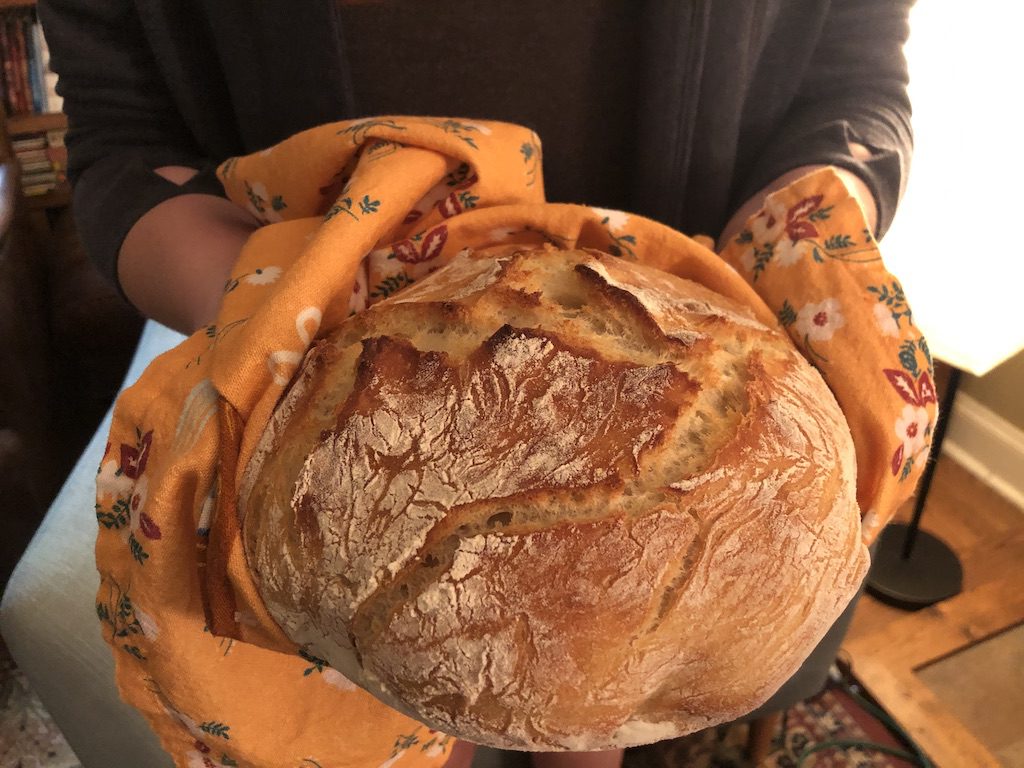
How about that! Nora just brought that loaf of homemade bread straight from the oven. It’s still warm. She said, “Knowing how to make bread gives me superpowers.” It does: the power to make people insanely happy.
I was going to have to illustrate tonight’s Pandemic Diaries post with this miserable image of my late Lenten lunch: black beans and cauliflower rice. I was planning to say that when Jesus descends into death to harrow Hell, he is going to fling this glop at the Devil:

Honestly, it tastes good — but I’ve had so much of it these past few weeks, and am ready for grilled meats again.
No news here today, as ever. It was a surprisingly cool day. There was mononucleotic slumber in it. I learned that our dog likes to chew on stale chunks of defrosted rye bread, and to bury some chunks in the back yard. Nora baked bread. I’m going to dress my slice with apricot preserves given to me by the Slovak nuns who made them. There shall be rejoicing. Doug Wilson said that even as we suffer deprivation, we should be thanking God for the small things. He’s right about that, so I thank God for homemade bread, apricot preserves, sweet Slovak sisters, and a daughter whose superpower is bread-baking.
Wait, I wish to amend that statement. Here is the best thing that happened to me today. After writing those paragraphs, I checked Pandemic Diaries e-mail, and found this from a reader in Baton Rouge. It wasn’t submitted at a Pandemic Diary, but it was the brightest spot in my day, so here it is:
We exchanged emails about a month ago after I thanked you for helping me prepare for the coronavirus pandemic.
I’m sorry that you’re having to deal with the Epstein Barr flareup on top of everything else going on right now and am just checking in to see if there’s anything I can do for you or your family. I don’t get out and have been ordering my groceries online, but I’ve decided to venture out to Trader Joe’s in the morning (with mask and gloves) for their “senior” hours between nine and ten and will be happy to pick up something and drop it off at your door.
I’m not a health care professional, but I’m trying to serve Christ in the best ways I can, so I’ve been cooking and baking and will be happy to bring you anything you need.
I hope that you start to feel better soon.
Isn’t that great? I told her that we’re fine over here, but the offer itself was a gift greater than anything they sell at the grocery store.
From Los Angeles:
As I’ve mentioned before, my wife and I are regulars at a Pakistani market not too far from our home. (They just have a genuinely good selection of bread, tea, and spices, and Halal cuts of meat tend to be better than what you get at your average supermarket. Plus, they carry goat, a real weakness of mine.) During this pandemic, they’ve also been extremely prepared and well run, and as a result, have not suffered the shortages we’ve seen at big chain supermarkets.As stores are limiting how many people can enter at once, in order to encourage social distancing, my wife has been going solo to the markets where we used to like to go shopping together. This past week, the Pakistani market had surgical masks available for purchase, a new development, but were limiting one per customer. When my wife approached the counter to pay for our groceries, the man behind the counter said, “Normally you are two!”, and handed her a second mask, free of charge, so I could have one, too.It’s strange when something as simple as a small piece of cloth can make one feel moved, can remind us of our common humanity, and make one feel like they’re part of a true community, but these are strange times, are they not?
Here in our Pennsylvania diocese, Catholic churches are still open several hours each day for private prayer. My husband and I took advantage of this frequently during lent. We made plans to visit church on Easter morning. I was regretting that we wouldn’t be singing our favorite Easter hymns in church this year. Then it occurred to me that we could just sing them anyway when we visited, and hopefully anyone else in church at the same time wouldn’t mind, and might even want to join us. As holy week went on, our plan to sing “Jesus Christ is Risen Today” and the beautiful chant “Vicitmae Paschali Laudes” snowballed into a mini-service that included the three scripture readings of Easter morning mass, the Creed, and Prayer of the Faithful, the Lord’s Prayer, and the spiritual communion prayer that Catholics have become very familiar with during this crisis.So that’s what we did. There were about twenty other people in church when we got there. (our big old gothic church is cavernous–social distancing is easy) I announced what we were going to do, and told everyone where to find things in the missal if they wished to follow along. Well, you know that Catholics don’t have a reputation for enthusiastic congregational singing, but this little group really belted out that first hymn. I asked a friend who was there to do the readings, and it was a joy to hear them proclaimed out loud in our own church again. Same with the other prayers. The whole thing took less than 20 minutes, but as we walked away to the parking lot, several people called out behind me how much they appreciated it–that now it felt a little more like Easter. I don’t pretend for a second that this is anywhere near as good as the mass. But if fulfills a need we have to raise our voices in prayer and song in our churches. So I’d like to suggest that anyone whose Christian tradition is liturgical–and whose churches are not locked up–give it a try. Pray and sing out loud in your church with some elements of your church’s liturgical service. It feels wonderful.
I’m writing from Western Washington, not far from Seattle. In terms of the pandemic itself, things seem to be at least no longer getting worse. Infections, and possibly deaths as well, are not really increasing, but not decreasing either. We seem to have a plateau rather than an apex, like NYC, but much much lower volume. Our medical system is not past capacity as far as I know. In fact, we’ve sent away an Army field hospital that had no patients so other states can have it. I don’t like Governor Inslee, but I think he’s done a fine job in the crisis. We shut down early because we were the epicenter for a while, and now the curve may be about to flatten.I’m 24, but also in a high-risk group. I have Duchennes Muscular Dystrophy, so already have a bad heart and bad lungs. I’d have a pretty good chance of death if I came down with bad symptoms. I live at home with my parents, who both still have jobs: Dad works in the grocery business and Mom at the elementary school and is working from home. Dad does very well with precautions, sanitizing, changing clothes, face mask at work. So we’re free to request wanted groceries on a whim, since he’s at different stores every day already. Sister’s home from college taking classes online. She’s a softball player and was crushed when the season was canceled. I was unemployed already before all this so no change there. As of yesterday, I had not left the house in a month. I’m a homebody anyway, but it’s starting to get to me. It’s hard to maintain a decent sleep schedule.I’m a Catholic convert. As hard as it is to be away from the Mass and the Eucharist, I agree that the cancellation of public Masses is a necessary step to save lives. I watch an online Mass every Sunday. I approached all this as Lenten penance and a call to silence and repentance, our homes our monastic cells. This made the anticipation of Easter even more intense. I was abuzz with excitement during the Vigil during the readings waiting for the Gloria to be sung at last and the dark church to fill with light. Even this crisis is nothing in the face of the Resurrection. Now Easter is a strange mix of joyful penance and penitential joy. I hope we can carry this silence and rest in God forward, even beyond this crisis; and have a new appreciation, reverence, and awe for the Mass and the Eucharist. I just wish more parishes were finding creative ways to offer Confession. I’m also outraged at hearing about priests being unable to administer Last Rites, which is terrifying for me when I consider the chance I contract COVID. In terms of some Catholics’ anger towards Bishops, I don’t like it one bit. Obedience applies to decisions one likes AND doesn’t like. I just think about it like “above my pay grade. Nothing I can do and it doesn’t matter whether I like it or not.” And the cancellation takes a weight off of those who would struggle in making the decision of whether it would be right to stay home, myself included. Sometimes obedience offers its own consolations.Thanks for doing these Pandemic Diaries. Also, just want to say that I love your blog and your approach to it. I enjoy the way you use it as a place to think through things, allowing us to see it in real time. I know this is long but it was quite cathartic to write it all out.Also: I would appreciate if you would offer a prayer for my grandfather who just went into emergency surgery for a perforated colon. I will pray for you and your family and all your intentions.Thank you!He is risen! God bless!
I hope you and your readers are interested in an update on the situation in Jamaica. As of April 14, we have 73 cases and 4 deaths (on March 21 we had 19 cases, 1 death – Pandemic Diaries #6). The government is providing grants to many: the equivalent of US$130.00 per month for April, May and June if you earn less than US$ 11,000 per annum (which is most folks). It’s not enough, of course…Social distancing is just not really an option for most people in a poor country; extensive contact tracing is an attempt to assert some control over the situation and keep numbers of the infected as low as possible. The country is still closed – hotels are empty, no cruise ships arrive…the estimate is roughly 250,000 jobs lost in the tourism sector alone (in a national working age population of just about 1.7 million).
With talk of a global depression, Jamaica is screwed – and I worry about the potential for social unrest as well as the complete loss of all the developmental gains made since Independence.
In the Caribbean generally there are 6071 cases confirmed (April 13, 2020); the Dom Rep, Cuba and Puerto Rico account for 4790 of the cases.
Meanwhile, the US is not winning friends and influencing people in the region…
Cuba: US embargo blocks coronavirus aid shipment from Asia
AP 14:27 EDT, 3 April 2020
https://apnews.com/
2858fbaa2dd5460fa2988b888fc537 48 At least 5 countries — including a small Caribbean island — are accusing the US of blocking or taking medical equipment they need to fight the coronavirus
US seizes medical supplies bound for Cayman (4/8/2020)
https://caymannewsservice.com/
2020/04/us-seizes-medical- supplies-bound-for-cayman/ At the same time, the Caribbean and Latin America is said to be receiving assistance from Jack Ma and the Alibaba Foundation (in China). Whether this turns out to be minimal help or not, the optics look bad. In the case of Cayman we are talking about 8 ventilators and 50,000 face masks – bought and paid for – which would have no real impact on the supply of equipment for domestic US use.
Stay safe and well.
We live on the water, our quiet street being an understandably popular walking and jogging route. I simply cannot get accustomed to the sight of an increasing number of folks wearing masks on their walks, especially when the wind is blowing, as it often is. I keep telling my wife that I await with dread Wear Yellow Days, when Gov. Charlie Baker will issue an edict dictating which days of the week the citizenry must wear yellow. Based on what I’m seeing today, the Gov. will have little trouble getting his way. The coronavirus has given me far greater empathy for the “idiosyncratic” souls who live off the grid on the Idaho panhandle.
From Kansas:
I wanted to drop you another note for your pandemic diaries. It might not fit-in with your greater view of things, but what my wife and I experience is certainly part of the mosaic of stories.
We are both millennials working in education. My wife is a teacher. She is recording lessons and uploading them via Google classroom. Kids still have to submit assignments that are graded, and they have
to check-in with their teachers on a regular basis. Initially therewas concern about whether all kids would have internet access, but the schools really moved heaven and earth to get this done. For all the
faults of education in this country (and there are many) they are lavishly equipped with technology relative to what I had in the 1990s and early 2000s.I work in administration. Our central office is closed, and only one or two people are allowed in at a time to check the mail and fax machines. I read somewhere that this experience makes people realize
and appreciate how much work can be done from home. This is especially true for people who work in areas like finance, although I wonder about the integrity of our networks and what hackers might do.We both wonder what happens when schools open back up. At a minimum, kids will have five months of no real structure. Given we already had serious student behavior issues, I’m genuinely scared. We’ve had at least 30 years of parents outsourcing much of their role to teachers.
The public schools have actually started a hotline to advise parents how to handle their kids’ behavior. At first I was stunned, but then it made sense. Schools have been raising kids for a while, not parents. One silver lining to this pandemic is it forces parents to do their jobs again, and it’s kind of like the shock therapy that happened when Eastern Europe switched to free markets in the 1980s.
We used to go to church every Sunday morning and spend time with our Boomer-aged family members afterwards. No more. All of them are in their late-60s/early-70s and we take social distancing seriously. We’ve certainly lost something by socially isolating ourselves, however. Social media and streaming video and even a good book–these are all an ersatz substitute compared to genuine community.
Here’s where I start to complain:
My grandfather is in his 90s and in a nursing home. I send him postcards, and my mom talks to him once or twice a day. Residents are kept in their rooms 24 hours and their food is brought to them. It’s literally a more-comfortably solitary confinement, but then I see where 42 residents in a Virginia nursing home died and see what the alternative is. It’s a hell of a lot better than the alternative, but
it’s not something you would choose in normal times.Both of my parents have been laid off. They lost their house in the Great Recession and have rented ever since. They are Boomers with very little savings. We have talked about them moving in with our family before, but it was within the parameters of them having serious health problems. Now that their jobs have disappeared it’s a closer reality.
My brother works overseas in a poorer country. He is supposed to come home in May, but the government suspended all international air travel and has the army patrolling the streets. He works online and things could be much worse, but it’s still not the kind of thing you want a family member in.
My wife and I are lucky Millennials in that we have substantial savings, and we also own our own home. I’m lucky to complain about not being able to fly to the beach this summer.
But our Millennial neighbors aren’t as lucky: the sales rep across the street with a wife and two little kids got laid off. His wife works at a hospital, and during this time he can stay home with the kids
while she works insane shifts. He says he wanted to switch careers anyway, yet a career switch isn’t something hardly anyone wants…. The neighbor who rents a duplex behind us is a bartender; her job is gone.Same for another neighbor who worked in aerospace and depended on the Boeing 737 for his work.Did you see this article from the Atlantic about Millennials and the pandemic? Here’s your money quote:
“…Millennials are, for now, disproportionate holders of the kind of positions disappearing the fastest: This is a jobs crisis of the young, the diverse, and the contingent, meaning disproportionately of
the Millennials. They make up a majority of bartenders, half of restaurant workers, and a large share of retail workers. They are also heavily dependent on gig and contract work, which is evaporating as
the consumer economy grinds to a halt. It’s a cruel economic version of that old Catskill resort joke: These are terrible jobs, and now all the young people holding them are getting fired.”What we’re seeing now is social contract theory writ large. It really is a hell of an ask: after getting saddled with debt, giving up on the career of your dreams, putting home ownership and having a family in a hard-to-reach position…then on top of that taking away the menial jobs you got out of it…well, in other times that was a recipe for violence.
Ross Douthat was right in that social media allows us to play-act 1968 (or 1917, or 1793). I wonder how long that lasts, though.
From London:
The light is clearer, the birdsong and the silences more intense, but in some sense much remains the same here in London: trees, clouds, river. Are we returning to an elemental state or does this point to an awareness that the fundamental things that underlie the goodness of our lives are constant?
Much speculation on economic, political and institutional futures.Interesting and necessary but also, perhaps, a distraction. Social solidarity or a surveillance state? Ultimately, I marvel at the human spirit that imagines continuity and a ‘north of the future’. But another part of me-a deeper part?- dimly recognises all the interruptions that have gone up to make my life. Isn’t life itself this broken circle, a song of joy and sorrow?
So, to think too much about the future seems both impossible and something of a false consolation. The past, too. February nostalgia, a Bardo-like hankering for the simple pleasures we once enjoyed but took for granted: coffee, scrambled eggs, conversation…
For me this has been a time to reflect on what’s really important in my life (that makes it sound too self-referential for in reality there is no life without others). If we are what we love, then who am I?
I zig-zag up the street, trying to avoid people. If someone gives me way I nod my head in an exaggerated fashion or, in an old eastern gesture that people in London are calling ‘the Turkish, I move my hand to my heart in gratitude. Maybe something of the old gestures will remain or maybe we’ll learn to recognise smiles by the sparkling of someone’s eyes.
So, in the time that remains it seems important to not think too much about the future or the past but, instead, about what Rosenzweig called ‘the demands of the day’. Time is given to us and is not ours. If that was *truly* believed, I think to myself, there would be less anxiety.
Personally speaking, I’m not there. But I am grateful for all the beauty, friendship and love that have come my way (“Which of my favours will you deny?”, asks God in the Qur’an). All the striving of the ego seem hollow and shallow- more so than usual. I’m haunted by what Merton once wrote: “I want to be somebody that nobody knows”.
When everything appears to be in lockdown it is important to recall, as Rumi said, that freedom is the ability to thank the Almighty for his Beneficence. Now, right now, more so than ever.
From Kirkland, Washington:
I’m writing from Kirkland, Washington, specifically zip code 98034. The assisted living center that infamously kicked off the epidemic in my state is about a mile away. We have a higher mortality rate in my zip code (58.8 per 100,000) than Italy (33.86 per 100,000). That said, people here are of two minds. There are those who follow the guidelines, venturing out infrequently for supplies, taking the sunshine in their own backyards, keeping in touch with their loved ones electronically, etc. Then there are those who are treating our state’s stay home order like an extended snow day. As soon as the earth began to tilt toward summer and the sun returned they flocked to the parks and trails, even if that meant parking along the highway because the lots were closed or jostling for space on bike paths overcrowded with the like minded. Judging from the ratio of mask wearing faces to naked ones in the grocery stores, the unserious minds are winning out. Still, our state has supposedly “flattened the curve”, I guess time will tell.
Speaking of minds, I personally am having a hard time wrapping my own around the situation. My life has not changed much, as I am a homebody, my children are grown, and my shopping habits have not been affected at all. Yet, somehow everything has changed. It’s like having a dream that seems benign but you later realize is really a nightmare. I feel in my bones that everything is different now, but can’t point to anything tangible. I dread the effects of not only the virus, but the shutdown itself. So much misery yet my own life continues unchanged except for wiping down door knobs and car door handles with the wipes I made from Everclear and baby wipes and spraying down packages with the bleach solution made from the CDC website instructions. It’s all so dreary and banal.
So I sew masks. I try unsuccessfully to read books to enrich the part of my mind that isn’t obsessing over the uncertain future. I pray. I read the Bible. I attend virtual church. I read an editorial in the newspaper about how we could be seen to be experiencing a global Lent. I think maybe that’s true. We’re simplifying, doing without, focussing on what’s vital. My faith is strengthening.
On Easter Sunday my daughter and I watched the mass from our church on YouTube. I did my hair and makeup and dressed in the clothes I would have worn to actual church. Our Priest is brilliant and an excellent homilist. He’s an ex-professor of history who studied with that really famous homilist guy, can’t remember his name (Googled it – it’s Bishop Barron). Rod, you may be interested to know that his homily was about the Benedictines in Norcia. I can’t really do it justice here now, but basically he said that we can look at this virus as God’s way of tearing things down, just as he tore down that beautiful church in Norcia, so we can focus on what is really important. Apparently the leader of those Benedictines considered the destruction of the church something of a blessing because it enabled them to return to their initial mission, something that had been hampered by caring for the church itself and its location in the middle of a bustling town. Because they were forced to move to tents in a rural location they were better able to focus on a simple life of prayer and devotion.
And that’s true. This virus is tearing things down, our conceits most of all. We think because we are young, or rich, or smart, or careful or whatever, it won’t affect us, it can’t happen to us, but it can. There isn’t really an escape because even if we won’t die from it someone we love might. Nothing can save us from it. True, nothing can, but does that matter? As Saint Augustine said, “in the daily casualties of life every man is, as it were, threatened with numberless deaths, so long as it remains uncertain which of them is his fate, I would ask whether it is not better to suffer one and die, than to live in fear of all?”
We must soldier on, but the good news is that He has risen! There is no need to live in fear.