MAGA’s Dead. What’s Next?
True liberalism is a right-wing ideology.

MAGA died, the Iran war killed it, and a resurrection isn’t likely.
So argues Christopher Caldwell, a titan of intellectual conservatism, in a recent piece on Donald Trump for the Spectator. “The attack on Iran is so wildly inconsistent with the wishes of his own base, so diametrically opposed to their reading of the national interest, that it is likely to mark the end of Trumpism as a project,” Caldwell writes. I’ve argued much the same in The American Conservative.
Replying to such critiques, the Trump administration has brandished polls showing that 100 percent of MAGA-identified voters still approve of the president and around 85 percent of them support the war, but this riposte is less devastating than it may appear. That MAGA voters approve of Trump is tautological. The question is whether MAGA “as a project,” in Caldwell’s words, can again cobble together the kind of coalition needed to win national elections.
Looking at Trump’s approval ratings, the answer, increasingly, seems to be no. If you’d like to argue otherwise, I’d be happy to read, but this essay stipulates the death of MAGA and considers a different question: What’s next? The conservative-populist movement that Trump summoned has dominated the American right for a decade, but when he leaves office three years hence, either something new will take its place or a period of incoherence will commence.
Right-wingers in recent years have propounded several alternatives: Catholic “integralism,” which seems unable to garner much support in our secular, erstwhile Protestant nation; “post-liberalism,” an empty signifier and mere negation; white nationalism, a dead end; CEO-style monarchism, which Trumpism has in effect only further delegitimized (hence the “No Kings” protests); and so on.
This essay proposes and adumbrates a different ideology, which I believe could not only glue together a winning coalition but also guide responsible governance: right-liberalism.
Please don’t puke on the pages of this august publication just yet. To be sure, “right-liberalism” normally signifies some wishy-washy form of moderate conservatism—what the author Sohrab Ahmari termed “David French-ism” after the crypto-liberal “conservative” columnist. But I have in mind something more authentically right-wing. (Some other term may be needed in public discourse, though “right-liberalism” works best for this essay.)
The raison d’etre of liberalism is individual liberty; of the right, community, tradition, and authority. There would seem, then, to be a tension at the heart of any right-wing liberalism. But it’s a tension familiar to everyone. We are all, at once, both individuals and members of groups, and this duality entails a life-long negotiation of our desires and duties. One advantage of right-liberalism is that it provides a framework for dealing with this tension.
Both right- and left-liberalism value individual liberty. But they differ markedly in their understandings of how it is achieved. For left-liberals, liberty is a natural property of individuals, and the trappings of artifice are its obstacles. This ideology legitimizes a politics of progressive reform, chipping away at hierarchies, laws, and other purported constraints on liberty—if not outright revolution, burning everything down to “emancipate” the individual.
Right-liberals take a different, less adolescent view. They maintain that liberty, wherever it endures, is sheltered by the social and political order in which it is found. And they deduce that preserving liberty requires sustaining this order.
Consider, briefly, lessons from three leading lights of the Western canon, all of whom have captured the imagination of rightists and liberals alike: Hobbes, Hegel, and Nietzsche. If that sounds like a snooze-fest, then you can skip to the final section; there I’ll apply those lessons, laying out a right-liberal approach to navigating left-liberal hegemony, winning elections, and governing the country in our coming post-MAGA age.
Political Theory
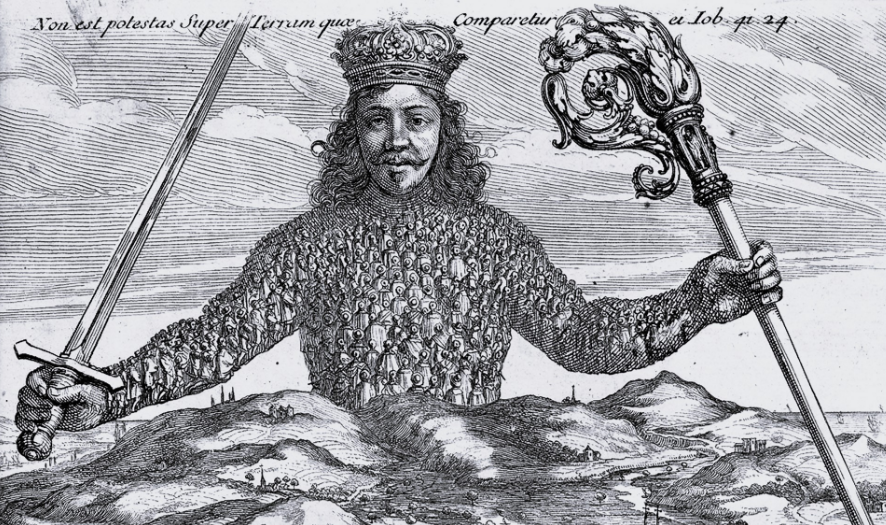
Readers of Thomas Hobbes encounter a paradox. The 17th-century English political theorist seems to have been both an arch-royalist and a liberal avant la lettre.
According to Hobbes, free individuals enter into a social contract to erect a state that will protect their rights. So far, so liberal. But the product of their voluntary action is an absolute sovereign who acknowledges no limits on his right to rule over them. Immanuel Kant, the preeminent liberal political theorist, condemned Hobbes’s “quite terrifying” idea that “the head of state has no contractual obligations towards the people; he can do no injustice to a citizen, but may act towards him as he pleases.”
Something, liberals agree, has gone awry in Hobbes’s theory.
In recent decades, scholars have tried to split the difference between Hobbes’s absolutism and his liberalism. Jürgen Habermas agreed with Leo Strauss that Hobbes founded liberalism, but he detected that Hobbes also sacrificed “the liberal content of natural right” to the state. Alan Ryan drew something like the opposite conclusion, writing that “it would be absurd to call Hobbes a liberal even while one might want to acknowledge that he supplied many of the ingredients for a liberal theory of politics.”
Many scholars, to sidestep the awkwardness of granting a radical monarchist the title of liberalism’s founder, have instead given that honor to a compatriot and near contemporary of Hobbes whom he deeply influenced: John Locke.
Contra these great thinkers, I think that there is no difference to split, that the seeming paradox of Hobbes’s ultra-right-wing liberalism is just that: seeming. For Hobbes both crafted a novel and “negative” concept of liberty as absence of impediments—the cornerstone of liberal theory—and discerned that, outside an overarching structure of political constraints, liberty eats itself. More prosaically, Hobbes believed that human predators exploit the absence of laws and state power to terrorize—and tyrannize—other community members.
The implications of this reading are profound: Liberalism, in its origins, is a right-wing ideology—with roots deeper than even so-called classical liberalism.
In addition to discerning the necessity of state power for safeguarding what he termed the “true liberty of subjects,” Hobbes also recognized, more perceptively still, that the romanticization of “natural” liberty motivated civil subjects to tear away at the state. Political elites, resenting the sovereign and concocting schemes to grow their own power, were often happy to spur such rebellion along.
Other political theorists have deepened the right-liberal conception of liberty. For them, liberty doesn’t merely find shelter in the social and political order but is in some way constituted by it. Some such thinkers depict even the autonomous individual himself as an artifact of history, elevated out of his tribal beginnings by a long, tumultuous process that seems to have sought him as a goal. G.W.F. Hegel is the canonical figure most associated with this view.
Early in the Elements of the Philosophy of Right (1820), Hegel distinguishes between “concept” and what he calls “Idea.” A concept is an abstract formal structure, an Idea the instantiation of a concept in reality, and Hegel announces he is dealing with Ideas. To use an example that resonates with Hobbesian thinking, the political order of police, courts, and prisons may seem, to the left-liberal, like the antithesis of liberty. But the right-liberal knows that such an order is what the concept of liberty looks like in practice. (So don’t “defund the police” just yet!)
If history fashioned the free individual, then society must reproduce him each generation. Hegel saw a vital role in that process for family, civil society, and the state. Absent the shaping influence of strong families, no human being can develop into a full person whose choices are meaningful. Outside of civil society, where markets hold sway, no person can exercise freedom in pursuit of his self-interest. And without a state, no civil society can survive for long, and the individual cannot attain, as a citizen, the rights and duties that consummate his liberty.
Like Hobbes, Hegel was deeply suspicious of revolutionaries. Their “negative spirit,” Hegel believed, grew out of a confusion between Ideas and concepts and led them to destroy actual liberty in the mad pursuit of its “universal” abstraction. “Universal freedom can thus produce neither a positive achievement nor a deed,” Hegel wrote in the Phenomenology of Spirit (1807). “There is left for it only negative action; it is merely the rage and fury of destruction.”
Friedrich Nietzsche, our last right-liberal political theorist, shared with Hobbes and Hegel a distrust of this negative spirit, which he termed ressentiment. And he repudiated those who believe it leads to justice, rather than anarchy. Admittedly, he may have gone too far in his critique. Nietzsche held that morality itself, at least as we have known it, merely expresses the will-to-power of the weak and resentful. He thus championed a “transvaluation of all values” to reassert nobility and joie de vivre and to put equality and pity back in their (lowly) place.
To that end, Nietzsche saw fit to adopt a ruthlessly “critical” orientation toward the negative spirit of modern Europe. Or as he phrased it: to say No to the “No-saying spirit” and thereby say Yes to life. This radical edge of right-liberalism may come in handy whenever conservatism, as a temperament rooted in gratitude, proves insufficient to address social-political problems that are dauntingly comprehensive. In other words, this radical edge can come in handy today.
How about Nietzsche’s theory of liberty, then? Nietzsche was a much less systematic theoretician than either Hobbes or Hegel, but his understanding of liberty dovetails nicely with theirs. Like Hegel, Nietzsche understood the autonomous individual in historical terms. In On the Genealogy of Morality (1887), he writes:
If we place ourselves at the end of this tremendous process, where the tree at last brings forth fruit, where society and the morality of custom at last reveal what they have simply been the means to: then we discover that the ripest fruit is the sovereign individual, like only to himself.
And, like Hobbes, Nietzsche recognized the necessity of bashing the head of the lawbreaker who has shattered the social contract, of throwing him “back again into the savage and outlaw state against which he has hitherto been protected.” That sounds like Hobbes’s “state of nature” to me.
Thus, Hobbes, Hegel, and Nietzsche—three thinkers not often grouped together— share two views central to right-liberalism. They recognize the social and political character of true liberty, and they discern that the negative spirit threatens the very order that produces liberty.
They share something else as well: an aversion to democracy, equality, and mass movements. Caldwell says, in his essay, that “Trumpism was a movement of democratic restoration.” Right-liberalism, by contrast, would be a movement of restoring liberty, properly understood. For that reason, it would be less populist than Trumpism, which is to say, its elitism wouldn’t hide behind the pretense that some rapacious strongman represents “the people” against the establishment.
Real Politics
Okay, enough with the egghead theorizing. I’ve sketched out a theoretical basis for right-liberal ideology. But what’s it all about, Alfie?
One advantage of right-liberalism is that it enables the right to dispense with the false hope that Americans are ready for post-liberalism. America is the citadel of Western liberalism, so getting Americans to reject that ideology in toto seems nigh impossible. Young people and educated elites are enamored of liberal ideals, and we should lure them, where possible, to the right. Even MAGA conservatives supported Trump in large part because of his promise to restore free speech, a crowning achievement of liberalism.
Better, then, to urge a rejection of left-liberalism in all its progressive and revolutionary guises. The political benefits of doing so go beyond cultural appeal.
For while Trump has interrupted the ideological and cultural hegemony of left-liberalism, we should expect its resumption in the coming years. Worse, left-liberalism can turn tyrannical when its adherents gain power. A state controlled by left-liberals and guided by their ressentiment can be a very dangerous thing. Right-wingers will need to bolster the barrier separating the state from the individual, the family, and civil society. That barrier is the product of liberalism as it has evolved since Hobbes, and now is no time to erode it.
One reason for the tyrannical potential of left-liberalism is, paradoxically, its dual commitment to liberty and equality, both of which it construes as natural conditions unjustly abolished by “structures of oppression.” Left-liberals are perennially tempted to use state power to dismantle those structures, e.g., “systemic racism,” and you can be sure they’ll slip back into a destructive mood by the time Trump leaves the White House (though at least they might repair the half-demolished White House itself).
Moreover, liberty and equality make for an uneasy pairing, and left-liberals downplay one and promote the other as expedience demands. Thus, election results are annulled for producing illiberal outcomes, as has happened in Romania and as American liberals had hoped the Russiagate hoax would achieve, and rights are sacrificed to the mob, as when police tolerated the destruction of property during the Black Lives Matter riots in 2020.
Right-liberalism, by contrast, unambiguously favors liberty over equality, even as it inherently circumscribes liberty for the sake of preserving the ethical order within which it has been achieved. Thus, while right-liberals are committed to free speech, they see no problem with bans on pornography or even regulations of titillating imagery in public spaces.
Americans shouldn’t shy away from such uses of state power. The First Amendment was intended to protect political speech, and it’s a testament to the perversions of left-liberalism that it hallucinates a “right” to pornography while undermining our Constitutional right to express controversial opinions, as occurred during the Covid pandemic. Most Americans deem the consumption of pornography to be immoral but cherish the right to express unpopular views, so the right-liberal perspective on this issue could prove a popular one.
Similarly, most Americans value the freedom to move through public spaces without fear of the human predators in our midst, and they blanch at calls by left-liberals like Zohran Mamdani, the new mayor of New York City, to end the “carceral state.” Even New Yorkers, among America’s most devoted liberals, reliably punish mayors who fail to uphold public safety. That’s because law and order is popular and Americans intuitively grasp its compatibility with liberty.
Immigration restriction could be another political winner for right-liberals, for whom the “individual” is an empty abstraction unless he comes into being in a particular cultural context. Armed with this understanding of human nature, right-liberals should seek to preserve the American nation as an historic people and, to that end, restrict the mass influx of outsiders who threaten social cohesion.
Trump proved that a presidential candidate can win, and even attract Hispanic voters, on a platform of ending illegal immigration. But after high-profile, aggressive deportation moves—including a surge of immigration officers into Minneapolis—Trump has lost support on the issue. In my opinion, the White House’s strategy has been driven by the ressentiment of the top Trump advisor Stephen Miller, a manifestly hateful man, who seems more enthusiastic about afflicting foreigners and triggering Democrats than solving the immigration crisis.
A right-liberal immigration program would look different. MAGA’s commitment to democratic restoration entails fierce opposition to the “administrative state.” Right-liberals do not share MAGA’s aversion to the instruments of technocracy, which would include, in the case of immigration policy, taxing remittances, withholding welfare from illegal aliens if not all non-citizens, and compelling employers to verify the legal status of workers. This program would work better than splashy deportations and yield fewer sob stories for the media to harp on.
Right-liberals should bring a technocratic mindset to economic policy as well. Like Trump, they recognize the importance of domestic manufacturing and want the government to support it. America should not be dependent on hostile countries for critical supplies, and U.S. leaders should ensure that dignified, gainful work is available to family breadwinners.
But unlike Trump, right-liberals understand markets and the economy as being, though locally embedded, abstract entities whose inherent rationality arises from the voluntary actions of buyers and sellers. And they eschew the personalistic and, frankly, corrupt approach to economics that the president instinctively practices.
For example, Trump’s reckless tariff policy has generated significant uncertainty in the global economy, and it seems designed less to shore up U.S. manufacturing than to gain leverage for the president over world leaders and American CEOs. Right-liberal protectionism would look more like the Tariff Act of 1789—the first major legislation passed by the U.S. Congress—which set levies on most imported goods at a modest rate of 5 percent. Such a policy fits within a right-liberal model of patriotic capitalism.
On foreign affairs, right-liberals are America First but don’t see international laws, norms, and organizations as inherently corrosive to American interests. In the discipline of international relations, the school of thought called “liberalism,” pace common misunderstanding, endorses neither world government nor foreign interventions to spread democracy. Rather, it takes a broadly realist view of states as rational actors pursuing their interests, but emphasizes that institutions can facilitate mutually beneficial cooperation between them.
Trump, with his pathologically zero-sum thinking about all human interaction, has done significant damage to world order. He has ripped up arms control agreements that had stabilized relations with adversaries. He has weaponized economic interdependence against allies. And rather than avoiding unnecessary wars, as he had promised to do, he has used force and belligerent threats with little regard for second-order effects, ushering in a dangerous era of Machtpolitik.
Subscribe Today
Get daily emails in your inbox
Of course, right-liberalism doesn’t settle all political disputes, but it does provide a framework for thinking them through. For example, some right-liberals may take a live-and-let-live attitude toward homosexuality, which is where I stand on the matter. But others may oppose the debauchery of gay pride parades and believe that opening marriage to gay couples has compromised the essence of that ancient family institution.
As for the trans phenomenon, right-liberals can see that it arises from a negative spirit directed against the felt constraints of one’s own biology. A trans-identified person is acutely beset by the same general confusions about liberty that plague most Westerners today. Right-liberals would encourage young people to “become who they are,” as Nietzsche might put it, rather than hand them a dizzying list of genders to choose from. On this and other subjects, right-liberalism aligns with MAGA ideology but anchors a more nuanced understanding.
Without question, Trump has assembled one of the most impressive right-wing movements in history, but that movement has unraveled due to the war with Iran. The American right should prepare now to build something new upon the ground that Trump has cleared. Right-liberalism, I submit, or whatever we may want to call it, represents the best project to pursue.