
Louise Glück Wins Nobel Prize
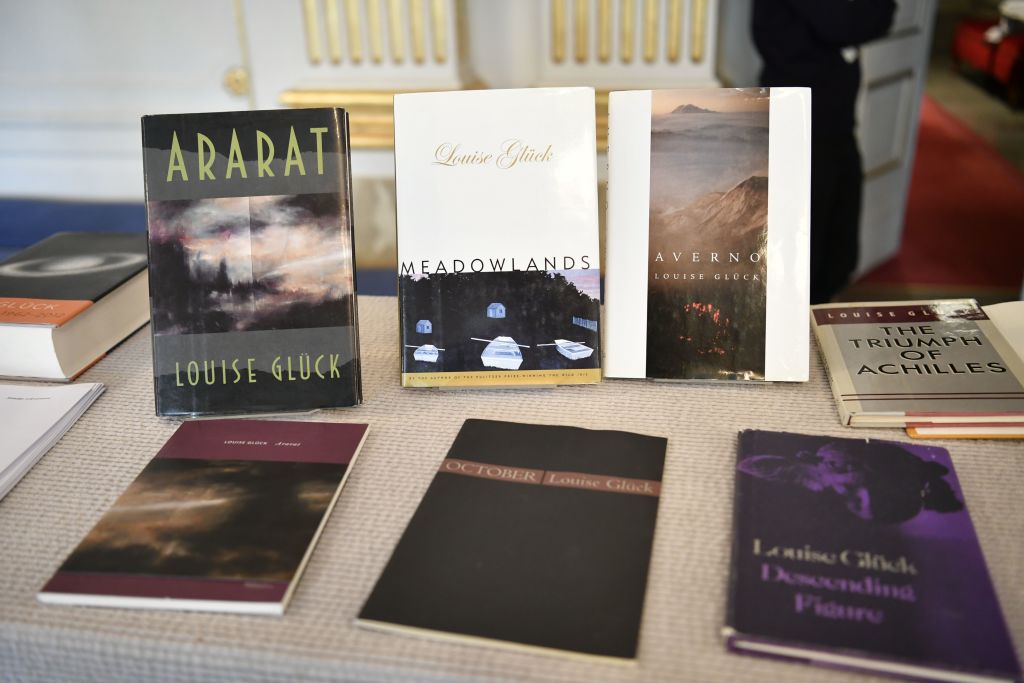
The big news this morning is that Louise Glück has won the Nobel Prize in Literature. I’m rather happy to learn this. Glück may not be to everyone’s tastes, and she may not be the best choice for the Nobel, but she is, at least, undoubtedly committed to the craft of poetry. Her work is more in the line of Lowell than Bishop—written in the voice of stark honesty, if occasionally sentimental and unabashedly needy, self-centered even. Yet, she can possess the same constraint and coolness as Bishop. Her office was just a few doors down from mine at Yale, and I remember hearing the strikes of her typewriter reverberating out of her slightly ajar door and down the hall. I never saw her enter or leave her office. In fact, I don’t think I ever saw her at all. Her presence was the sound of her typewriter, and that seems appropriate. Read some of her poems here. Perhaps start with “Visitors from Abroad” and “Vespers [Once I believed in you…].” For something lighter, read “Anniversary.”
In other news: The great art deaccession continues: “The Baltimore Museum is one of eight art institutions selling blue-chip art at auction this season amid relaxed rules about deaccessioning.”
When Stig Abell was named editor of the Times Literary Supplement, he was presented as “a hot young mover and shaker.” He was recently replaced by Martin Ivens, as we reported a few months ago. What happened? The Fence has the story: “It would [be] hard to overstate how widely loathed Abell was by the literary world, with whom he never mingled socially. ‘Stig Abell represents everything I despise about the contemporary book world’, said one TLS contributor. Abell always gave the impression of a man who, blessed wit, had laboured hard to make himself into a producer of milky, thin intellectual porridge. He presented Front Row. His Twitter feed was, and remains, widely screenshotted and mocked. During his tenure, the paper was said to be inundated with letters protesting its perceived dumbing down. But beyond the grousing of jaded critics, there were rumblings of incompetence, as well as an increasingly autocratic editorial style, whereby information was withheld from senior editorial staff, and pieces were pulled without consultation at the last minute. June saw two big changes. First came the departure of TLS stalwart and deputy editor Alan Jenkins, said to have left because he simply couldn’t bear what Abell was doing to the paper. Within weeks, Abell had left as well, to become executive editor of Wireless – News UK’s internet radio venture and the home of Times Radio.” Now TLS has a £1 million hole to fill. More: “It was Potts – now nicknamed ‘Pol’ Potts by his recent enemies – who was forced to wield the axe this month, when six members of staff were laid off, as was the paper’s in-house illustrator. The excised editorial staff include notable experts on the Middle East, France and also renowned philosopher Tim Crane. James Campbell, whose back-page column has more than once been the only readable thing in Abell’s paper, has also gone the way of all hacks.”
In Harper’s, Lauren Oyler revisits the refined work of Shirley Hazzard: “Shirley Hazzard is a perfectionist’s writer. Her books, composed of dense, layered sentences, are like the sort of difficult, delicate cakes no one bothers to make anymore. They’re slender yet solid, consummate, as fascinated and affected by the mysteries of experience as they are self-assured . . . If you asked me where to start with her work, like everyone else I’d probably tell you to read The Transit of Venus, her 1980 bestseller about the plaited lives of two Australian sisters and their lovers, which is widely considered a masterpiece. But I would feel I’d committed a small injustice—really, you could start anywhere. From her first stories, published in the early 1960s, to her last novel, The Great Fire, about a British war hero who travels to Japan and falls in love with an Australian teenager, which won the National Book Award in 2003, Hazzard’s fiction is remarkably consistent in theme, style, and accomplishment . . . We could chuckle, good-naturedly, all day about how old-fashioned Hazzard was. The New York Review of Books called her ‘crypto-Victorian’; in her foreword to the Collected Stories, Zoë Heller writes that one of Hazzard’s young characters ‘is rather how one might expect George Eliot’s Dorothea Brooke to sound, were she to be spirited out of Victorian England and given contraception and an apartment.’ In a Paris Review interview with J. D. McClatchy in 2005, Hazzard offered succinct dismissals of, among other things, ‘such contortions as deconstruction’ (a futile, self-aggrandizing attempt to eliminate life’s essential mystery), ‘the assertiveness of the “New York Intellectual”’ (narcissism of small differences), American fiction writers ‘intent to seem casual, sassy, democratic, “young”’ (fair), and ‘the audible nightmare of the cell phone’ (she has no idea).”
Fernanda Eberstadt reviews Hilary Mantel’s collection of essays: “Mantel Pieces, which includes nearly 30 years of Mantel’s essays for the London Review of Books, accompanied by facsimiles of her correspondence with its editors, is the story of an outsider finding her literary home. When the book opens, it’s 1987, and Mantel, with exaggerated self-deprecation, is offering her services to a magazine she considers the finest in Europe.”
Heinrich von Kleist’s singular style: “It is customary when introducing the work of Heinrich von Kleist to an English-language readership to begin by supplying two biographical details. The first is the “Kant crisis” that Kleist, the son of a Prussian military family, suffered in 1801, during his student years in Frankfurt am Oder. Reading the cornerstone thinker of the German Enlightenment, Kleist took away only the dispiriting lesson that the human mind could have no access to objective reality. The second, better known, is Kleist’s suicide in 1811 at the age of thirty-four, following a largely unsuccessful career as a soldier, dramatist, prose writer, journalist and political agitator. On the banks of the Wannsee outside Berlin, Kleist first shot Henriette Vogel, a terminally ill woman of letters with whom he had arranged a suicide pact, and then himself. The Kleist-Vogel grave still stands on the spot today, screened by a grove of trees from the lake’s summer yachters and swimmers. Yet the particularities of Kleist’s life shed little light on just how his singular style came to be. With its loping sentences and tangled syntax; its icy distance and psychological claustrophobia; its vivid realism and grim humour, Kleist’s work dropped fully formed into the fallow field of German prose.”
Kafka’s fragments: “The unfinished draft of The Castle, Franz Kafka’s third and final novel, ends mid-sentence. But when the manuscript made its initial entree into the world, the text had been edited into completion. Max Brod, Kafka’s friend and literary executor, who prepared the original 1926 edition, later reflected that his ‘aim was to present in accessible form an unconventional, disturbing work which had not been quite finished: thus every effort was made to avoid anything that might have emphasized its fragmentary state.’ To accomplish this obfuscation of the novel’s incomplete form, Brod redacted nearly a fifth of the text. He eventually thought better of the choice, and in the second edition restored most of what he’d cut—but by then, his success at attracting interest in Kafka’s work had led to its placement on the Nazis’ ‘List of Harmful and Undesirable Literature.’ This prevented the more faithful edition from reaching a wide German audience until the fall of the Reich. Meanwhile, Kafka’s readership grew abroad thanks to the 1930 English translations by Willa and Edwin Muir, who based their rendering of The Castle on Brod’s original edition—presenting the novel not as a fragment, but as a completed whole. The state in which Kafka left The Castle is representative of the condition of his entire oeuvre. . . . For the most part, the pieces making up The Lost Writings do not offer a new or more richly understood Kafka so much as a concentrated expression of the same dynamics, motifs, and obsessions that occupy his longer and more familiar works.”
Photos: Floods in southeastern France