Lamenting Lutyens

Of all the British imperials to coerce India into modernity, four men—a Welshman, two Englishmen, and a Scot—stand out as the most influential. Contrary to the fantasies of most fevered online onanists, none of them were either military conquerors or plunderers. One was a judge, two were historians, and the last was an architect.
Sir William Jones, a Welsh scholar and judge, founded the Asiatic Society in Calcutta and modern qualitative and historical research in India. An early historian of Indo-European languages, his efforts led to the foundation of the Journal of the Asiatic Society (his name is still prominently displayed on the cover of the journal), along with its editor, James Prinsep. Jones and Prinsep were foundational in explaining that Sanskrit, Greek, and Latin shared a common origin, an insight that helped establish the study of the Indo-European language family and eventually led to the landmark contribution by Prinsep to historiography in deciphering the ancient Brahmi script in the 1830s. This breakthrough enabled scholars to read early inscriptions, including the edicts of Emperor Ashoka, opening vast new sources for the reconstruction of early Indian history and establishing the foundations of modern Indian epigraphy and numismatics.
Thomas Macaulay and Edwin Lutyens each also played influential roles in shaping intellectual, administrative, and architectural aspects of the British imperial presence. Macaulay served on the Supreme Council of India and authored the influential “Minute on Indian Education” in 1835, which proposed the introduction of English-language education to the subcontinent, shaping the neutral and elite civil service that lasts to this day. Lutyens, by contrast, left a lasting legacy in the form of a school of syncretic architecture that imbibed Hindu, Victorian, and Mughal styles, through his design of New Delhi, the imperial capital of the Raj.
It is pedestrian to debate who among the four—Jones, Prinsep, Macaulay, and Lutyens—was the most influential (it was Macaulay). Without any one of them, modern India as we know it wouldn’t exist. In a severe irony of history, modern India’s entire historical image is predicated on four selfless British academics, whose contributions to Indian society remain, much to the chagrin of those who are ideologically opposed to any reference to imperial cosmopolitanism in (to use Robert Tombs’s terminology) the British-Indian empire. The state emblem of the Indian republic, the pillars and lions of Ashoka, and the ultimate sign of state authority in India, the Ashoka chakra (chariot wheel), wouldn’t be there without Prinsep’s research, Jones’ journals, Macaulay’s dissemination, and Lutyens’s vision.
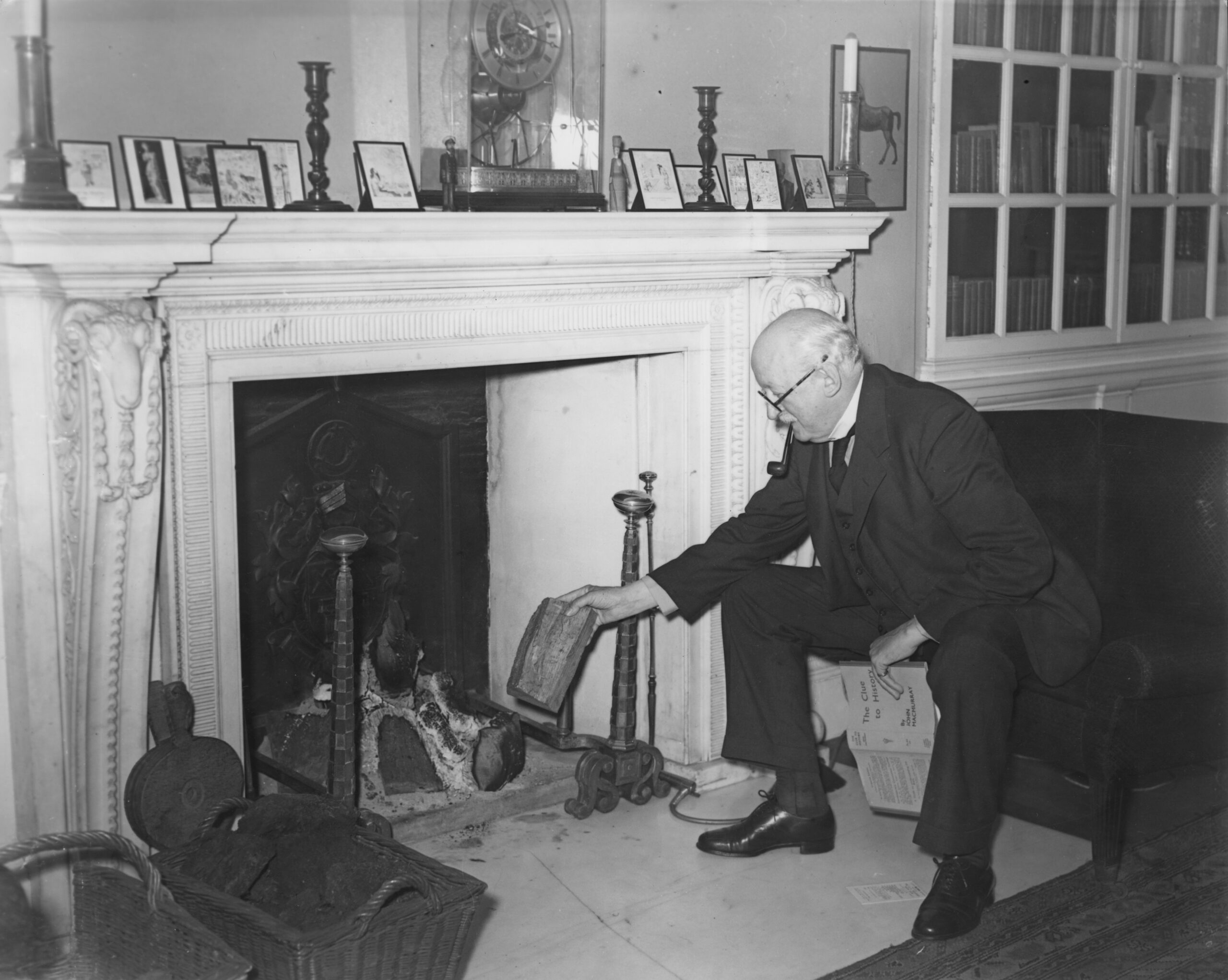
Most Indians are ignorant about either Prinsep or Jones. Macaulay is hated by both the Hindu decolonial right and the British far right for the simple folly of thinking that Indians can (and should) be Englishmen in taste, and that there are no qualitative differences between the races that cannot be erased by a shared culture, language, and discipline. Lutyens is the latest victim of Indian decolonization: His bust has been removed from the Rashtrapati Bhavan, a sprawling estate that was previously the viceregal residence, by a government determined to return to pre-modernity.
It is absurd to witness Indian toxicity towards Lutyens, a prominent whig with a declared love for India. Sir Edwin Lutyens developed a distinctive syncretic architectural style blending elements of European classicism with motifs drawn from Indo-Islamic and Hindu architectural traditions, as one might expect from a lover of the land he inhabited. It was the British imperial officer class that demanded Lutyens incorporate more and more Indian forms, a piece of historical evidence that wrecks much of the current decolonial antipathy and protestations of plunder. Lutyens happily obliged. Commissioned during the British decision to shift the capital of the Raj from Calcutta to Delhi in 1911, Lutyens was acutely aware of the symbolic demands of imperial governance and incorporated indigenous architectural features. The Viceroy’s House combines, for example, a classical symmetry and the monumental collonnades reminiscent of Edwardian imperial architecture blended with features such as chhatris and jali screens derived from Hindu and Persian-Mughal precedents. The great dome was influenced by the Sanchi Stupa, reflecting further adaptation of Indian forms into a fundamentally European monumental framework. Lutyens created this whole new identity distinct from Britain’s, almost treating Indian subjects as equal if not better in contribution within the subcontinent’s historical traditions, legitimizing further imperial cosmopolitanism. Lutyens’s New Delhi work represents the lasting example of colonial architectural syncretism, where Victorian imperial monumentalism was consciously merged with Mughal and Rajput elements.
Yet the Indian nationalist right is enraged because legitimizing Lutyens is everything that they and their cause stand against. For a group of people that cannot stop signaling about Vasudhaiva Kutumbakam (“the world is one family”), Hindu nationalists are spiritually and instinctively opposed to any universalism. To them, the Mughals and British were both conquerors and nothing else; their idea, staring blankly in the face of history, is that civilization ended in the Second Battle of Tarain in 1192. Nothing after is legitimate, and all else needs to be eventually destroyed.
The notion of a prolonged “dark age” spanning roughly a millennium is found in different forms in both Europe and the Indian subcontinent, roughly around the same time and for similar reasons: in Europe in the centuries following the collapse of the Western Roman imperial order in the 5th century; in India, from the 6th century onwards, when the learning centers of antiquity were first destroyed in Hindu–Buddhist strife and eventually forgotten by the end of 12th century, until their rediscovery by the British. Although neither Europe nor India experienced a total cultural vacuum, these centuries in both regions were characterized by the weakening of earlier cosmopolitan intellectual traditions to religious chauvinism and the loss of entire bodies of knowledge that would only be revived centuries later. It is that same cosmopolitanism that led to the flourishing of the imperial meritocracy in India under the British.
Rather than operating as a purely monolithic imposition of British authority, imperial governance often relied on locally embedded elites who adopted Western education and collaborated with colonial institutions. These elites acted as intermediaries between imperial administration and indigenous society, contributing to modernization in areas such as governance, education, and infrastructure. The empire’s multiethnic structure was primarily aristocratic and feudal, and the princely states were at the forefront of cooperating with British authority and pursuing progressive aims. But it was Bengal that was the true imperial intellectual backbone. Elite and aristocratic, and almost incurably English and liberal in aesthetics and habits, it fomented what is now known as the Bengal Renaissance, perhaps the greatest period of intellectual flourishing still unparallelled in the history of the subcontinent.
Quintessentially Presbyterian in taste, the Bengal Renaissance was led by the Young Bengal movement, a convergence of Anglo-Indian intellectual influences and indigenous reformist impulses. Under the leadership of Henry Louis Vivian Derozio, a high-school teacher who introduced concepts of liberty and rationalism to Eastern philosophy, it simultaneously made Calcutta a global metropolis and invited a backlash from entrenched pagan casteist interests.
Among the most prominent figures associated with the movement were the Reverend Krishna Mohan Banerjee and Michael Madhusudhan Dutt, whose conversions to Christianity did not diminish their advocacy for social reform, so much so that the movement broadly reinterpreted the classical Sanskrit tradition to determine that even Hinduism was historically monotheistic, qualitatively similar to, albeit perhaps a heretical form of, Christianity.
Influenced by Jones and Prinsep, and patronised by the imperial government, Bengali elites—including Sisir Kumar Maitra, Ramtanu Lahiri, Ramgopal Ghose, Dakhsinaranjan Mukherjee, Rasik Krishna Mallick, Hara Chandra Ghosh, Tarachand Chakraborti, Peary Chand Mitra, Surendranath Banerjee, Anandamohan Bose, Nilratan Sircar, Ishwarchandra Vidyasagar, Jagadish Chandra Bose, and Sib Chandra Deb—were at the forefront of resistance to organized casteism and of the promotion of women’s liberation, widow remarriage, and creating intellectual societies and book clubs promoting historical and anthropological education. They were also the first Indians to reform the Indian civil service and to serve in the judiciary. Reformers such as Bhudev Mukhopadhyay authored ethics texts; Gooroodas Banerjee pioneered legal education as Calcutta University’s first Indian vice-chancellor, the chemist Prafulla Chandra Ray founded industries and taught at Presidency College, and Sir Ashutosh Mukherjee modernized legal education standards with English common law, still the constitutional basis of the Republic of India. Sir Jadunath Sarkar wrote what can still be considered India’s only answer to Edward Gibbon or Theodor Mommsen, an epochal grand-historical account of the fall of the Mughal Empire. These were all Macaulay’s Indians “in blood and colour, but English in taste, in opinions, in morals, and in intellect.” (Of course, a clue to their cosmopolitanism lies in their surnames.)
Rammohan Roy wrote in a letter to Lord Amherst, in 1823, arguing against a return to the dark ages,
If it had been intended to keep the British nation in ignorance of real knowledge, the Baconian philosophy would not have been allowed to displace the system of the schoolmen, which was best calculated to perpetuate ignorance. In the same manner the Sanskrit system of education would be the best calculated to keep this country in darkness, if such had been the policy of the British legislature, but as the improvement of the native population is the object of the government, it will consequently promote a more liberal and enlightened system of instruction; embracing mathematics, natural philosophy, chemistry, anatomy, with other useful sciences, which may be accomplished with the sum proposed by employing a few gentlemen of talents and learning educated in Europe, and providing a college furnished with the necessary books, instruments, and other apparatus.
The reformist impulses associated with Roy and the Young Bengal movement generated a significant intellectual and religious backlash among orthodox Hindu circles. Reformists were accused of promoting monotheism, opposition to idol worship, women’s education, social reforms including critiques of caste hierarchy and child marriage, and ideas that were deeply influenced by Enlish rationalism and Christian Unitarian thought. Contrary to the accepted Marxist historiography of the Indian independence movement, which paints it as a liberal project, it was the lower- to middle-class ultra-Hindu nationalists who were the primary opposition to upper-class Western liberals, perceiving them to be a threat to established rituals and imperial collaborators. It was the nationalists who opposed liberal reformist campaigns and colonial legislation.
The current Indian majoritarian (civilizationalist?) project then is a true decolonial project. Seen through that lens, the removal of Lutyens’s bust is one more step towards the logical end of the project—a return to pre-modernity. After all, the social darkness that was gradually washed away by the Anglo-Indian project that encompassed Jones, Prinsep, Rammohan, and Lutyens can only appear again in a reversion to a pre-enlightenment world, where majoritarianism coupled with civilizational chauvinism will lead to centuries of true history being buried under prejudice, someday to be deciphered again by some other successor state.
Subscribe Today
Get daily emails in your inbox
It is also an interesting historical irony that those who talk the most about civilization are often the most destructive of the primary force that sustains any civilization, a cosmopolitan and aristocratic exchange of culture. Because, regardless of the ahistoricism of Western “civilizationalists,” the only true successful cross-civilizational alignment between the West and East was between the 19th century liberals in Britain, the United States, and the greater British Empire, including India. It is laughable to think William Jones, James Prinsep, Thomas Macaulay, or Edwin Lutyens would have more in common with, say, Restore Britain’s online apparatchiks than with Rammohan Roy or Michael Madhusudhan Dutt.
In a way, the Hindu decolonial right is no different than the Anglo restorationist right, sharing striking sociological and intellectual characteristics. Both movements draw much of their energy from segments of the lower-middle class and are marked by a form of partial education that is often accompanied by a striking absence of history or curiosity. Their rhetoric tends to be intensely ideological, frequently dismissive of moderation, and often indifferent to democratic restraint. Both camps rely on a simplified and racialized narrative in which a small group of Englishmen are portrayed as having merely conquered and exploited India, a framing that conveniently sustains their respective political fantasies. For the British side, this narrative channels a sense of impotence amid perceived national decline, while for the Indian side it sustains a posture of historical grievance that diverts attention from contemporary shortcomings such as corruption, institutional weakness, and limited achievement. In both contexts, the discourse is animated by a resentful social class seeking redress through historical reinterpretation.
Meanwhile, for us, a few historians outside the academy who still aspire to humbly follow the disciplinesine ira et studio, watching the social media chatter around the unceremonial removal of Lutyens’s statue from what remains Lutyens’s timeless creation feels like looking at the Western Taliban and Indian Taliban and finding it nigh impossible to say which is which.