Europe’s Three Lies About Ukraine
The European bloc’s reasons to keep the war grinding are unsound at best.
As the negotiations for a diplomatic settlement to end the war in Ukraine gain momentum, European leaders insist on slowing them down by repeating three lies. These are, essentially, the same lies they have been telling since the war began.
The first is that the Ukrainian armed forces have not lost the war, the situation on the battlefield is not so desperate as the Russians are telling Trump, and there is no necessity for Ukraine to cede territory. The second is that there is still an open NATO door for Ukraine, and Europe is committed to the irreversible path to Ukrainian membership. And the third is that the Ukraine war is Europe’s war; Ukraine is the line that must be held because, if the U.S. forces Ukraine to capitulate, the dam will break, and the Russian army will pour into Europe and NATO will be next.
None of these claims is grounded in reality or the recent historical record. Each of them is a lie designed to maintain support for Ukraine and keep the war going. But not one of the lies will change the reality that each day it is told, dozens, and perhaps hundreds, of Ukrainians die.
The war has taken a decisive and irreversible turn. The situation on the battlefield is every bit as desperate as the Russians are telling Trump. The public continues to be told that the fall of Pokrovsk will not lead to the collapse of the Ukrainian defenses, and its significance is only in how Russia will use it to shape Trump’s perception. It has also been claimed that, since Russia has only taken 1 percent more of Ukraine since the end of 2022, the struggling Russian army at the current pace will take at least another year to conquer the remainder of Donbas. At that pace, the argument goes, there is no rush for Ukraine to concede unconquered territory.
This message is deceptive. The method of measuring Russian advances and rate of capture ignores Russia’s strategy. Russia has not pursued rapid advance, but rather attrition that devours Ukrainian weapons and troops until the line is stretched so thin and weak that it collapses under unrelenting Russian pressure. That time seems to be nigh. Lacking sufficient troops, plagued by multiplying desertions, Ukraine is facing the real risk of collapse and a more rapid Russian advance.
As the Ukrainian armed forces scramble to redeploy troops to knit together the porous Donetsk line, it creates holes in other fronts, allowing the Russian armed forces to make rapid advances in other regions like Zaporizhzhia, where Russia quickly captured 75 square miles in November.
And even the slow, grinding advance argument is no longer scoring big points. Citing Ukrainian sources with ties to the military, the New York Times concedes that the “incremental moves have started to add up.” They report that the Russian armed forces doubled their pace, capturing 200 square miles of territory in November, compared to 100 square miles in October. In 2025, Russia has gained territory 80 percent faster than in 2024. The pace is quickening.
Prolonging the war, even if it leads to an increase in financial and military support for Ukraine, will not turn the tide in Ukraine’s favor. It will only cost Ukraine more land and more lives. The European deception will not stop Ukraine from ceding territory: it will only increase the cost in lives of that concession.
The second lie is that the war must be fought for the principle—a principle that was never true—that NATO has an open-door policy, and any country has the right to determine its own choice of allies and enter that door. Europe continues to insist that Ukraine must have an irreversible path to NATO membership.
But the irreversible path was never a promise. Ukraine realized that at the start of the war; it has been confirmed in its realization by the U.S. and Europe’s calibrated refusal to become directly militarily involved with Russia, and the insistence of both the Biden and Trump administrations that World War III was not to be fought over Ukraine.
Ukraine has also known since the start that Russia went to war for the primary purpose of barring the NATO door to Ukraine. “As far as I remember, they started the war because of this,” Zelensky said in his first interview after the Russian invasion. Nearly four years later, Ukraine realizes that Russia is not going to surrender this demand. On December 14, Zelensky said that he is prepared to surrender Ukraine’s demand for NATO membership in exchange for NATO “Article 5–like” security guarantees from the U.S. and Europe.
Any hope that the Trump administration might pressure Russia to give up that demand died with the policy priority of “ending the perception, and preventing the reality, of NATO as a perpetually expanding alliance” expressed in the recently released 2025 National Security Strategy of the United States of America.
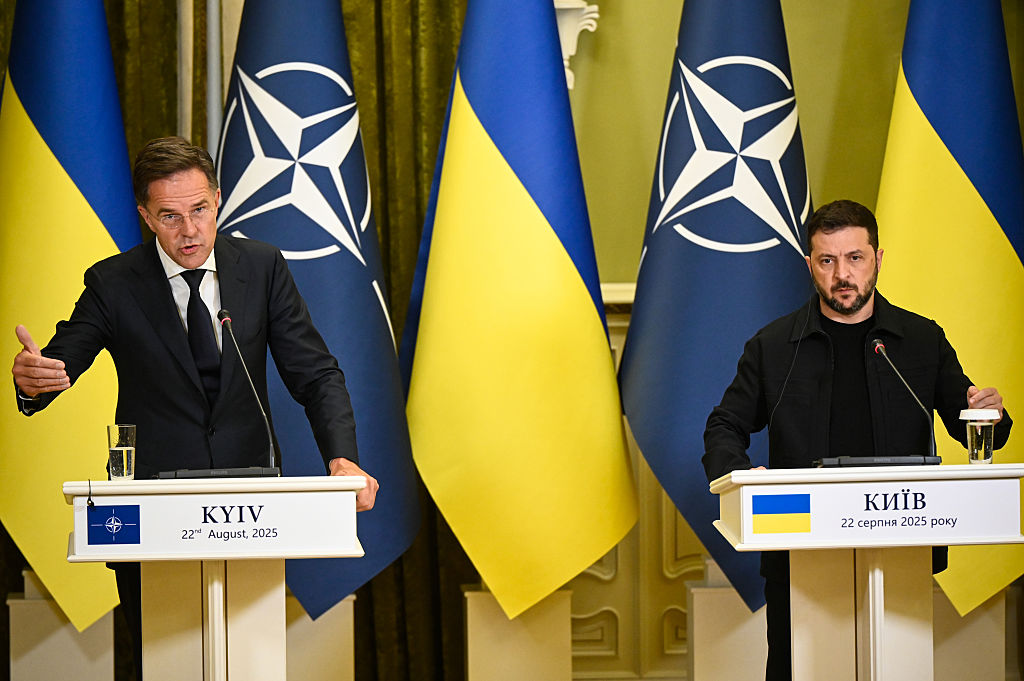
The third lie was most recently restated by NATO Secretary General Mark Rutte on December 11, when he said that “we need to be crystal clear about the threat. We are Russia’s next target, and we are already in harm’s way.”
Rutte’s warning that, after Ukraine, Russia would march through Europe in a war with NATO is just the latest reiteration of the constantly repeated warning that “If Putin takes Ukraine, he won’t stop there,” that he will march through Europe and “reconstitute the Soviet empire”—despite the inconvenient fact that the U.S. does “not have indicators or warnings right now that a Russian war is imminent on NATO territory.”
The Washington Post reports, “Rarely a week goes by now without a European government, military or security chief making a grim speech warning the public that they are headed toward a potential war with Russia.” Germany’s Chancellor Friedrich Merz compared Putin to Hitler: “If Ukraine falls, he won’t stop. Just like the Sudetenland wasn’t enough in 1938.”
There is absolutely nothing in the historical record to suggest that Putin is bent on going to war with NATO, conquering Europe, or acquiring territory beyond the goals of the war with Ukraine. Putin has insisted since the beginning that the war in Ukraine is not about territory but about the root causes and “principles underlying the new international order,” namely, NATO expansion, Ukrainian neutrality and protection of the ethnic Russian citizens of Ukraine.
The historical record suggests the opposite, namely that Putin went to war to avoid war with NATO. Three weeks before the invasion, Putin said, “Suppose Ukraine is a NATO member.... Suppose it starts operations in Crimea, not to mention Donbass for now…. What are we supposed to do? Fight against the NATO bloc? Has anyone given at least some thought to this? Apparently not.”
Subscribe Today
Get daily emails in your inbox
Just three days before the invasion, Putin expressed the same need to avoid war with NATO: “The reality we live in” is that if Ukraine is “accepted into...NATO, the threat against our country will increase because of Article 5” since “there is a real threat that they will try to take back the territory they believe is theirs using military force. And they do say this in their documents, obviously. Then the entire North Atlantic Alliance will have to get involved.”
The historical record suggests that Putin decided to invade Ukraine in large part out of concern that a NATO-member Ukraine might attack Donbas or Crimea and draw Russia into a war with the alliance. If Putin went to war in Ukraine to prevent a war with NATO, then it makes little sense that he would use the war in Ukraine as a means for starting a war with NATO.
These lies are intended to continue the war in Ukraine in order to attain more leverage for Ukraine at the negotiating table and to further Europe’s own goals, neither of which will be achieved. The only achievement of the lies will be to kill more Ukrainians in pursuit of impossible goals. Ukraine cannot win the war; they will be forced to concede territory; they will not join NATO; Europe will not face Russian tanks. It is time for Europe to drop the lies, align with reality, encourage and assist the negotiations and, at last, bring peace to the continent.