Chuck Norris, Patriot: Rest in Peace
Obituaries have understated how much the late martial-arts star meant for Americans in the armed services.

Somewhere on or near the Persian Gulf an American serviceman is at this moment scribbling a Chuck Norris joke (some call them Norris “facts”) on a porta-potty wall. It may be one everyone has heard a thousand times but still smiles at in the worst of conditions, or something new, to be repeated as it works its way across the Gulf on hangar walls and in mess halls, written on the sides of weapons to be dropped, or just passed on verbally as troops crouch in some bunker. It will make the men laugh even as the air raid sirens try (and fail—it is a Chuck Norris joke after all) to drown it out.
If you’re one of the handful of people on earth who has never heard a Chuck Norris joke, here’s a couple: Chuck Norris doesn’t have a bearskin rug in his den; he’s just convinced the bear to lie still. Chuck Norris can light a fire by rubbing two ice cubes together. Chuck Norris doesn’t flush the toilet; he scares the s**t out of it. Chuck Norris can slam a revolving door. There is no theory of evolution, just a list of animals Chuck Norris allows to live. Chuck Norris does not cough; nothing escapes Chuck Norris. Death once had a near–Chuck Norris experience.
In the end, Chuck did of course pass away, just about a week ago at 86. During his life he made some pretty cool martial arts movies, and some mediocre ones that almost slipped into self-parody. He pioneered a genre, and paved the way for Sylvester Stallone, Jean-Claude Van Damme, and others. The many obituaries written about Norris touch on all this, but seem to fail to understand how much he will be missed within America’s armed forces. Norris occupies a curious place in American cultural memory in general, where the boundaries between real military service, cinematic heroism, and internet mythology blur into something larger than the man himself. To write about Chuck Norris and the military is to navigate not only his actual biography, but also the symbolic role he has come to play, a figure representing discipline, toughness, and an idealized version of American virtue.
The thousands of jokes Norris spawned (“When Alexander Graham Bell invented the telephone, he already had three missed calls from Chuck Norris”; “Chuck Norris beat the sun in a staring contest”) helped hold American soldiers together. When in Iraq with the State Department, I spent time at one small helicopter base where an entire office door was devoted to nothing but Chuck Norris jokes, hundreds of them written in every color of mil-issue Sharpie. If you wanted to add one, it had to pass the laugh test among all the soldiers waiting there, or you were shamed into sitting back down. Nothing, except maybe the old M*A*S*H* reruns, seems to show the funny side of war, but it is there.
And this helicopter base was a place where soldiers needed Chuck. You would wait there, sometimes hours of forever, for a storm to pass, or a mission to be scrubbed, or something to be fixed, or anyone more important than you to arrive late. The TV was often broken, or tuned to some Middle East soccer match nobody cared about because U.S. military TV was down. WiFi had barely been invented, and someone had thrown away any naughty magazines left behind. Chuck got you through it, making people laugh via his memes through some of the darkest and dullest times. The Norris door from Iraq was eventually taken back to the U.S., where it lives on in the hands of a private collector.
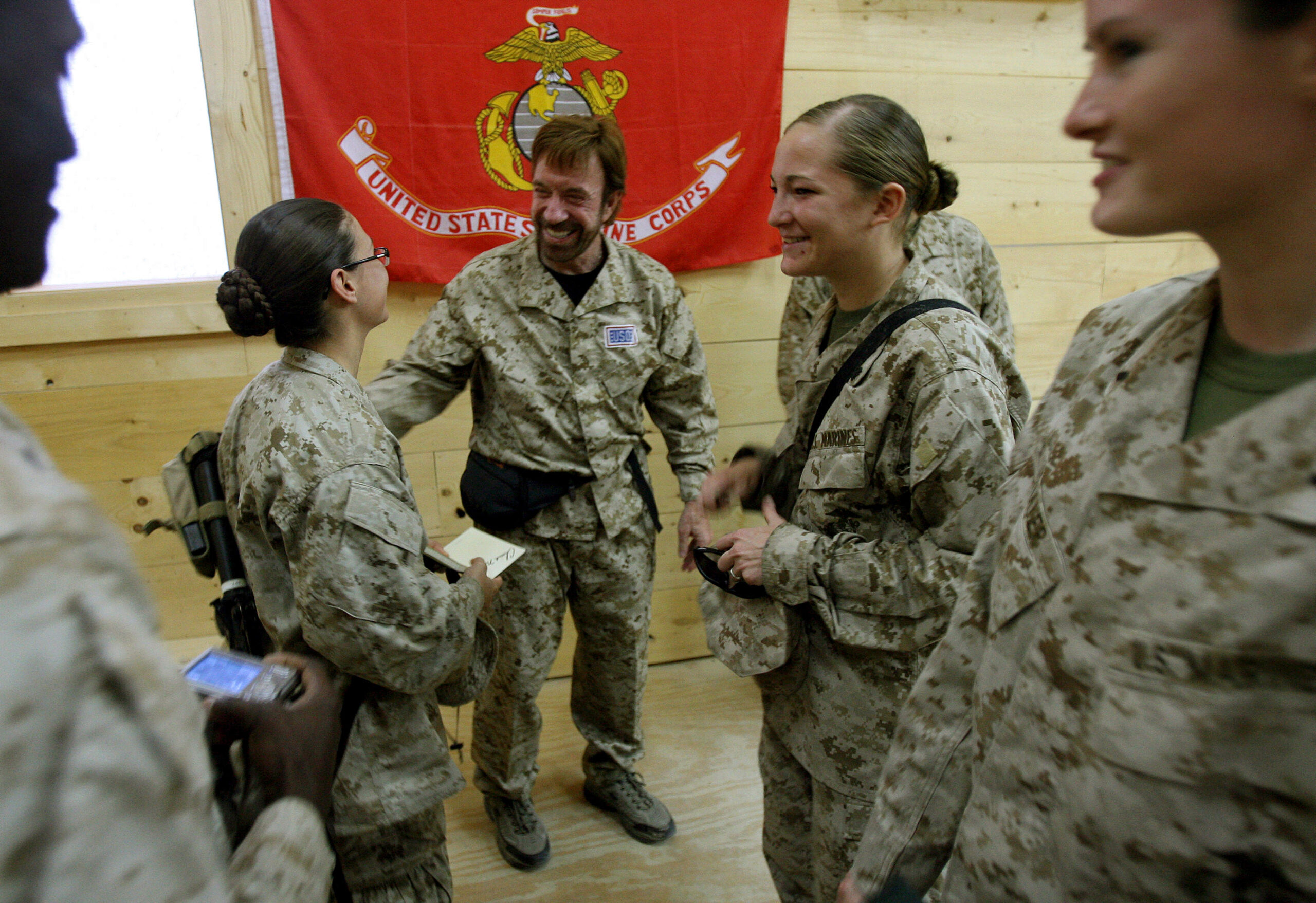
None of the current Norris obituaries really emphasize enough the time the real man spent traveling to remote combat outposts, starting in Kosovo right through Afghanistan. He was sponsored by USO to spend time with troops far enough out there or in dangerous enough places not to see USO shows very often. My colleague got to attend one, and explained Chuck spent only a few minutes on stage and most of his time mingling with people, often famously putting soldiers into a headlock when they asked for a selfie. He acted as if he had nothing else to do in the world but hang out in Fallujah (“Chuck Norris doesn’t wear a watch; he decides the time”), and he was loved for it.
One other reason Norris was so popular was because of his unabashed conservative politics, which matched those of most of the soldiers and stood out from the other Hollywood entertainers USO would bring out. Not only did Chuck endorse Ronald Reagan before most of the soldiers were born, he went on to stump for Trump 1.0 long after most made it home. But Chuck also believed and spoke sincerely about conservative issues with a small “c,” not candidates but the Second Amendment, Christianity, and support for law enforcement. (“Chuck Norris got pulled over by police once. He let the cop go with a warning.”) It was this way of thinking that earned him the scorn of much of left-leaning Hollywood.
For example, Variety, the liberal Hollywood trade newspaper, remembered Chuck this way:
Chuck Norris was a great action star — but politics may overshadow his legacy. In nearly every Norris movie, he’s muscling into a foreign land or othered community, kicking a bunch of a—, completing his mission and hitting the road — or neutralizing the new threat that came into his town. An all-American loner has to gun down outsiders who threaten his way of life, or go to another country to make sure justice is done.
Like the U.S. in Venezuela, Cuba, and Iran—hint, hint?
The obit goes on to say in 1993 Norris took on the title role in the TV series Walker, Texas Ranger, about a modern lawman “who always does what’s right, even if he doesn’t have a warrant or is quick to just kill the bad guys... the black-and-white, right-and-wrong simplicity of ‘Walker’ is cop-aganda.”
Then, in case you still did not get it, Variety ends its by saying that all this
Subscribe Today
Get daily emails in your inbox
seems less fun in a year in which our country is funneling money into bombing Iran and ICE agents are acting like one-man militias. Given our nation’s divisions in morality, information literacy, and overall sense of reality, it’s easier to see Norris’ characters as justification for a fringe conspiracy movement rather than a moral standing... his legacy transitions from escapism to dangerous propaganda.
Rep. Tim Burchett (R-TN) responded on X on behalf of so many of us, writing, “Chuck Norris spent an enormous amount of time celebrating what was great about America with those who kept us free and safe. And you showed in your arrogance why we hate Hollywood.”
Chuck is in heaven now, where he said to God “Hey, you’re in my seat.” Chuck Norris—the actor, the humanitarian, the jokester—passed away peacefully, knowing he had made the lives of an uncountable number of servicemembers a little better. R.I.P.