Democrats Spooked By Obamacare Ghost At Debates
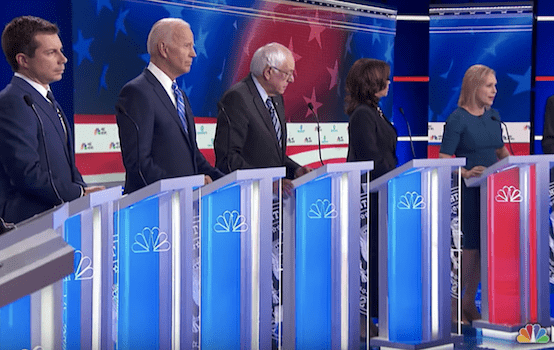
Anyone watching the first two Democratic debates could see that President Barack Obama’s signature legislative initiative remains a hot potato almost a decade after it was introduced in the House. In fact, the 2020 candidates were practically fleeing from it.
The 20 White House hopefuls who took the stage for two nights in Miami revealed that not only are Democrats deeply divided over how to improve what’s become universally known as Obamacare, but that they are willing to go further left on the issue to ostensibly fix it.
Astoundingly, not one of the candidates praised Obama for having narrowly pushed the historic health care bill through Congress in 2010 over unanimous Republican opposition with some Democratic defections. That would have been de rigueur in 2016.
The closest anyone came to crediting Obama was his vice president. “The quickest, fastest way to [improve] it is to build on Obamacare, build on what we did,” Joe Biden declared.
Senator Amy Klobuchar of Minnesota delivered a backhanded compliment, saying Obama had a “bold approach” for universal coverage, but then added, “I am just simply concerned about kicking half of America off of their health insurance in four years.”
Of course, that concern echoed one of the Republicans’ main arguments against Obama’s proposal a decade ago.
A few presidential candidates, notably Senators Elizabeth Warren of Massachusetts and Bernie Sanders of Vermont, came out in favor of “Medicare for All”—a system run entirely by the government with no deductibles, no copayments, and no maximum annual payouts. A few others, led by Klobuchar and former representative John Delaney, are clearly against it.
In a stark statement that made his Google searches spike, Delaney delivered the strongest strike against moving to single-payer.
“If you go to every hospital in this country and you ask them one question—which is, how would it have been for you last year if every one of your bills were paid at the Medicare rate?—every single hospital administrator said they would close,” he said.
The other candidates were all over the map.
South Bend Mayor Peter Buttigieg pushed something called “Medicare for All Who Want It,” which he explained as “Medicare, a flavor of that” that coexisted with private plans.
As if President Donald Trump were whispering “government takeover” in his ear, Mayor Pete quickly added, “Let’s remember even in countries that have outright socialized medicine, like England, even there there’s still a private sector.”
Representative Beto O’Rourke of Texas told a story about meeting a man in Laredo who went to the doctor for the first time at 27, and was diagnosed with diabetes and glaucoma—and warned he’d be dead by 40 if those diseases went untreated because he didn’t have insurance.
The man obviously hadn’t died yet. The head-scratching tale left it unclear as to whether he’d obtained insurance or hadn’t reached 40—or perhaps paid for treatment from his own pocket.
Nevertheless, it inspired O’Rourke to back “getting to guaranteed, high-quality, universal health care as quickly and surely as possible.”
Within the space of a few minutes, Senator Kirsten Gillibrand of New York appeared to adopt every major stance on tweaking Obamacare.
First she urged “a buy-in over a four- or five-year period” to move to universal coverage.
Then she recalled how she “ran on Medicare for All” to win her House seat in 2005, though her constituents would have to “buy it in a percentage of income they could afford.”
Now, Gillibrand continued, she wants “to get to universal health care as a right, not a privilege,” but through “competition among the insurers.”
Finally, the senator said she “would make it an earned benefit like Social Security.”
You could call her plan “Medicare for All Eventually But Some of You Have To Pay For It (and Don’t End Private Insurance).”
At times, the discourse became unintelligible. Senator Michael Bennet of Colorado elicited blank stares as he tried to give Sanders some props.
“I will say, Bernie is a very honest person,” Bennet said in explaining why he opposes Sanders’ Medicare for All plan. “He said over and over again unlike others that have supported this legislation over and over again that this will ban making it illegal all insurance except cosmetic, except insurance for I guess that’s where plastic surgery.”
The debaters’ muddiness on health care was all the more surprising given that 2018 midterm election voters cited it as their top issue in awarding Democrats a sweeping victory.
Imagine the six Democratic presidential candidates in 1972 arguing about President Lyndon Johnson’s 1964 Civil Rights Act—and scarcely mentioning LBJ’s name, much less praising him for the landmark legislation.
That scenario, actually, would have made more sense, given that Johnson in 1972 was unpopular with large swaths of the Democratic base, mainly over Vietnam.
Obama, by contrast, is “literally more popular than Jesus among Democrats,” as Edward-Isaac Dovere of The Atlantic put it in a May 23 piece.
Obama had a 95 percent approval rating among Democrats when he left office, and there’s little evidence it’s dropped much since then.
When Biden laid out his plan, it sounded a lot like Obamacare.
“Everyone, whether they have private insurance, employer insurance or no insurance, they, in fact, can buy into the exchange to a Medicare like plan,” he said.
That’s what Obama had promised.
“Under the reform we’re proposing, if you like your doctor, you can keep your doctor,” Obama told a friendly audience in Portsmouth, New Hampshire, on August 11, 2009. “If you like your health care plan, you can keep your health care plan.”
The nonpartisan Politifact later branded that its “Lie of the Year” in 2013. The backlash was so intense that Obama later apologized.
In 2014, Obama acknowledged that he had oversold his plan, though he didn’t go so far as to say he’d done so for the political purpose of getting it through Congress.
In his fashion, Obama instead tried to look ahead to a more positive day.
“I think as the Affordable Care Act grows, and more and more people sign up, you may see insurance companies starting to add more doctors to their networks, putting more options on the table,” he said.
If anything, the trend has been the opposite. I’ve experienced it firsthand.
After leaving my longtime job in 2017, I signed up for health insurance through Obamacare. I was dismayed at my choices.
In Virginia, the 12th-most populous state, I found no “gold” options—Preferred Provider Organization (PPO) plans that have large numbers of in-network doctors and more importantly provide substantial reimbursements if you see an out-of-network physician.
Instead I was forced to choose among a half-dozen or so “silver” or “bronze” options. The best of them, called Exclusive Provider Organization (EPO) plans, offered fairly broad networks, but they were almost entirely limited to Virginia doctors.
That covered my primary care provider, but a couple specialists I’d seen in Washington, D.C. and suburban Maryland were knocked out. To continue visiting them, I’d have to pay full freight.
Once I chose a Cigna Connect plan, I learned its limits the hard way.
Visiting my brother on vacation in northern Michigan, I developed an infection that forced us to go to the emergency room at a hospital in West Branch. Doctors found I had a high fever and ordered me to stay overnight.
Weeks later, I was surprised to receive a bill for thousands of dollars from the hospital. When I called Cigna to inquire, I was told that it had denied coverage for my overnight stay.
I was shocked to hear a senior supervisor tell me, after two lower-level representatives spouted talking points, that a single doctor in Cigna’s “certification department” had looked through the medical records sent by the hospital and determined that I was not sick enough to warrant overnight care.
That Cigna doctor had concluded, in any event, that I could have left the rural hospital and gone to an in-network one.
Here we entered Alice in Wonderland territory.
When I asked where the nearest in-network hospital was located, I was told Chicago. Chicago is 340 miles from West Branch, a five hour-plus drive around Lake Michigan into Illinois.
Months later, Cigna eventually covered my overnight hospital stay—but only after an appeal in which I and the doctors who’d treated me at the West Branch hospital, along with their staff, spent hours compiling records, filling out forms, and conducting “peer to peer” interviews with Cigna physicians. And this was nine years after Obamacare became law.
Consider that experience, with all its bureaucratic work, Exhibit A in why the United States has the most expensive per capita medical care in the world—more than twice as pricey as Canada, France, Australia, Japan, or Great Britain, according to the World Health Organization.
Obama did make good on two important promises. His plan provided at least some coverage to millions of Americans, decreasing the number of uninsured from 16.2 million when Obamacare was signed into law to 10.9 million when Trump was elected.
However, since the Republican tax bill of last December eliminated the individual mandate penalizing people for non-coverage, the number of uninsured has gone back up to 13.7 million.
Obama’s second fulfilled promise was his insistence that preexisting conditions be covered, a stance that even the most stalwart Obamacare foe now supports.
But the biggest promise Obama failed on was when he said that bad plans would be replaced by good ones. As my experience shows, the insurance companies are still gaming the system. They’ll give you coverage all right, but instead of the Cadillac plans Obama foresaw, you’ll get only Chevy policies.
Those policies are better than nothing. But they’re not very good. And the 2020 Democrats know it. Outside of full-on single payer, they don’t have a clear plan to fix it.
James Rosen, former Washington Bureau reporter for McClatchy, is a politics and national security correspondent. He is co-author of an international espionage novel, High Hand, which received an IPPY bronze medal in May 2019 for best new fiction. He was also awarded the Military Reporters and Editors Association’s Joe Galloway Award last year for his reporting on U.S-Saudi relations.