Among Hungary’s Weird Nomad Nationalists
A dispatch from the “Meeting of the Tribes.”
In late summer, the drive south from Budapest has an ominous, apocalyptic feel. As suburbs give way to the flat expanse of the Hungarian countryside, the landscape turns brown and yellow, broken only by a few dull streaks of green. On the outskirts of the city, a billboard looms against the skyline. It’s for a Hungarian rapper who calls himself Pogány Induló—“Pagan March.”
The billboard is an appropriate marker for a journey to the Kurultáj, a self-styled gathering of nomadic tribes that happens every year on the plains of south-central Hungary. Would-be khans, warlords, merchants, and others from across the Eurasian steppe converge on the small town of Bugac for a multi-day event that is something between a renaissance fair, a steppe encampment, and a caravanserai. To liberal Hungarians, it all seems a gigantic LARP—live-action role-playing game—with dashes of pseudoscience and right-wing nationalism thrown in for good measure.
But as you approach the festival grounds, you’d be forgiven for thinking you’ve traveled back in time. First you’re stuck behind cars, then tractors, then horse-drawn wagons. Then you are caught in a stream of people, many on horseback or wearing leather and cotton tunics, chain mail hauberks, and elaborate steppe headgear. You hear the festival before you actually see it—loud cracks rise above the din of conversation as attendees test thick leather bullwhips, a traditional accoutrement for Hungarian herdsmen and bandits.
The spiritual and geographic antithesis of the Kurultáj is Sziget, another festival that takes place every August on a Danube island just north of Budapest. Sziget advertises itself as “the Island of Freedom” and attracts pop stars, rock bands, DJs, and hundreds of thousands of festivalgoers from across the globe. For many younger Hungarians, Sziget is the much-anticipated climax of their summer.
The crowd at the Kurultáj is something else entirely. There are plenty of Hungarians, yes, but also Turks, Turkmens, Azeris, Kazakhs, Mongols, and other, more exotic ethnicities from across the length and breadth of Central Asia. The festival bills itself as a gathering of steppe peoples, and many Hungarian attendees consider themselves the westernmost branch of this family of nations. Even the on-site accommodations have a nomadic flavor: Whereas Sziget festivalgoers favor repurposed camping gear, Kurultáj attendees get free space if they bring their own yurt. The only things the two events have in common are lung-choking amounts of dust and the condition of their respective port-a-potties. (After two days of enduring the smell, you understand why nomads kept moving.)
The entrance to this year’s Kurultáj was appropriately dramatic. Red runic banners flew from two parallel rows of flagpoles that channeled visitors towards the grand arena, a venue for horsemanship, archery, and other feats of nomadic derring-do. The space beyond the arena was filled with tents, benches, stalls, yurts, a music stage, and two domed stucco towers that evoked Samarkand or Tashkent. Fluttering above the arena was a massive banner of Attila the Hun, the patron saint of the Kurultáj, and a smaller banner of Árpád, the quasi-mythic chieftain who led the Hungarian tribes into the Carpathian Basin in the late 9th century. Curiously, the third most popular historical figure seemed to be Atatürk, the father of modern Turkey. Although he did not rate an official banner, his face adorned flags and posters outside many attendees’ tents.
Heat shimmered over the grand arena and great plumes of dust rose with the ebb and flow of the crowds, but the costume-clad performers were nothing if not committed. During an archery competition on the second day of the festival, a young woman in a long leather and wool tunic had to be carried out of the arena by paramedics.
Other performers were tougher, or perhaps more accustomed to the conditions. The second day featured a variety of performances on horseback, including mounted archery and an elaborately staged steppe wedding. After the ceremonies concluded, spectators were treated to a game of Kokpar, a Kazakh version of polo. As a concession to modern sensibilities, the traditional goat carcass used for scoring was replaced by a goat-shaped leather sack, but this did not dim the players’ competitive spirit. Several riders were unhorsed in the scrum and many a nasty red welt was evident on bared arms and backs from all the whipping.
After several games of Kokpar, it was time for the Hungarians to show their mettle. Native horsemen shot arrows and threw lances at a target dragged from horseback. Other riders performed daring acrobatic feats at the gallop, including standing on horseback, holding themselves perpendicular across their horses’ saddles, and dismounting to run alongside their steeds.
To some Hungarians, these feats of horsemanship suggest a deeper connection between the peoples whose ancestors once wandered the steppes. Indeed, this is one of the Kurultáj’s foundational ideas. Between wrestling, archery, and horsemanship demonstrations, festivalgoers absorbed presentations from Hungarian, Turkish, and Central Asian academics on their shared ethnic and linguistic heritage. The festival’s regnant ideology, known as Turanism, holds that Hungarians, Turks, Mongols, and a few other scattered ethnic groups share a deep kinship based on their common steppe ancestry. It is well outside the academic mainstream, but the very disreputability of the theory, the idea that it represents outlaw or suppressed knowledge, seemed to enhance its appeal.
Devotees of this obscure idea were easy to find during the festival. Attendance at a dry talk from an Azerbaijani academic painstakingly translated into Hungarian might be explained by the availability of shade and seating inside the tent, but other, less-credentialed festivalgoers were also eager to discuss nomadic kinship to anyone who would listen.
A rosy-cheeked attendee from the Székely people, a Hungarian-speaking minority in Romania, had adorned his tent with the flags of what he called “brother nations.” His collection included banners from countries as diverse as Hungary, Turkey, Kazakhstan, Japan, and Korea—all members in good standing, he told me, of the Turanic club.
My new Székely friend was an enthusiastic proponent of his own people winning independence from Romania, although he declined to specify how this might happen. When I told him I was from Washington, D.C., he assumed I meant Washington State and immediately asked if I supported Cascadia, the movement for an independent Pacific Northwest.
The most articulate defender of Turanism I met was a 16-year-old named Nimrod, a Hungarian from northern Serbia who sported a new bullwhip wrapped around his shoulder. A self-taught linguist, Nimrod told me about the connection between Hungarian and the Turkic language family. In fluent English, he explained that he had found thousands of Turkish loanwords in Hungarian—definitive proof, he said, of the two languages’ kinship. His next project is learning Kazakh so he can visit his distant relatives in Central Asia.
Nimrod’s enthusiasm for the Turanic thesis was shared by many festivalgoers. From China’s Uyghurs to the Hungarian-speaking minorities of the Balkans, Kurultáj attendees often came from diaspora communities and persecuted ethnic groups. For these festivalgoers, the gathering of tribes is more than history-themed entertainment; it’s an opportunity to belong to a larger club. One couple I ran into was a particularly striking pairing: a pale Asiatic woman from the Karakalpak minority of Uzbekistan and a red-bearded member of Turkey’s Crimean Tatars, a group that originally hailed from the Ukrainian steppe.
Not all of the attendees were as friendly as Nimrod. A young man named Malik overheard me speaking English and insisted I couldn’t be an American because, in his words, “there’s no such thing.” My features, he continued, were clearly Germanic, something he was familiar with because his family has lived in Germany for decades. But he does not consider himself German, Malik was quick to add. He had come to the Kurultáj to reconnect with his authentically Turkish roots.
Is there truth to the Turanic thesis? More than English or even Hungarian, Turkish was the lingua franca of the Kurultáj. Even today, the Turkic languages that stretch from Central Asia to the Hellespont are mutually intelligible to varying degrees. Most academics, however, reject the idea that Mongolian, Turkish, and the famously weird Hungarian language are part of the same family. Even some festival attendees were skeptical of this extravagant claim. Aslihan Abdikoğlu, a half-Turkish, half-Hungarian Kurultáj organizer who switched effortlessly between the two languages and English, laughingly told me she couldn’t hear a connection.
Perceptions of the Kurultáj in Hungary vary widely and often depend on your political sympathies. If you’re on the left, you’re likely to dismiss the event as a pseudoscientific nationalist project or simply a waste of money. Now that Viktor Orbán and the conservative Fidesz Party have lost power, the festival’s government funding is suddenly in jeopardy. Abdikoğlu told me she isn’t sure whether the new government will continue to support the festival, though she believes that there’s enough organic enthusiasm from attendees and participants to keep the Kurultáj going.
It’s not clear whether Orbán and Fidesz actually bought into the Turanic thesis or merely saw the festival as a way to enhance Hungarian influence in Central Asia and the Near East. After lecturing me on my Germanic features, Malik suggested I look up János Csák, the former Hungarian minister for culture and innovation. Sure enough, Csák was an outspoken proponent of Turanism, proclaiming publicly, “We Hungarians see ourselves as a Turkic nation coming from Central Asia, even from the east of Central Asia.” His enthusiasm for Turanism extended to theorizing about a connection between Hungarian folk music and Korean K-pop.
Orbán and other Fidesz higher-ups were more circumspect about these ideas, speaking instead of an “Eastern Opening” in Hungarian foreign policy. This approach was quite a departure from older notions of Hungary’s place in the world. In 1989, a youthful, fiery Orbán publicly accused the ruling Communist Party of leading the country into an “Asiatic dead end.” By the end of his tenure as prime minister, he was enthusiastically courting Turkey and the nations of Central Asia.
Back at the actual festival, many Hungarian attendees wore T-shirts with patriotic and nationalistic slogans and clearly reveled in their nomad heritage. The atmosphere, however, was generally relaxed and friendly, more akin to a theme park than a political rally. Many young families were drawn by the free admission—festivalgoers only pay for parking and a camping spot (unless, of course, they’ve brought their own yurts)—as well as the elaborate historical costumes and feats of horsemanship. I did see one festivalgoer walking around in a “Brotherhood of White Nations” tank top. It seemed a strange fit at an event with so many conspicuously Asian and Middle Eastern attendees.
The most obvious national agenda on display was not Hungarian, but Turkish—little wonder, perhaps, as Turanism was the quasi-official ideology of the early Republic of Turkey. A department of the Turkish Ministry of Culture and Tourism had set up a large tent at the center of the festival documenting Ankara’s infrastructure and developmental projects in places as varied as Uzbekistan, Kyrgyzstan, and Kazakhstan. According to the exhibition, even Hungary had received a bit of funding. As the leading Turkic state and a formidable regional power, Ankara is still using the ideology of Turanism to amplify its already considerable influence.
Other, unofficial expressions of Turkish nationalism were also easy to find. Many attendees wore T-shirts or carried flags of the Grey Wolves, an ultra-nationalist group that some governments and courts have labeled a terror organization. (The group’s most infamous member was Mehmet Ali Ağca, who tried to assassinate Pope John Paul II in 1981.) A festivalgoer carrying a Grey Wolves banner sheepishly explained to me in broken English that the symbol was linked to Turkish nationalism before hurriedly excusing himself. Later, a Turkish videographer showed me how to make the Grey Wolf hand sign. Following a particularly spirited musical performance on the festival’s second day, a performer led the crowd in a Grey Wolf howl, although it’s doubtful that the Hungarians in the audience knew what the call meant. After two days of overhearing Turkish conversations, wolf howls, and seeing Atatürk and Grey Wolf flags, I was inclined to think that the Kurultáj was more of a coup for Ankara’s soft power aspirations than for those of Hungary.
On the third and final day of the festival, I got to meet some of the performers. Outside the press tent, three young men were dressed in furry black hats and striking blue tunics that stretched down to their black leather boots. The outfits were terrifically unsuited for the sweltering heat, but the men, who turned out to be Dagestani dancers, were preparing to go on stage.
The Dagestanis were another curious addition to the festival’s roster of performers. Dagestan, a region in the Caucasus Mountains of Russia, is home to dozens of languages and ethnic groups. It is, according to Abdul, the lead Dagestani performer, “a real melting pot,” although the Dagestani language family is considered separate from its Turkic neighbors. At the Kurultáj, however, none of this matters. Everyone from the steppes (or their borderlands) can be part of the Turanic brotherhood.
Abdul introduced his two fellow dancers, Murat and Islam, and proceeded to explain their elaborate costumes. His silver ceremonial dagger was called a “kindjal,” a term I already knew because Frank Herbert borrowed it for the Dune books (Dagestan’s international footprint comes down to two things: Dune and top-tier MMA fighters). The silver cylinders that stretched across his chest, he continued, were bandoliers that traditionally stored gunpowder and shot. The scorching conditions, Abdul said, could be an issue when dancing. This is his third Kurultáj, and four years ago, he passed out from the heat. “Now I’m tougher,” he added with a grin.
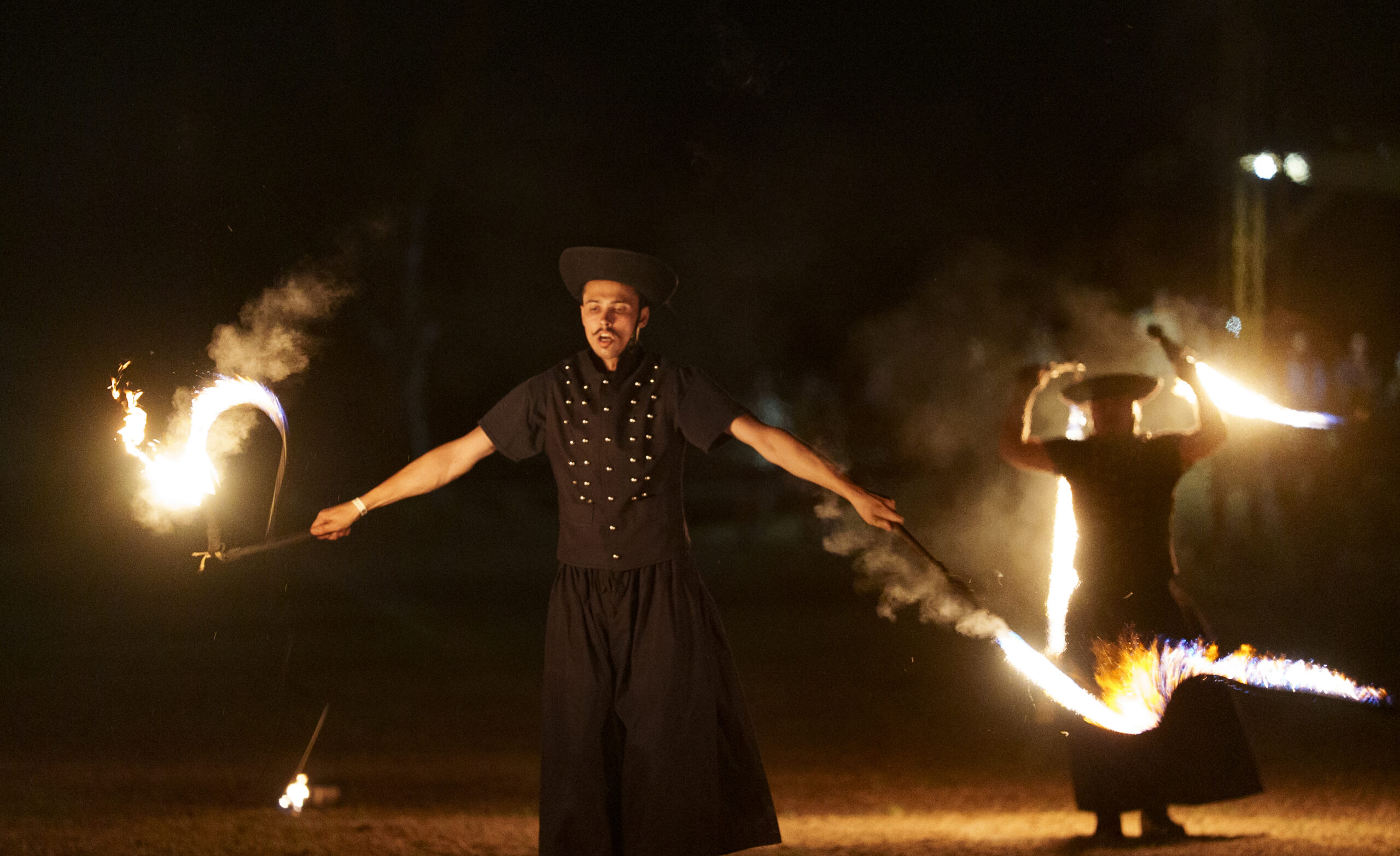
Despite the dust and the heat, the Dagestani dancers put on a tremendous show, whirling, clapping, and tossing daggers to the thump of accompanying folk music. At the climax of their performance, Abdul and company jumped down from the stage and started dancing in the crowd, inviting bystanders to join in the performance. Several young women eagerly complied, but even the Dagestanis seemed taken aback when a man in a steel helmet and scale armor joined the fray and started swinging his sabre to the music. Mercifully, the performance ended before anyone lost a limb.
It is tempting to lump the Kurultáj in with the nationalistic upheavals that have fractured European politics in recent years, a return to the old gods in the face of technological change, cultural upheaval, and encroaching Western liberalism. In truth, the gathering of the clans is much weirder and harder to categorize. Instead of a tightly regimented nationalist rally, the event turned out to be a curious mixture of genuine historical enthusiasm, family-friendly entertainment, government propaganda, and several strange and sometimes conflicting ideological, political, and national agendas.
This heady blend is quite different from traditional Hungarian nationalism, which tends to celebrate the uniqueness of the Hungarian language and emphasize Hungary’s historic links to the West. In this account, the Turks are not friends but enemies, foreign invaders whose prolonged occupation of Hungary deprived the country of its rightful place in Europe. (The lengthy Ottoman occupation is also a likely source for the Hungarian language’s many Turkish loanwords.)
Subscribe Today
Get daily emails in your inbox
The trappings of traditional Hungarian nationalism were easier to find in Izsák, the small town where I stayed overnight during the festival. Despite its modest size, Izsák has monuments to Sándor Petőfi, the hero poet of the Revolution of 1848, and to the anti-Soviet uprising of 1956. Similar shrines can be found in towns and villages across the country. These are legacies of an older project of nation-building, the stuff of textbooks, patriotic pamphlets, and national anthems. They emerged from a 19th- and 20th-century information landscape that was much more centralized and easily channeled, an era of mass public education, propaganda, national newspapers, and state TV and radio stations.
The Kurultáj, however, is very much a 21st-century phenomenon. The curious blend of fringe academic ideas, alternate histories, niche hobbies, and government propaganda (both open and covert) brought to mind an internet message board, or perhaps the bowels of social media. Here the Turks, Hungary’s traditional enemy, have been reimagined as a “brother nation,” or maybe a vehicle for extending Hungarian influence to the East. Instead of looking to Western Europe or the United States, festivalgoers sought out their Central Asian “kin” and celebrated their shared nomadic heritage.
The festival’s veneration of steppe ancestors, the peddlers selling animistic totems, and the ubiquitous pagan iconography also implied a spiritual longing that goes beyond academic interest in the distant past. Christianity and Christian symbolism, usually easy to find in Hungary, were almost entirely absent from the Kurultáj. Instead, festivalgoers sought meaning in an ancient family of proud nomad nations, a steppe brotherhood stretching from Siberia to the Great Hungarian Plain. From their musical preferences to their costumes, the shamans, folk dancers, and Hungarian cowboys of the Kurultáj don’t have much in common with the flower children of Sziget, but both groups revel in the ecstatic release of the crowd, the sense of being a part of a larger entity, and a certain pagan sensibility. Pogány Induló, I’m told, delivered an energetic performance at Sziget 2026. Next year, he should consider putting in an appearance at the Kurultáj.