Zelensky’s Caspian Gambit Failed—for Now
President Trump should rebuff Ukraine’s efforts to get involved in the Iran War.
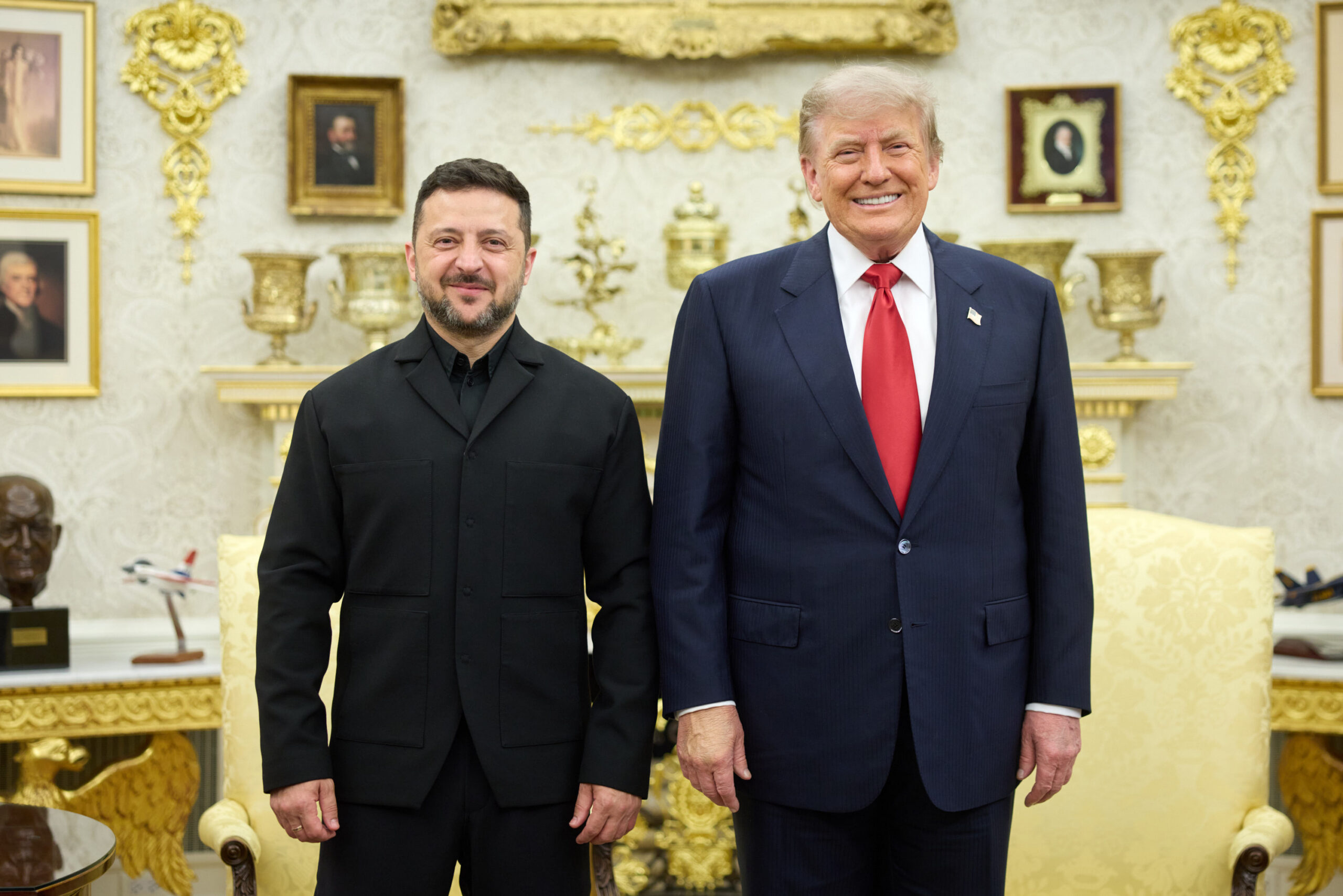
Recent images from the White House showed a familiar scene: Ukraine’s President Volodymyr Zelensky once again making a pilgrimage to meet President Donald Trump. The stated purpose for this visit was to secure continued American support for Ukraine’s struggle against Russia, particularly through the provision of more air defense missile interceptors.
In the days before the meeting, Ukraine had launched a strike against an Iranian ship in the Caspian Sea, and then scrambled to contain the diplomatic fallout. The rationale seems clear: The attack was timed to immediately precede Zelensky’s U.S. trip, apparently with an eye to impressing Trump and playing on his hostility toward Tehran. By striking the route used to ship materiel between Russia and Iran, Zelensky was trying to demonstrate that Ukraine could be a useful auxiliary in Washington’s latest Mideast war.
And the Caspian Sea may not be Ukraine’s only entry point into the conflict. The government of Iraq recently announced the arrest of a group of militants who have confessed to “working for Ukraine” by carrying out attacks inside the country on Iranian-backed Shiite militias. Baghdad’s national security advisor, Qasim al-Aboudi, accused Ukraine of violating Iraqi sovereignty, telling reporters that the individuals his government arrested confessed to working for Ukrainian interests. (Kiev has rejected the allegations.)
The apparent objective of Zelensky’s two-front strategy is to merge the wars in Ukraine and Iran, making American support for Kiev inseparable from America’s own war in the Middle East—and making the U.S. effectively a cobelligerent in Ukraine’s war against Russia.
The timing was no accident. Trump is increasingly exasperated as his administration fails to settle on a path forward in the Iran War. Washington paused hostilities over the weekend, yet Iran launched a surprise attack against the U.S. in Jordan, seizing the strategic initiative. With stockpiles depleted, the U.S. likely cannot force Iranian capitulation through air power alone, and sending in ground troops is politically perilous. Meanwhile, the continued crisis in the Hormuz Strait is now compounded by a blockade of the Bab el-Mandeb by the Yemeni Houthis targeting Saudi Arabia—all of which could send energy prices soaring (just in time for the midterms).
With Trump running out of options, Zelensky saw an opening. He could demonstrate that Ukraine—unlike Western Europe, which Trump has publicly excoriated for its “weakness”—was a useful partner in confronting America’s enemies in the Middle East. It was a neoconservative dream come true.
But there is critical context to the Caspian and Iraqi gambits that Kiev may have overlooked. The United States has been pressing Iraqi authorities to take on the numerous Iranian-oriented Shiite militias. If Ukrainian intelligence was indeed operating in Iraq, it appears Kiev was attempting to help implement Washington's plan. However, judging by the statements and actions of Iraqi authorities, not everyone in Baghdad supports these intentions. By exposing Ukrainian involvement, Iraq has effectively told both Washington and Kiev: This is our country, not your battlefield.
As for the Caspian attack, many analysts expected Iranian retaliatory strikes. And for good reason: Iran possesses several types of ballistic missiles capable of reaching Ukrainian territory. Moreover, in the course of the war against the U.S. and Israel, Tehran has grown far less risk-averse than it was under the leadership of the Ayatollah Ali Khamenei, who was killed in the conflict’s opening days.
Iranian officials indeed reacted harshly after Ukraine’s strike. The threat was credible enough to force Kiev into damage-control mode. Ukraine’s foreign minister Andrii Sybiga had a “frank conversation” with his Iranian counterpart, Abbas Araghchi, insisting that Kiev’s actions were purely defensive and “never intended to target civilian vessels or people.” He emphasized the need “to refrain from any escalatory steps.” For his part, Araghchi seemed to accept the assurance that the attack was “unintentional” and that Ukraine “seeks no escalation.” Araghchi reiterated that Iran does not seek escalation either, but he made clear that “any attack on our citizens or interests is unacceptable,” demanding restitution for losses.
This exchange reveals the new complexity. Both sides are now publicly committed to deescalation—but for different reasons. Ukraine simply realized it had overreached in its desperation and needed a way out. Tehran has its own reasons for calming tensions. An open conflict with Ukraine would threaten its Caspian sea lanes and could draw European powers into the Iran War. The last thing Iran needs is a new front with a Western-backed Ukraine. Araghchi’s measured response signals that Tehran is willing to let this incident pass, provided Kiev does not repeat it.
The gamble, however, may still tempt Zelensky. His core objective—locking the United States into a broader confrontation with Russia—has not changed, and he is continually looking for new ways to win over Trump. The Caspian strikes and Iraqi operations were a test. Whether the diplomatic backpedaling signals an abandonment of the strategy or merely an acknowledgment that the execution was clumsy remains to be seen.
Of course, Ukraine’s calculus is understandable. The country depends on external support to sustain its fight against Russia, which is escalating air attacks and slowly grinding forward on the battlefield as President Vladimir Putin stubbornly refuses to freeze the war along the current front lines. But America’s own interests diverge from Ukraine’s.
Subscribe Today
Get daily emails in your inbox
Trump should rebuff Ukraine’s risky efforts to demonstrate its value as a partner against Iran. Fortunately, this seems to be his inclination. Trump didn’t appear to commit to providing more weapons to Ukraine and, after the meeting with Zelensky, told reporters that he has a good relationship with both the Ukrainian and Russian leaders and just wants them to end the fighting. And (as The American Conservative’s senior editor Andrew Day noted on X) Zelensky’s announcement of new intelligence that Russia is helping Iran target American forces does not seem to have impressed the U.S. President, who is cool to the idea of directly implicating Putin in the Iran War.
The correct response from Washington should be detachment from the whole scheme. Trump should welcome the newfound commitment to restraint from Ukraine and Iran, and then quietly but firmly insist that Ukraine abandon any strategy that risks merging the two wars. The president has leverage over Zelensky—far more than he has over Russia and Iran—and he should use it to keep a lid on the potential for escalation or spillover.
That done, he should revive the pushes for diplomatic resolutions to both of these dangerous wars. He could make use of his direct line to Putin, urging the Russian leader to accept an outcome in Ukraine that freezes the front lines (and could be sold to the Russian public as a victory). And he should make every effort to return to the memorandum of understanding with Tehran, which despite its apparent abrogation remains the clearest way to end a Mideast war that has become a quagmire. Everything else is a costly distraction. America’s national interest is not served by endless wars which Trump himself promised to end, especially when those wars begin to merge.