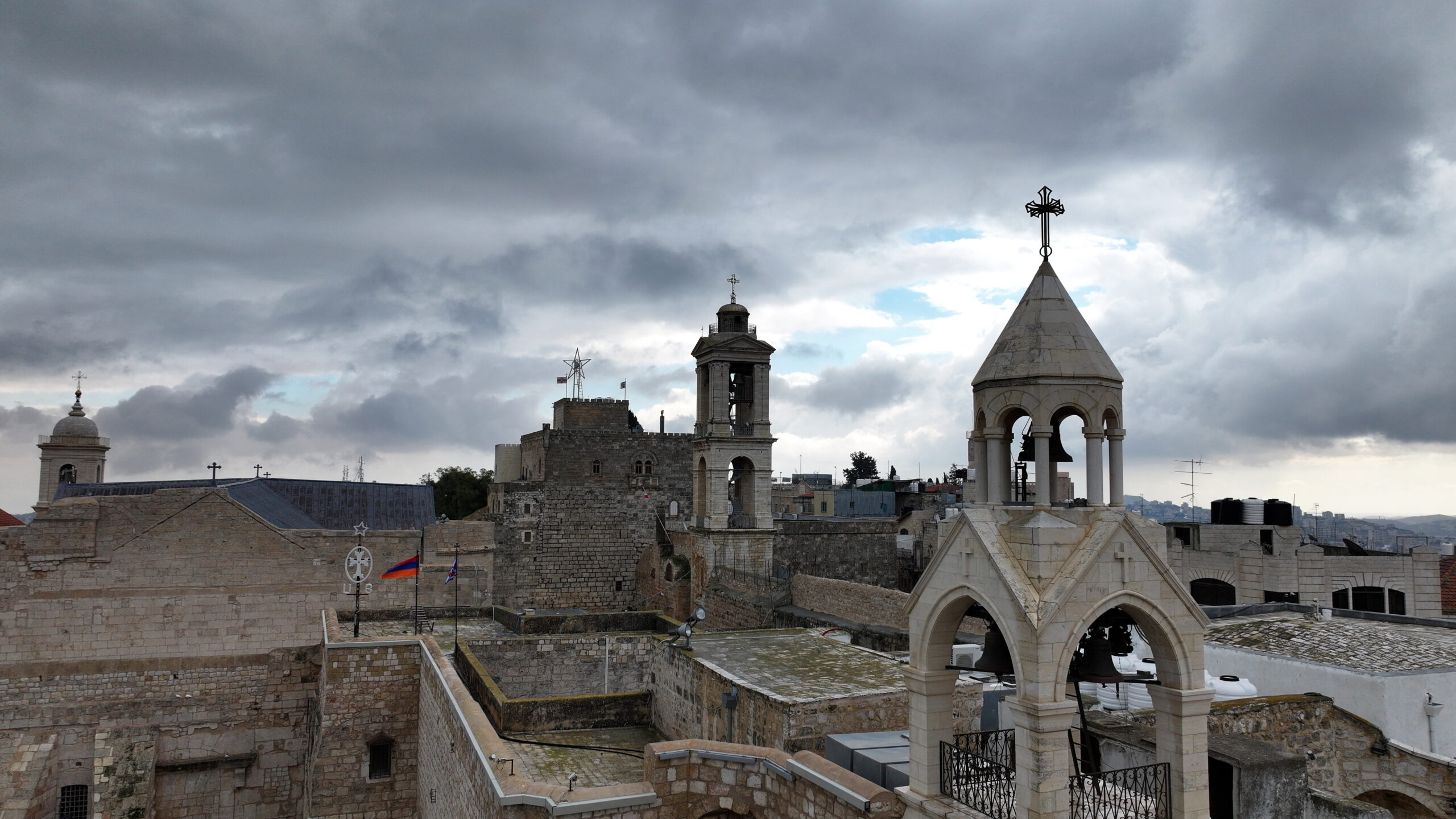
On January 17, 2026, the leaders of all the major churches in Jerusalem issued a sobering warning. They released a statement in which they cautioned that “damaging ideologies, such as Christian Zionism, mislead the public, sow confusion, and harm the unity of our flock.” The leaders noted that these efforts have found favor among political actors in Israel and beyond and have led to the advancement of agendas that now threaten the Christian presence in the Holy Land and the wider Middle East.
The statement’s significance lies in its timing and rarity. The patriarchs of Jerusalem last addressed Christian Zionism in their 2006 Jerusalem Declaration, so this pastoral statement is their first comment on the issue in nearly two decades. It is a warning that signals an immediate danger to Christian unity and survival.
It closely followed a summit sponsored by Israel’s Ministry of Foreign Affairs in Jerusalem last December, a gathering of more than 1,000 U.S. pastors that advanced a Christian Zionist narrative while sidelining Jerusalem’s historic churches.
Those who signed this statement are the patriarchs and senior bishops of the historic churches of the Holy Land, Orthodox, Catholic, and Protestant alike. Their offices predate modern nation-states, the Crusades, and even Islam. In matters of religious, communal, and pastoral Christian life in the Holy Land, there is no higher ecclesial authority.
Faithful American Christians should recognize the gravity of this moment. These leaders are the custodians of Christianity’s oldest continuous communities, and when they warn that a modern ideology is harming the Church and threatening its survival, Christians everywhere have a responsibility to listen.
Yet only a few weeks earlier, in a Christmas message from Jerusalem, Benjamin Netanyahu cast Israel as a haven for Christians, claiming it is “the only country in the Middle East where Christians can practice their faith with full rights and in total freedom.” The claim resonates in the West because it trades in a familiar moral binary: safety under Israel, persecution everywhere else. But its power lies less in accuracy than in selectivity.
That claim does not withstand scrutiny. Leading Israeli human-rights organizations such as B’Tselem and HaMoked document the severe impact of occupation policies on Palestinian civilian life, including restrictions on movement and the denial of basic protections. These conditions affect all residents, including the region’s dwindling Christian communities.
In Jerusalem, the desecration of a Christian cemetery was described as a clear “hate crime” by Anglican Archbishop Hosam Naoum, while the British Consulate said it was part of a broader pattern of assaults on the Christian community.
These concerns are not confined to local testimony. The Associated Press reported that Holy Land church leaders publicly condemned Israeli settler violence during a West Bank visit, prompting U.S. Ambassador Mike Huckabee to travel to Taybeh and denounce the attacks.
In places like Beit Sahour, historic Christian communities face mounting pressure from recent illegal settlement expansion that threatens their very existence.
Christian life under Israeli occupation is increasingly constrained. In February, the Jerusalem Post reported that the foreclosure of properties belonging to the Armenian Church of Jerusalem threatens Christian communities rooted in the city for more than 1,700 years. Clergy encounter visa and residency restrictions, and Christian communities are steadily pushed out through land confiscation and economic pressure.
The World Council of Churches has repeatedly warned of an existential threat to Christians in the Holy Land, citing unjustified taxation, attacks by settlers, and the killing of Christians in Gaza.
The Jerusalem church leaders’ warning does not stand alone. In December, Andrea Zaki, President of the Protestant Churches of Egypt, issued a public statement distancing all Egyptian evangelicals from Christian Zionism, calling it a political movement rather than a theological conviction and warning that Scripture must never be used to justify war, dispossession, or domination.
These statements by church leaders in Egypt and Jerusalem are not the first of their type. In August 2024, prominent evangelical pastors and leaders from across the Middle East issued “A Collective Call to the Global Church,” condemning all ideologies that lead to injustice and violence. They rejected all attempts to baptize bloodshed with biblical language and called the church back to unity, compassion, and peace.
Taken together, these voices form a coherent and deeply conservative witness. From Jerusalem to Cairo, from patriarchs to evangelical pastors, indigenous Christian leaders are saying the same thing: When Christianity is fused to political movements, military power, or national destiny, it ceases to be faithful and becomes destructive to the very communities it claims to defend.
There is also a strategic reality that Americans should not ignore. A Middle East emptied of Christians will not be more stable, more pluralistic, or more aligned with Western interests and values. Christian communities have long served as moral anchors and cultural mediators. Their disappearance strengthens extremism and accelerates civilizational fracture.
Subscribe Today
Get daily emails in your inbox
Supporting Israel’s security does not require ignoring Christian suffering, distorting theology, or silencing Christians whose faith predates modern borders and modern politics.
Church leaders in Jerusalem and across the Middle East are not asking Americans to abandon Israel. They are asking them to abandon illusions. They are calling the Church to moral clarity: Faith must not be weaponized, Scripture must not be conscripted, and ancient Christian communities must not be sacrificed on the altar of any political ideology.
American Christian communities now face a choice. They can continue aligning themselves with Christian Zionist activist and political movements that emerged far from the land they claim to defend. Or they can listen to the Christians who have carried the faith in the land of its birth, at great cost, for two millennia.