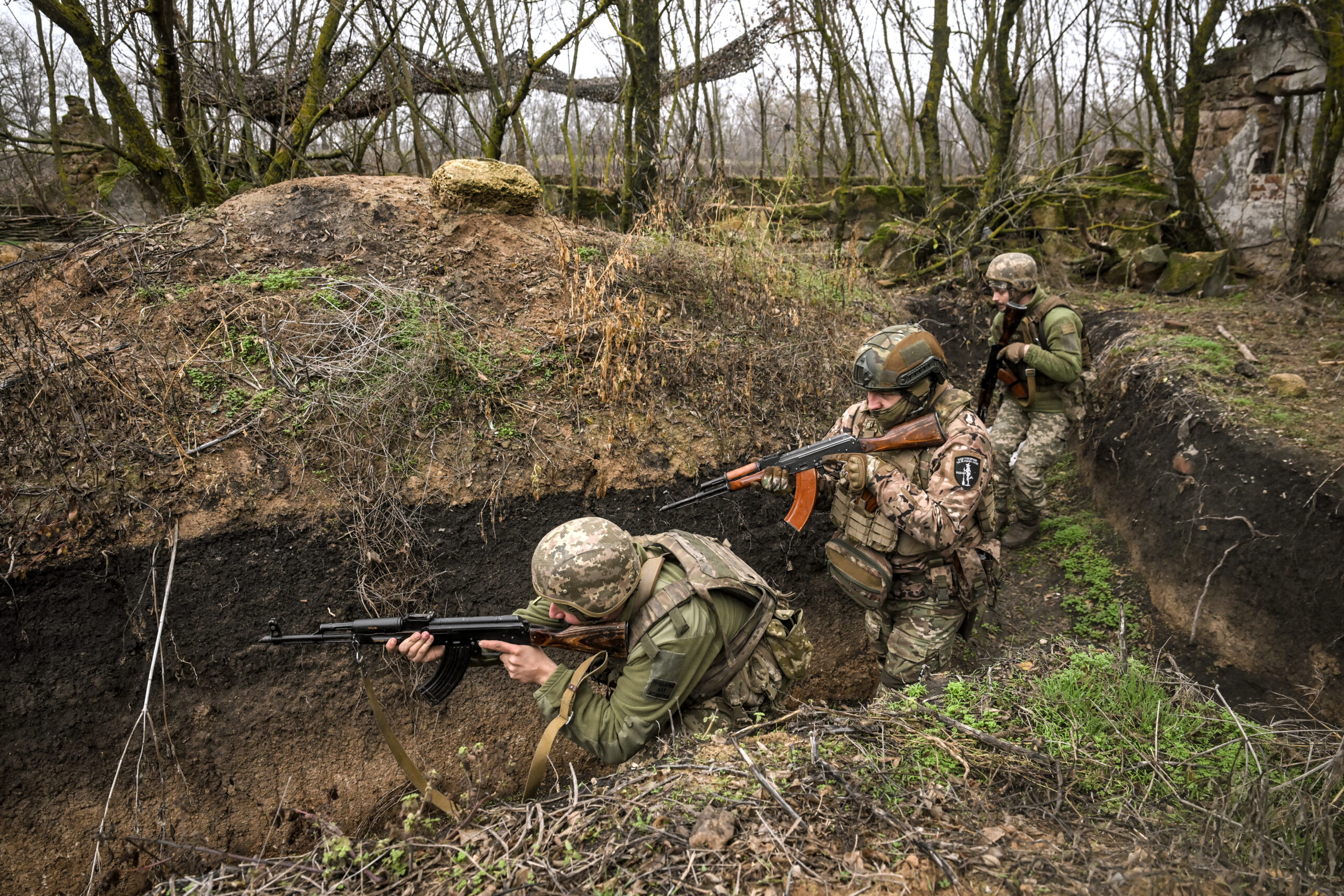
Rumors are swirling that the Trump administration is willing to offer Ukraine “Article 5–like” security guarantees in its effort to end the almost four-year Russia–Ukraine war. The exact terms of the offer remain uncertain. In broad form, however, the guarantee appears to involve an American commitment to support a European-led “multinational force”; to lead monitoring and verification efforts that will enforce any peace deal and provide Kiev warning of an impending Russian attack; to help arm Ukraine in peacetime; and, most importantly, via a legally binding pledge “subject to national procedures, to take measures to restore peace and security” if war again erupts.
A security guarantee for Ukraine is a terrible idea. Even as it would reverse Trump’s long-standing opposition to further enmeshing the United States with Ukraine, a guarantee carries a range of dangers for the United States, Ukraine, and the European NATO allies while delivering few benefits. Whether offered as part of a peace deal or ceasefire, the guarantee may do little to deter Russia. Further, should a conflict break out, the arrangement is poised to trigger a fundamental crisis in U.S.–European relations. Above all, the guarantee promises to complicate rather than ameliorate Ukraine’s own understandable desire to find security for itself in the shadow of its Russian neighbor. Rather than continuing the security guarantee conversation, Washington would be wise to back away from the pledge.
The central problem for any security guarantee is the asymmetry of interests between the United States and Russia vis-à-vis Ukraine. Russia’s willingness to invade Ukraine and then stay in the fight for nearly four years demonstrates that it views Ukraine as an interest worth sacrificing blood, treasure, and even other interests to pursue. The United States, in contrast, was and remains unwilling to go to war on Ukraine’s behalf—indeed, policymakers across two administrations and the American public alike have converged on this point. Ukraine simply matters less to the United States than it does to Russia. As a direct result, any American promise is inherently less credible than are Russian threats when it comes to shaping Ukraine’s future.
Russia has already borne enormous costs in Ukraine, just as Ukrainian sacrifices have contributed to the future deterrence of Russian aggression. Against this backdrop, an American security guarantee to Ukraine could set Moscow and the United States on a dangerous collision course. The ambiguity of a security guarantee committing the U.S. to “restore peace and security” in Ukraine invites Moscow to test the United States’ resolve and to see how far it could aggress without provoking a serious American response. Moscow’s incentive for doing so is that by probing the U.S. guarantee, it would determine exactly where and in what ways it could resume acting at Ukraine’s expense. Indeed, Russian leaders could reasonably hope to show that the security guarantee is not worth the paper it is printed on. Under such circumstances, however, the United States would be caught in an exposed position.
On the one hand, acting on the guarantee and truly coming to Ukraine’s defense—as Ukrainian leaders would demand—would be contrary to the U.S. national interest. Barring a sea change in policymakers’ understanding of Ukraine’s importance to the U.S., rolling the iron dice on Kiev’s behalf does not seem likely. On the other hand, tolerating Russian probes would reveal the non-credible nature of the American guarantee. This could quickly pave the way for conflict to resume: After all, if Moscow concludes that a U.S. security guarantee does not mean American entry into the war, Russia has little reason not to resume hostilities and see what else it might win on the battlefield. Additional conflict—rather a durable peace—could well be the ironic result, along with additional damage to the United States’ reputation.
These same circumstances are poised to generate a crisis within NATO. Since the United States is marketing its security guarantee to Ukraine as “Article 5–like,” should Washington reveal that it interpreted such a commitment narrowly, then NATO allies such as the Baltic states might reasonably question whether Washington’s interpretation of NATO Article 5 itself would likewise leave them in the lurch in the event of a crisis. Moscow could be left asking which NATO commitments were more like those to the major European powers and which were more like the undefended commitment to Ukraine. Even if these concerns can be finessed, questions over whether NATO is a tiered alliance are likely to endure.
Similar problems abound when it comes to the nominal U.S. pledge to backstop a European-led security force in Ukraine. This issue is wrapped up with the Trump administration’s efforts to encourage the European allies to invest in their militaries and take responsibility for continental defense. On the face of it, that the European force will be deployed at all might seem proof that the Trump push is working. In reality, however, discussions of a European-led force for Ukraine have been under way for over a year; crucially, key allies such as Germany have long resisted the idea without U.S. support for the operation, while even proponents of the operation such as Britain recognize that the effort cannot move forward without the United States acting as a “tripwire” tied to the “assurance force.”
Viewed in this light, the U.S. offer to support a European-led force in Ukraine as part of a security guarantee is less about Europe stepping up and more about continuing European reliance on the United States under fraught circumstances. Indeed, by backstopping European efforts as part of a security guarantee, Washington could end up creating conditions that allow the European allies to hold off arranging the logistics, command and control, and intelligence systems needed for Europe to take greater responsibility for continental defense. At the same time, should the force actually be called upon to fight, the same interest gap that invites Russian opportunism means that the United States may be more likely to abandon the operation than continue the backstop. Not only would this undermine the force’s ability to fulfill any militarily useful mission, but it would similarly lead to an alliance rupture.
Finally, the security guarantee misleads Ukraine, risking dangerous consequences for all parties. On one level, after the current war ends, Kiev will still need to find some way of creating security for itself in the shadow of its Russian neighbor. So far, Ukrainian leaders have pinned their hopes on a two-pronged strategy of building up Ukrainian military capabilities while seeking external allies. The latter effort traditionally focused on gaining membership in NATO but, given allied ambivalence on admitting Ukraine given the risks with Russia, this has now shifted towards the sort of NATO-like security guarantees on offer from Washington.
The problem, however, is that the U.S. offer continues leading Ukraine down what John Mearsheimer termed “the primrose path.” No matter what is pledged in peacetime, Ukraine is unlikely to be able to call upon the U.S. as an ally in wartime. Instead, Ukraine’s best security bet lies in a combination of arming—acquiring the capability to defend itself by itself—and diplomacy—trying to forestall additional conflicts with Russia before they start. With the prospect of a security guarantee before it, however, Ukraine is likely to seek as strong of a security guarantee from the United States in the near term as possible, and to try to further upgrade the commitment in the years ahead (ideally paving the way for NATO accession). American domestic politics may reinforce Kiev’s ambitions, as Democrats eager to distinguish themselves from the Trump administration and those Republicans still committed to U.S. dominance in Europe would probably encourage Ukrainian efforts. Far from taking steps to provide security for itself against Russia, Kiev would be incentivized to adopt the political and military efforts that it thinks will curry favor with Washington. The result could leave Ukraine further vulnerable to future Russian aggression.
Subscribe Today
Get daily emails in your inbox
Meanwhile, the same incentive to extract further U.S. concessions may also lead Ukraine to adopt provocative policies of its own in order to create favorable political conditions for Ukraine in the U.S. The current conflict has already produced this sort of behavior, for example when Ukraine sought baselessly to pin the destruction of the Nord Stream pipeline on Russia, or claimed that Russian missiles had hit Poland when in fact the missiles were errant Ukrainian assets. A security guarantee could amplify these incentives, encouraging Ukraine to try to provoke Russia in hopes that the appearance of Russian aggression would translate into greater U.S. support for Kiev. From Kiev’s perspective, this action would be entirely understandable and reasonable. Still, Ukrainian moral hazard risks causing renewed hostilities—with deleterious consequences for the U.S., Ukraine, and others.
A U.S. security guarantee may appear reasonable on paper, but is risky and strategically problematic in practice. The Trump administration would be wise to back away from the idea as expeditiously as possible. It is time for frank and honest talk among the parties to the war about their real future roles in Ukraine.
Such discussions would be more than diplomatic niceties: just as wars erupt when states disagree over the balance of power between them, so too does a stable peace deal require clarity on the enduring distribution of power between Kiev and Moscow, given what the countries themselves can mobilize and credibly call upon from their partners. Given demonstrated U.S. unwillingness to enter the war, and declining European and American interest in supporting Ukraine’s war effort, all parties would be wise to end the myth-making and instead determine what (if any) sort of long-term Western backing for Ukraine is realistic. Only at that point will conditions be favorable for a stable arrangement. A security guarantee is not credible, but the United States can foster a situation that will help end the current conflict, prevent future violence, and allow the U.S. to turn its attention elsewhere.