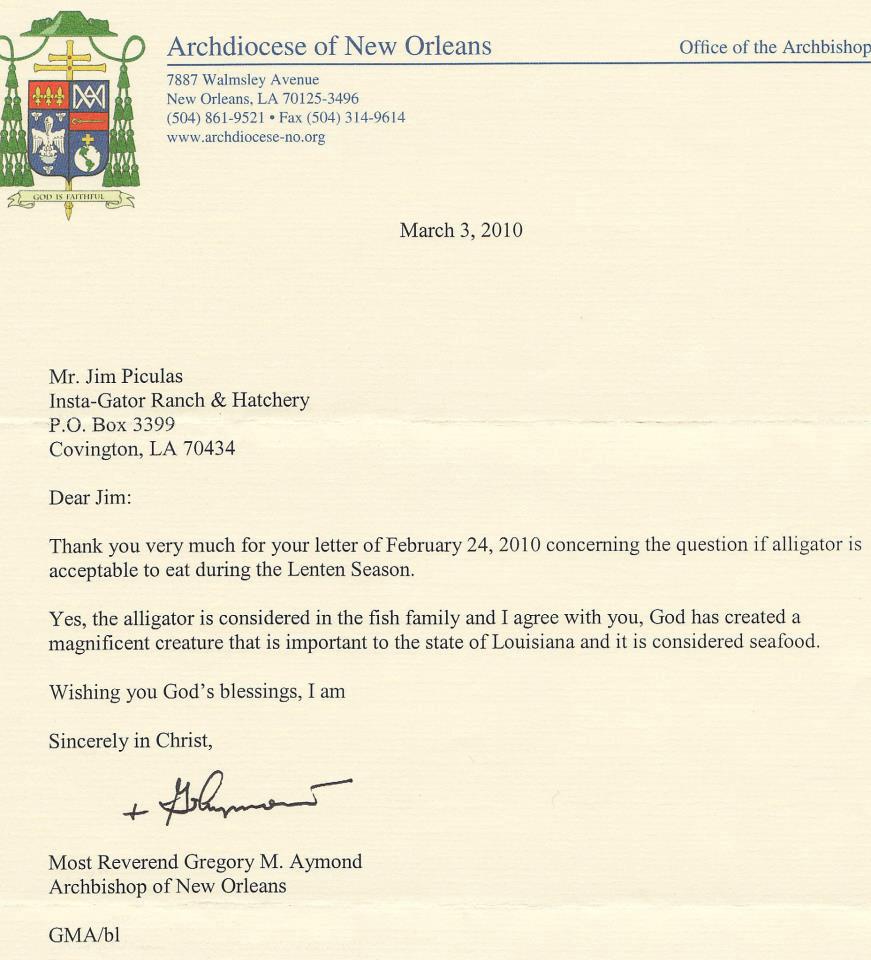
Lent In Louisiana
59 Responses to Lent In Louisiana
← Older Comments-
@LUKE1732 re: John 21 — While I’m in total agreement with you concerning Abp Aymond’s apostolic authority, please remember that ancient Hebrew had no word for reptile. Ergo, just as the Hebrew words “brother” and “sister” actually mean cousin, auntie, BFF, and old lady from down the street when referring to the family of the Lord; in the same way “fish” in Hebrew actually refers not only to alligator, nutria, and capybara, but to crocodile, cayman, eel, and platypus as well.
As an alternative exegesis of John 21, it is entirely possible that the apostles were grilling alligator with a bit of platypus by the shore of Genesseret, but our Lord thought it was icky and changed it into tilapia when they weren’t looking.
-
@ Pat — I think your mullet fishermen make a reasonable case for mullet being poultry. Given the fact that tuna has already been determined to be the “chicken of the sea,” mullet are very probably ducks, or maybe guinea fowl. I’ll ask the bishop.
-
In the middle ages, barnacle geese were considered acceptable fare for Lent, and Fridays generally, because they were believed to be goose barnacles grown up, and therefore fish rather than fowl. Modern biology has unfortunately dashed these hopeful assumptions.
-
Luke,
So now you admit that alligators can “swing both ways”. Play for “either team” so to speak.
I think this is now officially the gayest thread in the history of this blog.
My only question for you is, why do you want to put into your mouth chunks of meat that swing both ways?
-
As a former resident of the Pelican state, conservative Presbyterian (but I have LOTS of RC friends!) and an “objective” third-party to this doctrinal dinner debate*, may I humbly suggest that all this dissecting of genetic codes and parsing of Holy Scripture is excessive to the point of paranoia. I think the answer is as elegantly straightforward as the Archbishop’s correspondence.
To wit: If it lives in Louisana, it gets wet. (Just wait for a Hurricane to come along and see if steaks don’t swim!) Therefore, if it “ain’t” fried boudin balls…
* Mea culpa: I have devoured certain dishes in Louisiana which have caused me to ponder the possibility of conversion in order to receive tangible proof of absolution for my sinful delight!
-
Luke,
You know what the problem with people who think that alligators are reptiles and not fish is? Epistemic closure. That’s why they will NEVER be able to figure out what’s wrong with themselves. Careful, JUDICIOUS analysis of reality does not appear to be a strong point for them. You have to be deep in the their rabbit hole not to understand why the entire reptile/amphibian thing looks absurd.
My suspicion is that, at a deep level, they lack the intellectual virtues, the attitude of scientific realism to acknowledge that gators are fish, to the point that they will simply flame out politically. Deservedly. I wonder if we’ll soon be arguing about how their party managed to last this long.
They’ve lost the gator-fish wars. It’s a done deal. The Supreme Court will rule on it and it will be the law of the land. The generations that had the bigoted belief that gators were reptiles are dying off. We know they are fish. The future is us.
-
What about armadillo??? I’m jus sayin…
-
Charles Cosimano,
Your Monty Python reference nearly made me choke on my beer! FUNNY!


Alcogito writes: “These are both required on Ash Wednesday, Good Friday and all Fridays in Lent, and strongly recommended the rest of the time.”
I believe you are mistaken. Fasting and abstinence are both required on Ash Wednesday and Good Friday. Abstinence, but not fasting, is required on all the Fridays of Lent. As voluntary penances they are recommended the rest of Lent.
I sometimes hear my fellow Catholics grumble that “the rules” regarding fasting during Lent were too severely relaxed such that they don’t burden anybody anymore. An old post of mine may be of interest to some:
http://redcardigan.blogspot.com/2010/02/when-you-fast.html
In the past, whole groups of people were automatically exempt from fasting for reasons such as age, health, pregnancy, type of labor they did, etc., and others could be exempted just by asking their pastors. This makes sense, of course; few of us would want, say, a new roof installed by crews of fasting construction workers if only because we would fear the danger of them becoming dizzy from lack of nourishment and falling off the roof. But the Church’s present approach, of requiring less and encouraging more, makes more sense to me than saying: “These are the rules of fasting! Except for…unless you…in case of…etc.”
The permission to eat alligator or capybara on fast days seems to come from that same sort of common-sense approach: in places where these are customary foods, it would make little sense to require people to go out and buy more expensive fish or harder-to-obtain (in winter, in some places in the world) vegetables than to eat what is available and is not given the same dinner table pride of place as animal flesh.
Of course, most Americans can easily satisfy the abstinence requirement without eating alligator these days. Outside of Louisiana, anyway.