From Sarajevo to the Senkakus
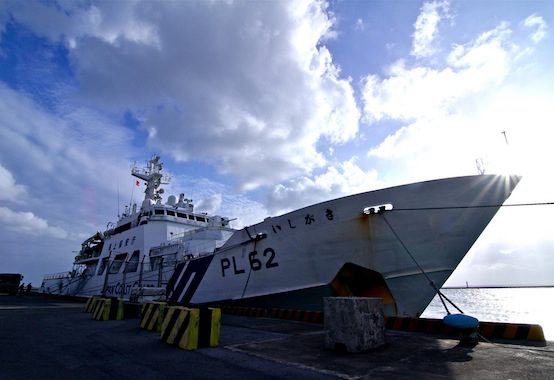
On 30 January, a Chinese Jiangwei II-class frigate entered the disputed waters around the Senkaku Islands, a cluster of uninhabited rocks in the East China Sea claimed by China as the Diaoyu Islands. A Japanese destroyer was waiting.
When the two warships were only 3 km apart, the Chinese frigate turned on its fire-control radar that aims its 100mm gun and C-802 anti-ship missiles and “painted” the Japanese vessel. The Japanese destroyer went to battle stations and targeted its weapons on the Chinese intruder.
Fortunately, both sides backed down. But this was the most dangerous confrontation to date over the disputed Senkakus. Japan and China were a button push from war.
Soon after, a Japanese naval helicopter was again “painted’ by Chinese fire-control radar. Earlier, Chinese aircraft made a clear intrusion over waters claimed by Japan.
China’s Peoples Liberation Army HQ ordered the armed forces onto high alert and reportedly moved large numbers of warplanes and missile batteries to the East China Sea coast.
A U.S. AWACS radar aircraft went on station to monitor the Senkaku/Diaoyus—a reminder that under the 1951 U.S.-Japan mutual defense treaty, Washington recognized the Senkaku Islands as part of Japan and pledged to defend them if attacked. Japan seized the Senkakus as a prize of its 1894-95 war with Imperial China.
China’s state-run media claimed the U.S. was pushing Japan into a confrontation with Beijing to keep China on the strategic defensive.
Japan’s newly elected government led by conservative PM Shinzo Abe vowed to face down with China. Spasms of angry nationalism erupted in both feuding nations. The Philippines, Taiwan, and Vietnam, who also claim the Senkakus, chimed in with their territorial demands.
A special Chinese crisis group led by new President Xi Jinping has been set up to deal with the Senkakus—meaning any clash there may be more likely to become a major crisis.
Shades of August, 1914, when swaggering, breast-beating, and a bloody incident triggered World War I, a conflict few wanted but none could avoid.
Japan is in a difficult situation over the Senkakus. Its nearest air bases are in Okinawa, 500 km away; Japan’s main airbases are 1,000 km further to the Northeast.
Japan’s F-15J strike aircraft have the combat range to cover the Senkakus but they cannot linger for long with full bomb loads due to the long distances involved. By contrast, Chinese warplanes based on the coast near Fuzhou are well within range of the Diaoyus.
Japan’s defense architecture was built to stop an invasion by the Soviet Union. Its so-called Self Defense Forces are able but not configured for long-range offensive operations. China’s are. They have been redesigned with a major amphibious invasion of Taiwan and a fight with the U.S. Seventh Fleet in mind.
Unless U.S. carrier strike groups intervened, Japan would probably face defeat in a clash with China over the islands, a fact that has Tokyo deeply worried. This latest crisis again reminds Tokyo that it is naked before China’s nuclear weapons. Recent incursions over Northern Japan by Russian warplanes did nothing to calm Tokyo’s nerves.
However, war between China and Japan sounds as crazy and illogical as war between China, and the U.S. Japan is China’s largest foreign investor, having discreetly built much of China’s industry. China is a major export market for Japan. A war against China would shatter Japan’s prosperity and force it to embark on a hugely expensive armaments campaign, including building nuclear weapons—which it has the capability to do in 90 days.
China has no desire to fight the United States unless absolutely necessary, and less to spark a U.S. trade embargo. China holds over $1 trillion in U.S. government debt. Beijing has no desire to panic all of East Asia.
A war over the Senkaku/Diaoyus would be like the 1998-2000 desert war between Eritrea and Ethiopia, described as “two bald men fighting over a comb.” No matter how much fish swim around the Senkakus, or how much oil and gas may be found underwater, nothing justifies a war.
But then again, nothing justified World War I that began by a murder in obscure Bosnia. Pray for cool heads in Beijing and Tokyo.
Eric Margolis is the author of War at the Top of the World and American Raj: Domination or Liberation. Copyright Eric S. Margolis 2012